
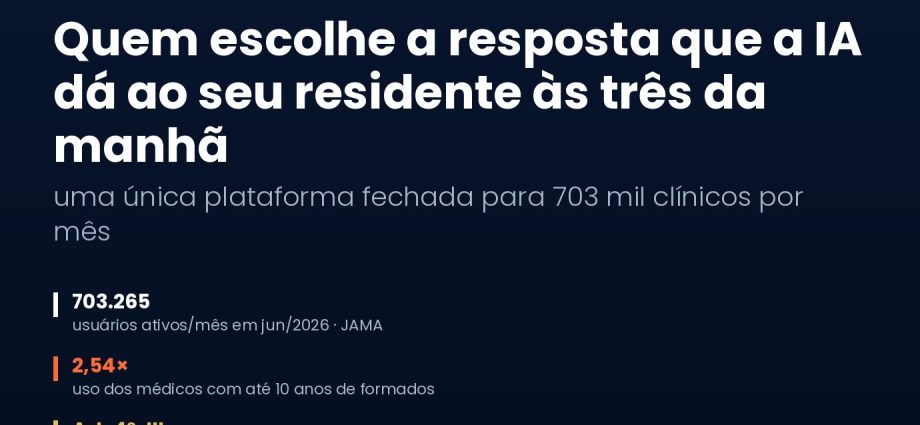
Quem Escolhe a Resposta Que a IA Dá ao Seu Residente às Três da Manhã
O JAMA publicou em 15 de outubro o primeiro retrato em larga escala de como clínicos usam IA: 952.008 profissionais americanos, 271 milhões de perguntas em dois anos e meio, e a maior parte delas sobre tratamento, não sobre diagnóstico. É o número que vai circular. Mas há outro, menos citado: todas essas perguntas foram feitas a uma única plataforma fechada, financiada por publicidade da indústria farmacêutica, e o estudo foi assinado em parte por funcionários dela. Este artigo projeta o que vem nos próximos três anos, lê a Resolução CFM 2.454 no texto oficial (ela diz menos e mais do que se repete por aí) e mostra onde está o letramento que de fato protege o médico e o paciente.
📅 Publicado em 26 de outubro de 2026
Navegue pelo Artigo
Do dado que vai circular ao viés que ninguém mede, e do que a norma pede ao que fazer na segunda-feira
- 1. Por Que Isso Importa Para Quem Está na Ponta
- 2. O Que o Estudo Entregou
- 3. Os Números, Sem Filtro — e a Projeção Para 2029
- 4. A Armadilha: Uma Fonte Só, Fechada, Para Todo Mundo
- 5. Como o Viés Impede de Pensar Fora da Curva
- 6. A Solução Como Ato Clínico: Prompt e Harness
- 7. O Que a CFM 2.454 Diz de Fato
- 8. A Linha do Tempo
- 9. O Que Fazer na Segunda-Feira
- 10. Considerações Finais
- 11. Referências
Por Que Isso Importa Para Quem Está na Ponta
Três da manhã. Uma criança de quatro anos no terceiro dia de pós-operatório de cardiopatia congênita começa a fazer febre, o lactato sobe e a diurese cai. O residente, sozinho com o caso até a passagem de plantão, abre o celular e digita a pergunta num aplicativo de IA clínica. A resposta vem em segundos, organizada, com referências de periódicos de primeira linha.
A cena acontece todas as noites. O que o estudo do JAMA mostrou em outubro é a escala dela, e o perfil de quem a protagoniza: o médico jovem, o residente, o generalista que precisa decidir fora da própria especialidade. Ele não aparece nos congressos sobre IA, mas é quem mais usa a ferramenta.
A pergunta deste artigo é desconfortável. Ninguém duvida que essa resposta das três da manhã seja útil. O que eu quero saber é quem escolheu o que entra nela, quem paga por ela, e o que acontece com o caso que não cabe na média. A Resolução CFM 2.454, em vigor desde 26 de agosto, faz exatamente essas perguntas ao médico, e não ao fornecedor.
O Que o Estudo Entregou
Patel, Finlayson e colaboradores, de Harvard Medical School, Brigham and Women’s Hospital, NYU e da própria OpenEvidence, analisaram todas as contas de clínicos com identificador nacional (NPI) verificado na plataforma OpenEvidence entre 1º de janeiro de 2024 e 30 de junho de 2026. É um estudo transversal. Um modelo de linguagem classificou uma amostra aleatória estratificada de 38,8 milhões de perguntas por finalidade clínica e por tema.
Os achados centrais
No período, 952.008 clínicos (58,5% mulheres) fizeram 271 milhões de perguntas, sendo 556.200 deles médicos. Os usuários ativos mensais foram de 355 em janeiro de 2024 para 703.265 em junho de 2026, e a média de perguntas por usuário ativo subiu de 18,0 para 39,5 por mês. Nurse practitioners e physician assistants perguntaram mais (44,5 por usuário-mês) que médicos (37,1).
A maioria das perguntas tratou de decisão clínica (51,9%), sobretudo tratamento e manejo (33,1%). Diagnóstico ficou com 13,9%. Entre 35% (oncologistas e hematologistas) e 88% (emergencistas) das perguntas dos médicos eram sobre temas fora da própria especialidade.
O uso não se distribui por igual. Médicos com até dez anos de formados fizeram 2,54 vezes a quantidade de perguntas que o tamanho do grupo faria esperar. Residentes e fellows também ficaram bem acima do esperado: 1,84 vez. Oncologia e hematologia (2,00), clínica médica (1,88) e medicina de família (1,80) ficaram acima da média. Oftalmologia (0,23), radiologia (0,24) e ortopedia (0,24), bem abaixo.
💡 Tradutor: o que é “use ratio”
É a pergunta que você faria de cabeça: esse grupo usa a ferramenta mais ou menos do que o tamanho dele justificaria? Um use ratio de 1 significa uso proporcional. Os 2,54 dos médicos com até dez anos de formados querem dizer que esse grupo produz duas vezes e meia a fatia de perguntas que teria se usasse a ferramenta na mesma proporção que o resto. Os 0,24 da radiologia, um quarto.
Traduzindo para o chão da UTI: quem mais pergunta à máquina é quem tem menos anos de plantão para conferir a resposta. Nada de alarme aqui, mas é o primeiro dado deste artigo com consequência de beira de leito.
⚠ O que o estudo não mede
O desenho é transversal e descreve uso. Não mede se as respostas estavam certas, se mudaram conduta, nem se melhoraram desfecho de paciente. A população é de usuários de uma plataforma, nos Estados Unidos, o que já seleciona quem decidiu adotar. A classificação das perguntas foi feita por um LLM, com a margem de erro própria dessa etapa. E três dos sete autores têm afiliação com a OpenEvidence, a empresa que forneceu os dados. Os próprios autores dizem que o próximo passo é avaliar se o uso melhora o cuidado.
Os Números, Sem Filtro — e a Projeção Para 2029
| Data | Variável | Valor | Fonte | Leitura |
|---|---|---|---|---|
| jan/2024 | Usuários ativos mensais | 355 | Patel · JAMA · 2026 | → ponto de partida |
| jun/2026 | Usuários ativos mensais | 703.265 | Patel · JAMA · 2026 | ↑ adoção em massa |
| jan/2024 → jun/2026 | Perguntas por usuário ativo/mês | 18,0 → 39,5 | Patel · JAMA · 2026 | ↑ uso mais intenso |
| período | Clínicos usuários (médicos) | 952.008 (556.200) | Patel · JAMA · 2026 | → escala nacional |
| período | Perguntas totais | 271 milhões | Patel · JAMA · 2026 | → amostra classificada: 38,8 mi |
| período | Decisão clínica / diagnóstico | 51,9% / 13,9% | Patel · JAMA · 2026 | ⚠ uso para conduta |
| período | Perguntas fora da especialidade | 35% a 88% | Patel · JAMA · 2026 | ⚠ terreno onde o médico confere menos |
| período | Use ratio: ≤10 anos de formado / residentes | 2,54 / 1,84 | Patel · JAMA · 2026 | → gradiente geracional |
O que dá para projetar, e o que não dá
De 355 para 703.265 usuários em 29 meses, o crescimento composto médio é de cerca de 30% ao mês (cálculo meu). Esse número não serve para extrapolar. Ele é a média de uma plataforma saindo do zero, e mantido por mais um ano produziria mais usuários do que existem clínicos nos Estados Unidos.
Também é preciso dizer o limite estatístico com todas as letras. Com dois pontos, o início e o fim da série, não existe inferência no sentido técnico, com intervalo de confiança. Uma curva logística (o S clássico da difusão de tecnologia) passa pelos dois pontos para qualquer teto que eu escolher. O que segue são cenários condicionados ao teto, e não previsões.
| Horizonte | Teto de 1,0 milhão | Teto de 1,5 milhão | Teto de 2,0 milhões | Leitura |
|---|---|---|---|---|
| jun/2027 | ~989 mil | ~1,45 milhão | ~1,88 milhão | → quase no teto |
| jun/2028 | ~1,00 milhão | ~1,50 milhão | ~2,00 milhões | → saturado |
| jun/2029 | ~1,00 milhão | ~1,50 milhão | ~2,00 milhões | → saturado |
💡 A conclusão que sobrevive à incerteza
O teto muda tudo, menos uma coisa: em qualquer dos três cenários a plataforma satura antes de 2028. Para os próximos três anos, a pergunta útil é quem fica de fora, e com que custo.
No Brasil não encontrei dado publicado de uso de IA clínica que permita a mesma conta. A Demografia Médica (FMUSP/AMB) projetou 635.706 médicos em atividade no fim de 2025. Se a penetração de uso regular chegar a 50%, 70% ou 85% em 2029 (premissas minhas, não estimativas), ficariam de fora cerca de 318 mil, 191 mil ou 95 mil médicos. Os números servem para dimensionar o grupo, e não para prever qual será.
A Armadilha: Uma Fonte Só, Fechada, Para Todo Mundo
Quase toda a cobertura do estudo fala de adoção. O dado que muda a leitura está em outro lugar: as 271 milhões de perguntas foram feitas a uma única plataforma, e essa plataforma é um ecossistema fechado em três camadas.
O corpus é licenciado
A OpenEvidence firmou acordos de conteúdo com o New England Journal of Medicine, com a rede JAMA (13 periódicos da American Medical Association) e com parceiros como Mayo Clinic e NCCN. É uma base de alta qualidade. Também é uma base escolhida por contrato, que o usuário não vê nem consegue auditar: o que ficou de fora, em que data foi atualizado, como cada fonte pesa na resposta.
A receita vem da indústria
O acesso é gratuito para clínicos americanos verificados. A receita vem de publicidade de empresas farmacêuticas e de dispositivos médicos, exibida junto ao conteúdo. A EMARKETER, citando a The Information, falou em cerca de US$ 150 milhões anuais em dezembro de 2025. A Sacra estimou receita anualizada de US$ 300 milhões em julho de 2026 e valuation de US$ 15 bilhões em setembro. São estimativas de mercado, não balanço auditado.
O estudo nasceu dentro da casa
Os dados foram fornecidos pela empresa, e três dos sete autores são vinculados a ela. Isso não invalida a descrição de uso (que é, aliás, o único jeito de obtê-la). Mas faz do maior estudo de uso de IA clínica já publicado um retrato tirado por quem é dono da câmera.
⚠ O que eu afirmo e o que eu não afirmo
Não encontrei evidência de que a publicidade distorça as respostas clínicas da OpenEvidence, e não vou sugerir que distorça. Uma análise de mercado de outubro de 2026 faz a pergunta certa (se relações comerciais podem influenciar ranqueamento, recuperação ou recomendações) e acrescenta, com razão, que a presença de anúncio não prova distorção.
O que dá para afirmar é mais estreito e, por isso, mais sólido. Corpus, critério de ranqueamento e modelo de negócio são opacos para quem usa. E a Resolução CFM 2.454 exige que o médico conheça os “vieses conhecidos dos sistemas de IA utilizados” (Art. 4º, III). Como se conhece o viés de um sistema que não se deixa inspecionar? Essa é a tensão real entre a norma e o produto mais usado.
Como o Viés Impede de Pensar Fora da Curva
Separo aqui o que já foi medido em ensaio do que é mecanismo plausível. Misturar os dois seria cometer o erro que a resolução cobra do médico.
O que já foi medido: a ancoragem na resposta da máquina
Dois ensaios randomizados, ambos ainda em preprint no medRxiv e sem revisão por pares, testaram médicos paquistaneses que tinham feito 20 horas de treinamento em letramento em IA. Os dois usaram vinhetas simuladas e ChatGPT, não a OpenEvidence, então não falam do produto. Falam do fenômeno.
| Estudo | Desenho | Resultado | Fonte | Leitura |
|---|---|---|---|---|
| Viés de automação em médicos treinados em IA | 44 médicos, 264 casos; no grupo intervenção, 3 de 6 vinhetas com erro deliberado do LLM | Raciocínio diagnóstico 84,9% vs 73,3%: −14,0 pontos (IC95% −18,9 a −9,1) | medRxiv · 2025 · NCT06963957 | ↓ treino não imunizou |
| Nudges contra viés de automação | 72 médicos, 432 casos; âncora de acurácia do modelo + semáforo de atenção na interface | 82,8% vs 75,6%: +7,6 pontos (IC95% 1,4 a 13,9) | medRxiv · 2026 · NCT07328815 | ↑ a interface protege |
💡 O que os dois ensaios dizem juntos
Vinte horas de curso não impediram que o erro do modelo arrastasse o diagnóstico. O que reduziu o dano foi um sinal de calibração posto na própria tela, no momento da decisão. No segundo estudo, uma análise de subgrupo, exploratória e sem poder estatístico, sugere efeito maior em quem tinha até oito anos de prática, justamente o perfil que o JAMA mostrou usando mais.
Traduzindo para o chão da UTI: o glicosímetro de bolso só é seguro porque alguém o confere contra o laboratório, e porque ele avisa quando está fora da faixa. Numa plataforma fechada, quem decide se a tela vai avisar é o fornecedor.
Cinco mecanismos plausíveis, em cenários ilustrativos
Os exemplos abaixo são hipóteses de trabalho. Nenhum deles foi observado na OpenEvidence, e eu não os apresento como achado.
1. A criança que não cabe na moldura da pergunta
Um sistema que devolve a resposta mais consistente com o corpus premia a pergunta que já traz o diagnóstico embutido. “Qual a conduta na sepse com instabilidade hemodinâmica?” recebe uma resposta excelente, para a população média. A pergunta que sai da curva (“o que, neste paciente, não é sepse?”) depende de o médico saber fazê-la.
No pós-operatório de cardiopatia univentricular, em que preload, pressão intratorácica e fluxo pulmonar passivo mudam a resposta à expansão volêmica e à ventilação, a resposta bem fundamentada para a média pode ser exatamente a que atrapalha. O risco aí não está em a IA errar. Ela acerta para outro paciente.
2. O corpus que reflete quem publica
A literatura de primeira linha é majoritariamente adulta, de países de alta renda e do Hemisfério Norte. O que a ferramenta devolve para arbovirose grave numa criança do litoral catarinense, ou para uma UTI do SUS sem determinado recurso? Eu não sei, e esse é o ponto: quem não consegue inspecionar o corpus não sabe onde está o buraco. A hipótese é testável, e volto a ela no checklist.
3. O ranqueamento e o incentivo
Se a receita depende de anunciante farmacêutico, a pergunta de pesquisa legítima é se o ranqueamento pode favorecer, em algum grau, o que é anunciável (marca, classe nova, produto com dossiê robusto) sobre o que é barato, antigo e eficaz. Genéricos e condutas não farmacológicas seriam os primeiros a perder, se alguém perdesse. Não há prova de que aconteça. O problema é que, num sistema opaco, o médico não teria como distinguir um achado científico de uma preferência de ranqueamento.
4. O erro correlacionado
Quando 700 mil profissionais consultam a mesma fonte, os erros deixam de ser independentes. Uma recomendação subótima ali se repete em milhares de decisões ao mesmo tempo. Na medicina, a pluralidade de condutas funciona como proteção (o colega que diverge é quem descobre o erro do outro), e essa proteção encolhe. É raciocínio de teoria de sistemas, sem medição neste caso, mas descreve o risco específico de uma adoção concentrada.
5. A moldura de outra pessoa
Numa plataforma fechada o médico escreve só a pergunta. As instruções de sistema, a recuperação de fontes e os filtros já vêm decididos. Quem domina a camada em volta do modelo consegue pedir fontes alternativas, forçar o contra-argumento, exigir os diagnósticos ordenados por gravidade e não por probabilidade, e registrar a incerteza. Quem só usa o produto herda a moldura de outra pessoa. Pensar fora da curva exige moldura própria.
A Solução Como Ato Clínico: Prompt e Harness
Se a obrigação prática é julgar criticamente o que a IA devolve, a competência que sustenta isso é entender como a resposta foi produzida. Isso acontece em duas camadas.
A primeira é o prompt: especificar o caso, o papel da ferramenta, o formato da saída, o que ela não deve fazer e a pergunta de refutação. A segunda é o harness, o arcabouço em volta do modelo (instruções de sistema, recuperação de fontes, ferramentas, memória entre etapas, verificação e registro).
💡 Harness, sem sopa de letrinhas
Pense no ventilador mecânico. O modelo de linguagem é a turbina, e o harness é tudo o que transforma a turbina em ventilação segura: o modo, os limites de pressão, os alarmes, o circuito, o registro das curvas. Ninguém avalia um ventilador olhando só a turbina. Uma plataforma fechada entrega a turbina já montada num circuito que o médico não vê.
A rede neural em partículas ilustra a turbina. O que este artigo discute é o circuito em volta dela.
O que os dados recentes mostram sobre essa camada
No PhysicianBench, de Stanford (Liu e colaboradores, arXiv, maio de 2026), agentes de IA executaram 100 tarefas clínicas de várias etapas, em 21 subespecialidades, dentro de um prontuário eletrônico simulado (servidor FHIR). O melhor modelo, GPT-5.5, completou 46,3% das tarefas na primeira tentativa e apenas 28,0% em todas as três execuções. O melhor modelo aberto chegou a 18,7%. Entre as falhas de execução, o padrão mais comum foi o que os autores chamam de output gap: o agente descreve a conduta na nota e nunca cria a ordem no sistema (62% das falhas de ação do GPT-5.5).
A Stanford HAI, ao apresentar esse benchmark e o HealthAdminBench, descreve as falhas predominantes como de coordenação (informação perdida entre etapas, erro anterior que nunca é revisto) e sugere que a solução depende tanto de arquitetura e memória quanto do tamanho do modelo. Os autores do PhysicianBench usaram de propósito um arcabouço mínimo, justamente para medir o modelo e não o harness.
O exemplo inverso veio em 22 de outubro. Segundo a cobertura da TechCrunch sobre o MAI-DxO, orquestrador de agentes da Microsoft publicado na Science, o arcabouço acrescentou cerca de 4 pontos de acurácia ao GPT-5 em casos complexos simulados do NEJM (78,9% sozinho) e levou o Gemini 2.5 Flash de 46,4% para quase 69%. Em casos de pronto-socorro, com o GPT-5.5, não houve ganho (cerca de 85% com e sem). Não consegui acessar o artigo da Science; os números vêm da reportagem.
Um exemplo concreto: as duas perguntas das três da manhã
Volte ao residente do início. A primeira versão da pergunta é: “conduta na sepse pediátrica com lactato em ascensão”. A segunda é: “criança de 4 anos, terceiro dia de pós-operatório de cardiopatia univentricular, febre, lactato subindo, diurese caindo. Liste diagnósticos diferenciais ordenados por gravidade, diga o que contradiz a hipótese de sepse neste paciente, cite fonte e data de cada afirmação e marque o que não se aplica à fisiologia univentricular”.
Nenhuma das duas garante resposta certa. Só a segunda deixa o médico em condição de exercer o julgamento crítico que a resolução exige.
O Que a CFM 2.454 Diz de Fato
Circula a ideia de que a resolução obriga o médico a dominar a IA. Fui ao texto oficial, e eu mesmo comecei convencido disso. A frase não existe. Nenhum dispositivo impõe capacitação ou treinamento, nem diz a quem caberia essa obrigação. O que existe é mais estreito e, a meu ver, mais exigente.
| Dispositivo | O que diz | A quem obriga | Fonte | Leitura |
|---|---|---|---|---|
| Art. 4º, II | “exercer julgamento crítico sobre as informações e recomendações fornecidas pela IA” | Médico | CFM 2.454/2026 | ⚠ pressupõe entender a ferramenta |
| Art. 4º, III | “manter-se atualizado quanto às capacidades, limitações, riscos e vieses conhecidos dos sistemas de IA utilizados” | Médico | CFM 2.454/2026 | ⚠ letramento com outro nome |
| Art. 4º, V | Registrar no prontuário o uso de IA como apoio à decisão | Médico | CFM 2.454/2026 | → rastreabilidade |
| Art. 5º, §§1º e 3º | Paciente informado quando a IA for apoio relevante; respeito à recusa informada | Médico | CFM 2.454/2026 | → exige saber explicar |
| Art. 7º e Art. 8º | Responsabilidade integral do médico; descumprimento sujeito a sanção ética, sem prejuízo da civil e penal | Médico | CFM 2.454/2026 | ⚠ dever com consequência |
| Art. 3º, V | Proteção contra responsabilização indevida por falha exclusiva da IA, se comprovado uso diligente, crítico e ético | Protege o médico | CFM 2.454/2026 | ↑ o registro é a prova |
| Art. 19, caput e §1º | Direito de não utilizar ou desligar sistemas inadequados, assumindo a responsabilidade por essa decisão; sem penalidade por não seguir a IA | Médico | CFM 2.454/2026 | → não usar também é decisão |
| Art. 19, §2º | Instituições não devem impor metas ou políticas que subordinem a conduta médica | Instituição | CFM 2.454/2026 | ↑ autonomia preservada |
💡 O detalhe do Art. 19 que muda a conversa
A resolução não manda ninguém usar IA. Mas o direito de não usar vem acompanhado de uma cláusula que quase ninguém cita: o médico exerce esse direito “assumindo a responsabilidade por essa decisão”. Não usar deixou de ser omissão neutra. É uma decisão clínica, com dono.
E quem usa fica sob os Arts. 4º, 7º e 8º: julgamento crítico, atualização sobre vieses, registro em prontuário, com sanção ética prevista para o descumprimento. A obrigação de “dominar” a IA não está escrita, mas ela decorre da soma desses deveres. Para dizer isso em público, a formulação defensável é: a resolução cria deveres de julgamento crítico e de atualização sobre as ferramentas usadas, o que pressupõe letramento em IA.
⚠ Onde a analogia jurídica para
No direito, quando uma ferramenta se torna usual, a pergunta de responsabilidade costuma migrar de “ele usou mal?” para “por que não usou?”. A resolução trata do plano ético-profissional. O plano civil depende de doutrina e jurisprudência que eu não verifiquei, e que pede parecer jurídico antes de virar afirmação.
A Linha do Tempo
Da curiosidade à infraestrutura
Dados medidos até junho de 2026; de 2027 em diante, cenário condicional, não previsão.
O Que Fazer na Segunda-Feira
Checklist de letramento AIMED para IA clínica
Letramento em IA que se pratica no plantão
O AIMED ensina médicos a especificar, verificar e registrar o uso de IA clínica, com prompt, harness e auditoria aplicados a casos reais, em vez do tutorial de ferramenta.
Considerações Finais
O estudo do JAMA encerra uma discussão: médicos já usam IA clínica em escala, e quem mais usa é quem está no começo da carreira, decidindo tratamento, frequentemente fora da própria especialidade. A discussão que ele abre é outra. Quase toda essa escala passa por uma fonte só, fechada, financiada por quem tem interesse comercial na conduta, e os ensaios disponíveis sugerem que nem o médico treinado escapa da ancoragem quando a tela não ajuda.
A CFM 2.454 não obriga ninguém a usar IA. Obriga quem usa a conhecer os vieses da ferramenta, a julgar o que ela diz e a registrar, e transforma o não uso numa decisão com responsável. Entre o médico que recusa a IA por princípio e o que a usa sem perguntar de onde vem a resposta, sobra um espaço pequeno e muito valioso.
💡 Connecting the Dots: todo mundo vai citar os 703 mil usuários. O dado que quase ninguém vai traduzir é o use ratio de 2,54 dos médicos com até dez anos de formados, cruzado com o ensaio em que um sinal de calibração na tela rendeu ganho maior justamente em quem tinha menos anos de prática. Os dois juntos dizem que a próxima geração de médicos vai formar o raciocínio clínico dentro de uma interface que ela não desenhou. O médico que escreve o próprio prompt e entende o harness ocupa a terra de ninguém entre o cético e o entusiasta, porque consegue usar a ferramenta e auditá-la ao mesmo tempo. E o prontuário que a resolução manda preencher pode virar, se for estruturado (ferramenta, finalidade, aceite ou rejeição, versão do prompt), o primeiro dado brasileiro de adoção real, sem depender da câmera de ninguém.
Referências
- Patel VR, Finlayson SG, Liu-Hass M, Ray M, Burk-Rafel J, Zack TI, Jena AB. Clinician Use of an Artificial Intelligence–Enabled Clinical Information Platform. JAMA. 2026 out 15. doi:10.1001/jama.2026.21868. Disponível em: https://doi.org/10.1001/jama.2026.21868
- Conselho Federal de Medicina. Resolução CFM nº 2.454, de 11 de fevereiro de 2026 — Normatiza o uso da inteligência artificial na medicina. DOU 2026 fev 27; retificação em 2026 mar 5. (Art. 3º III, IV e V; Art. 4º II, III e V; Art. 5º §§1º e 3º; Art. 7º; Art. 8º; Art. 14 parágrafo único; Art. 19 caput, §§1º e 2º; Art. 23) Disponível em: https://sistemas.cfm.org.br/normas/arquivos/resolucoes/BR/2026/2454_2026.pdf
- Liu R, Mohiuddin IQ, Schoeffler AJ, et al. PhysicianBench: Evaluating LLM Agents in Real-World EHR Environments. arXiv:2605.02240. 2026 mai 4. Disponível em: https://arxiv.org/abs/2605.02240
- Stanford HAI. Measuring What Medical AI Can Actually Do. 2026 out 19. Disponível em: https://hai.stanford.edu/news/measuring-what-medical-ai-can-actually-do
- Automation Bias in Large Language Model Assisted Diagnostic Reasoning Among AI-Trained Physicians. medRxiv (preprint, sem revisão por pares). 2025. NCT06963957. Disponível em: https://www.medrxiv.org/content/10.1101/2025.08.23.25334280
- Mitigating Automation Bias in Physician-LLM Diagnostic Reasoning Using Behavioral Nudges: A Randomized Controlled Trial. medRxiv (preprint, sem revisão por pares). 2026 jun 2. NCT07328815. doi:10.64898/2026.06.01.26354596. Disponível em: https://www.medrxiv.org/content/10.64898/2026.06.01.26354596v1
- Bellan R. Microsoft’s Mustafa Suleyman says its AI outperforms doctors on hard cases as he chases ‘medical superintelligence’. TechCrunch. 2026 out 22. (Cobertura do artigo da Science, doi:10.1126/science.aeh7930, não acessado diretamente.) Disponível em: techcrunch.com
- Snyder Bulik B. OpenEvidence doubles in value as AI heats up physicians’ medical search. EMARKETER. 2025 dez 15. Disponível em: emarketer.com
- Sacra. OpenEvidence (estimativas de receita e valuation, não auditadas). 2026. Disponível em: https://sacra.com/research/openevidence
- iatroX. The economics of free clinical AI: OpenEvidence and competitors. 2026 out 15. Disponível em: iatrox.com
- Scheffer M, et al. Demografia Médica no Brasil 2025. FMUSP/AMB, com apoio do Ministério da Saúde. 2025 (projeção de 635.706 médicos, citada via portal Afya, 2025 mai 9). Disponível em: portal.afya.com.br
Who Chooses the Answer AI Gives Your Resident at 3 A.M.
On October 15, JAMA published the first large-scale portrait of how clinicians use AI: 952,008 US clinicians, 271 million questions in two and a half years, most of them about treatment rather than diagnosis. That is the number that will circulate. There is another one, cited far less: every one of those questions went to a single closed platform, funded by pharmaceutical advertising, and the study was co-authored in part by its employees. This article projects the next three years, reads Brazil’s CFM Resolution 2,454 in its official text (it says both less and more than people repeat), and shows where the literacy that actually protects physicians and patients lies.
📅 Published October 26, 2026
Table of Contents
From the number that will circulate to the bias no one measures, and from what the rule requires to what to do on Monday
- 1. Why This Matters at the Bedside
- 2. What the Study Delivered
- 3. The Numbers, Unfiltered — and the Projection to 2029
- 4. The Trap: One Closed Source for Everyone
- 5. How Bias Keeps You Inside the Curve
- 6. The Solution as a Clinical Act: Prompt and Harness
- 7. What CFM 2,454 Actually Says
- 8. The Timeline
- 9. What to Do on Monday
- 10. Final Considerations
- 11. References
Why This Matters at the Bedside
Three in the morning. A four-year-old on the third postoperative day after congenital heart surgery spikes a fever, lactate rises and urine output falls. The resident, alone with the case until handoff, opens a phone and types the question into a clinical AI app. The answer arrives in seconds, well organized, with references from top-tier journals.
The scene happens every night. What the JAMA study showed in October is its scale, and who plays the lead: the young physician, the resident, the generalist who has to decide outside their own specialty. They are not the ones speaking at AI conferences, but they are the ones using the tool most.
The question of this article is uncomfortable. No one doubts that the 3 a.m. answer is useful. What I want to know is who chose what goes into it, who pays for it, and what happens to the case that does not fit the average. CFM Resolution 2,454, in force in Brazil since August 26, asks exactly these questions of the physician, not of the vendor.
What the Study Delivered
Patel, Finlayson and colleagues, from Harvard Medical School, Brigham and Women’s Hospital, NYU and OpenEvidence itself, analyzed every clinician account with a verified National Provider Identifier on the OpenEvidence platform between January 1, 2024 and June 30, 2026. It is a cross-sectional study. A language model classified a stratified random sample of 38.8 million questions by clinical purpose and topic.
The core findings
Over the period, 952,008 clinicians (58.5% women) asked 271 million questions, 556,200 of them physicians. Monthly active users went from 355 in January 2024 to 703,265 in June 2026, and average questions per active user rose from 18.0 to 39.5 per month. Nurse practitioners and physician assistants asked more (44.5 per user-month) than physicians (37.1).
Most questions concerned clinical decision-making (51.9%), especially treatment and management (33.1%). Diagnosis accounted for 13.9%. Between 35% (oncologists and hematologists) and 88% (emergency physicians) of physicians’ questions addressed topics outside their own specialty.
Use is not evenly spread. Physicians within ten years of graduation asked 2.54 times as many questions as the size of their group would predict. Residents and fellows were also well above expectation: 1.84 times. Oncology and hematology (2.00), internal medicine (1.88) and family medicine (1.80) were above average. Ophthalmology (0.23), radiology (0.24) and orthopedics (0.24) were far below.
💡 Translator: what a “use ratio” means
It is the question you would ask yourself: does this group use the tool more or less than its size would justify? A use ratio of 1 means proportional use. The 2.54 for physicians within ten years of graduation means that group produces two and a half times the share of questions it would if it used the tool like everyone else. Radiology’s 0.24 means a quarter.
Translated to the ICU floor: those who ask the machine most are those with the fewest years of call to check the answer. No cause for alarm, but it is the first finding in this article with bedside consequences.
⚠ What the study does not measure
The design is cross-sectional and describes use. It does not measure whether the answers were right, whether they changed management, or whether they improved patient outcomes. The population is users of one platform in the United States, which already selects those who chose to adopt. Questions were classified by an LLM, with that step’s own margin of error. And three of the seven authors are affiliated with OpenEvidence, the company that provided the data. The authors themselves say the next step is to assess whether use improves care.
The Numbers, Unfiltered — and the Projection to 2029
| Date | Variable | Value | Source | Reading |
|---|---|---|---|---|
| Jan 2024 | Monthly active users | 355 | Patel · JAMA · 2026 | → starting point |
| Jun 2026 | Monthly active users | 703,265 | Patel · JAMA · 2026 | ↑ mass adoption |
| Jan 2024 → Jun 2026 | Questions per active user/month | 18.0 → 39.5 | Patel · JAMA · 2026 | ↑ more intense use |
| period | Clinician users (physicians) | 952,008 (556,200) | Patel · JAMA · 2026 | → national scale |
| period | Total questions | 271 million | Patel · JAMA · 2026 | → classified sample: 38.8 M |
| period | Clinical decision / diagnosis | 51.9% / 13.9% | Patel · JAMA · 2026 | ⚠ used for management |
| period | Questions outside own specialty | 35% to 88% | Patel · JAMA · 2026 | ⚠ where the physician checks least |
| period | Use ratio: ≤10 years since graduation / residents | 2.54 / 1.84 | Patel · JAMA · 2026 | → generational gradient |
What can be projected, and what cannot
From 355 to 703,265 users in 29 months, the average compound growth is about 30% per month (my calculation). That number cannot be extrapolated. It is the average of a platform starting from zero, and kept up for one more year it would produce more users than there are clinicians in the United States.
The statistical limit also has to be stated plainly. With two points, the start and end of the series, there is no inference in the technical sense, with a confidence interval. A logistic curve (the classic S of technology diffusion) passes through both points for any ceiling I choose. What follows are scenarios conditional on the ceiling, not forecasts.
| Horizon | Ceiling 1.0 million | Ceiling 1.5 million | Ceiling 2.0 million | Reading |
|---|---|---|---|---|
| Jun 2027 | ~989 thousand | ~1.45 million | ~1.88 million | → near the ceiling |
| Jun 2028 | ~1.00 million | ~1.50 million | ~2.00 million | → saturated |
| Jun 2029 | ~1.00 million | ~1.50 million | ~2.00 million | → saturated |
💡 The conclusion that survives the uncertainty
The ceiling changes everything except one thing: in all three scenarios the platform saturates before 2028. For the next three years, the useful question is who is left out, and at what cost.
In Brazil I found no published data on clinical AI use that would allow the same calculation. Brazil’s Medical Demography study (FMUSP/AMB) projected 635,706 practicing physicians by the end of 2025. If regular-use penetration reaches 50%, 70% or 85% by 2029 (my assumptions, not estimates), about 318,000, 191,000 or 95,000 physicians would be left out. The numbers size the group; they do not predict which it will be.
The Trap: One Closed Source for Everyone
Almost all coverage of the study talks about adoption. The finding that changes the reading lies elsewhere: the 271 million questions went to a single platform, and that platform is a closed ecosystem in three layers.
The corpus is licensed
OpenEvidence signed content agreements with the New England Journal of Medicine, the JAMA Network (13 journals of the American Medical Association) and partners such as Mayo Clinic and NCCN. It is a high-quality base. It is also a base chosen by contract that the user neither sees nor can audit: what was left out, when it was last updated, how each source weighs in the answer.
The revenue comes from industry
Access is free for verified US clinicians. Revenue comes from pharmaceutical and medical device advertising shown alongside the content. EMARKETER, citing The Information, reported about US$150 million a year in December 2025. Sacra estimated annualized revenue of US$300 million in July 2026 and a US$15 billion valuation in September. These are market estimates, not audited accounts.
The study was born in-house
The data were supplied by the company, and three of the seven authors are affiliated with it. That does not invalidate the description of use (which is, in fact, the only way to obtain it). But it makes the largest study of clinical AI use ever published a picture taken by the owner of the camera.
⚠ What I claim and what I do not
I found no evidence that advertising distorts OpenEvidence’s clinical answers, and I will not suggest that it does. A market analysis from October 2026 asks the right question (whether commercial relationships can influence ranking, retrieval or recommendations) and rightly adds that the presence of advertising does not prove distortion.
What can be claimed is narrower and therefore more solid. Corpus, ranking criteria and business model are opaque to the user. And CFM Resolution 2,454 requires physicians to know the “known biases of the AI systems used” (Art. 4, III). How do you know the bias of a system that cannot be inspected? That is the real tension between the rule and the most used product.
How Bias Keeps You Inside the Curve
Here I separate what has been measured in trials from what is a plausible mechanism. Mixing the two would be committing the very error the resolution charges physicians with.
What has been measured: anchoring on the machine’s answer
Two randomized trials, both still preprints on medRxiv without peer review, tested Pakistani physicians who had completed 20 hours of AI literacy training. Both used simulated vignettes and ChatGPT, not OpenEvidence, so they say nothing about the product. They speak to the phenomenon.
| Study | Design | Result | Source | Reading |
|---|---|---|---|---|
| Automation bias in AI-trained physicians | 44 physicians, 264 cases; in the intervention arm, 3 of 6 vignettes with a deliberate LLM error | Diagnostic reasoning 84.9% vs 73.3%: −14.0 points (95% CI −18.9 to −9.1) | medRxiv · 2025 · NCT06963957 | ↓ training did not immunize |
| Nudges against automation bias | 72 physicians, 432 cases; model-accuracy anchor + attention traffic light in the interface | 82.8% vs 75.6%: +7.6 points (95% CI 1.4 to 13.9) | medRxiv · 2026 · NCT07328815 | ↑ the interface protects |
💡 What the two trials say together
Twenty hours of coursework did not stop the model’s error from dragging the diagnosis along. What reduced the harm was a calibration signal placed on the screen itself, at the moment of decision. In the second study, a subgroup analysis, exploratory and not powered for it, suggests a larger effect among those with up to eight years of practice, precisely the profile JAMA showed using the tool most.
Translated to the ICU floor: the point-of-care glucometer is only safe because someone checks it against the lab, and because it warns you when it is out of range. On a closed platform, the vendor decides whether the screen will warn you.
Five plausible mechanisms, as illustrative scenarios
The examples below are working hypotheses. None of them has been observed on OpenEvidence, and I do not present them as findings.
1. The child who does not fit the frame of the question
A system that returns the answer most consistent with its corpus rewards the question that already carries the diagnosis. “What is the management of sepsis with hemodynamic instability?” gets an excellent answer, for the average population. The question that breaks out of the curve (“what, in this patient, is not sepsis?”) depends on the physician knowing to ask it.
After surgery for single-ventricle heart disease, where preload, intrathoracic pressure and passive pulmonary flow change the response to volume expansion and ventilation, the well-supported answer for the average may be exactly the one that gets in the way. The risk there is not that the AI is wrong. It is right for a different patient.
2. The corpus that reflects who publishes
Top-tier literature is mostly adult, from high-income countries and from the Northern Hemisphere. What does the tool return for severe arboviral disease in a child on the coast of Santa Catarina, or for a public-system ICU without a given resource? I do not know, and that is the point: whoever cannot inspect the corpus does not know where the hole is. The hypothesis is testable, and I return to it in the checklist.
3. Ranking and incentive
If revenue depends on pharmaceutical advertisers, a legitimate research question is whether ranking could favor, to any degree, what is advertisable (brand names, new drug classes, products with robust dossiers) over what is cheap, old and effective. Generics and non-pharmacological measures would be the first to lose, if anything lost. There is no proof that it happens. The problem is that, in an opaque system, the physician would have no way to tell a scientific finding from a ranking preference.
4. Correlated error
When 700,000 clinicians consult the same source, errors stop being independent. A suboptimal recommendation there repeats itself in thousands of decisions at once. In medicine, the plurality of practice works as protection (the colleague who disagrees is the one who catches the other’s error), and that protection shrinks. This is systems-theory reasoning, unmeasured in this case, but it describes the specific risk of concentrated adoption.
5. Someone else’s frame
On a closed platform the physician writes only the question. System instructions, source retrieval and filters come pre-decided. Whoever masters the layer around the model can ask for alternative sources, force the counterargument, demand diagnoses ranked by severity rather than probability, and record the uncertainty. Whoever only uses the product inherits someone else’s frame. Thinking outside the curve requires a frame of your own.
The Solution as a Clinical Act: Prompt and Harness
If the practical obligation is to judge critically what the AI returns, the competence behind it is understanding how the answer was produced. That happens in two layers.
The first is the prompt: specifying the case, the tool’s role, the output format, what it must not do, and the refutation question. The second is the harness, the scaffolding around the model (system instructions, source retrieval, tools, memory across steps, verification and logging).
💡 Harness, without the alphabet soup
Think of the mechanical ventilator. The language model is the turbine, and the harness is everything that turns the turbine into safe ventilation: the mode, the pressure limits, the alarms, the circuit, the waveform log. No one evaluates a ventilator by looking only at the turbine. A closed platform delivers the turbine already mounted in a circuit the physician cannot see.
The particle neural network illustrates the turbine. What this article discusses is the circuit around it.
What recent data show about this layer
In PhysicianBench, from Stanford (Liu and colleagues, arXiv, May 2026), AI agents carried out 100 multi-step clinical tasks across 21 subspecialties inside a simulated electronic health record (FHIR server). The best model, GPT-5.5, completed 46.3% of tasks on the first try and only 28.0% across all three runs. The best open model reached 18.7%. Among execution failures, the most common pattern was what the authors call the output gap: the agent describes the order in the note and never creates it in the system (62% of GPT-5.5’s action failures).
Stanford HAI, presenting this benchmark alongside HealthAdminBench, describes the predominant failures as coordination failures (information lost between steps, an earlier error never revisited) and suggests the fix depends as much on architecture and memory as on model size. The PhysicianBench authors deliberately used a minimal scaffold, precisely to measure the model rather than the harness.
The reverse example came on October 22. According to TechCrunch’s coverage of MAI-DxO, Microsoft’s agent orchestrator published in Science, the scaffold added about 4 accuracy points to GPT-5 on simulated complex NEJM cases (78.9% alone) and took Gemini 2.5 Flash from 46.4% to almost 69%. On emergency department cases, with GPT-5.5, there was no gain (about 85% with and without). I could not access the Science paper; the numbers come from the report.
A concrete example: the two 3 a.m. questions
Go back to the resident from the opening. The first version of the question is: “management of pediatric sepsis with rising lactate”. The second is: “4-year-old, postoperative day 3 after single-ventricle heart surgery, fever, rising lactate, falling urine output. List differential diagnoses ranked by severity, state what argues against sepsis in this patient, cite the source and date of each claim, and flag what does not apply to single-ventricle physiology”.
Neither guarantees a correct answer. Only the second leaves the physician able to exercise the critical judgment the resolution requires.
What CFM 2,454 Actually Says
The idea circulates that the resolution requires physicians to master AI. I went to the official text, and I started out convinced of it myself. The sentence does not exist. No provision imposes training, nor says who would bear that obligation. What exists is narrower and, in my view, more demanding.
| Provision | What it says | Who it binds | Source | Reading |
|---|---|---|---|---|
| Art. 4, II | “exercise critical judgment over the information and recommendations provided by AI” | Physician | CFM 2,454/2026 | ⚠ presupposes understanding the tool |
| Art. 4, III | “keep up to date on the capabilities, limitations, risks and known biases of the AI systems used” | Physician | CFM 2,454/2026 | ⚠ literacy by another name |
| Art. 4, V | Record in the chart the use of AI as decision support | Physician | CFM 2,454/2026 | → traceability |
| Art. 5, §§1 and 3 | Patient informed when AI is relevant support; informed refusal respected | Physician | CFM 2,454/2026 | → requires being able to explain |
| Arts. 7 and 8 | Physician fully responsible; non-compliance subject to ethical sanction, without prejudice to civil and criminal liability | Physician | CFM 2,454/2026 | ⚠ a duty with consequences |
| Art. 3, V | Protection against undue liability for failures attributable solely to AI, if diligent, critical and ethical use is proven | Protects the physician | CFM 2,454/2026 | ↑ the record is the proof |
| Art. 19, caput and §1 | Right not to use or to switch off inadequate systems, taking responsibility for that decision; no penalty for not following the AI | Physician | CFM 2,454/2026 | → not using is also a decision |
| Art. 19, §2 | Institutions must not impose targets or policies that subordinate medical conduct | Institution | CFM 2,454/2026 | ↑ autonomy preserved |
💡 The Art. 19 detail that changes the conversation
The resolution does not require anyone to use AI. But the right not to use it comes with a clause almost no one quotes: the physician exercises that right “taking responsibility for that decision”. Not using stopped being a neutral omission. It is a clinical decision, with an owner.
And whoever uses it falls under Arts. 4, 7 and 8: critical judgment, staying current on biases, charting, with ethical sanction for non-compliance. The obligation to “master” AI is not written down, but it follows from the sum of these duties. To say so in public, the defensible wording is: the resolution creates duties of critical judgment and of staying current on the tools used, which presupposes AI literacy.
⚠ Where the legal analogy stops
In law, when a tool becomes customary, the liability question tends to shift from “did they use it badly?” to “why didn’t they use it?”. The resolution addresses the ethical-professional sphere. The civil sphere depends on doctrine and case law I have not verified, and it calls for a legal opinion before becoming a claim.
The Timeline
From curiosity to infrastructure
Measured data through June 2026; from 2027 on, a conditional scenario, not a forecast.
What to Do on Monday
AIMED literacy checklist for clinical AI
AI literacy you practice on call
AIMED teaches physicians to specify, verify and record the use of clinical AI, with prompt, harness and auditing applied to real cases instead of tool tutorials.
Final Considerations
The JAMA study settles one debate: physicians already use clinical AI at scale, and those who use it most are early in their careers, deciding treatment, often outside their own specialty. The debate it opens is a different one. Almost all of that scale runs through a single closed source, funded by those with a commercial interest in the decision, and the available trials suggest that not even a trained physician escapes anchoring when the screen does not help.
CFM 2,454 does not require anyone to use AI. It requires whoever uses it to know the tool’s biases, to judge what it says and to chart it, and it turns non-use into a decision with someone responsible. Between the physician who refuses AI on principle and the one who uses it without asking where the answer comes from, there is a small and very valuable space.
💡 Connecting the Dots: everyone will quote the 703,000 users. The figure almost no one will translate is the 2.54 use ratio of physicians within ten years of graduation, crossed with the trial in which a calibration signal on the screen produced a larger gain precisely among those with fewer years of practice. Together they say that the next generation of physicians will shape its clinical reasoning inside an interface it did not design. The physician who writes their own prompt and understands the harness stands in the no-man’s-land between the skeptic and the enthusiast, able to use the tool and audit it at the same time. And the chart entry the resolution requires could become, if structured (tool, purpose, accepted or rejected, prompt version), Brazil’s first real adoption data, without depending on anyone else’s camera.
References
- Patel VR, Finlayson SG, Liu-Hass M, Ray M, Burk-Rafel J, Zack TI, Jena AB. Clinician Use of an Artificial Intelligence–Enabled Clinical Information Platform. JAMA. 2026 Oct 15. doi:10.1001/jama.2026.21868. Available at: https://doi.org/10.1001/jama.2026.21868
- Federal Council of Medicine (Brazil). Resolution CFM No. 2,454 of February 11, 2026 — Regulating the use of artificial intelligence in medicine. Official Gazette, 2026 Feb 27; correction 2026 Mar 5. (Art. 3 III, IV and V; Art. 4 II, III and V; Art. 5 §§1 and 3; Art. 7; Art. 8; Art. 14 sole paragraph; Art. 19 caput, §§1 and 2; Art. 23) Available at: https://sistemas.cfm.org.br/normas/arquivos/resolucoes/BR/2026/2454_2026.pdf
- Liu R, Mohiuddin IQ, Schoeffler AJ, et al. PhysicianBench: Evaluating LLM Agents in Real-World EHR Environments. arXiv:2605.02240. 2026 May 4. Available at: https://arxiv.org/abs/2605.02240
- Stanford HAI. Measuring What Medical AI Can Actually Do. 2026 Oct 19. Available at: https://hai.stanford.edu/news/measuring-what-medical-ai-can-actually-do
- Automation Bias in Large Language Model Assisted Diagnostic Reasoning Among AI-Trained Physicians. medRxiv (preprint, not peer reviewed). 2025. NCT06963957. Available at: https://www.medrxiv.org/content/10.1101/2025.08.23.25334280
- Mitigating Automation Bias in Physician-LLM Diagnostic Reasoning Using Behavioral Nudges: A Randomized Controlled Trial. medRxiv (preprint, not peer reviewed). 2026 Jun 2. NCT07328815. doi:10.64898/2026.06.01.26354596. Available at: https://www.medrxiv.org/content/10.64898/2026.06.01.26354596v1
- Bellan R. Microsoft’s Mustafa Suleyman says its AI outperforms doctors on hard cases as he chases ‘medical superintelligence’. TechCrunch. 2026 Oct 22. (Coverage of the Science paper, doi:10.1126/science.aeh7930, not accessed directly.) Available at: techcrunch.com
- Snyder Bulik B. OpenEvidence doubles in value as AI heats up physicians’ medical search. EMARKETER. 2025 Dec 15. Available at: emarketer.com
- Sacra. OpenEvidence (revenue and valuation estimates, not audited). 2026. Available at: https://sacra.com/research/openevidence
- iatroX. The economics of free clinical AI: OpenEvidence and competitors. 2026 Oct 15. Available at: iatrox.com
- Scheffer M, et al. Demografia Médica no Brasil 2025. FMUSP/AMB, with support from the Ministry of Health. 2025 (projection of 635,706 physicians, cited via Afya portal, 2025 May 9). Available at: portal.afya.com.br
◆ Novidades
- O coração que eu posso abrir na telaNOVO
- A Regra de IA do CFM Também Entra no Consultório — o Artigo 14 Que Ninguém Leu Até o Fim
- A Semana em Que a IA Começou a Agir — GPT‑6 Astra, Claude Fable 5.1 e a Fronteira Antes da AGI