
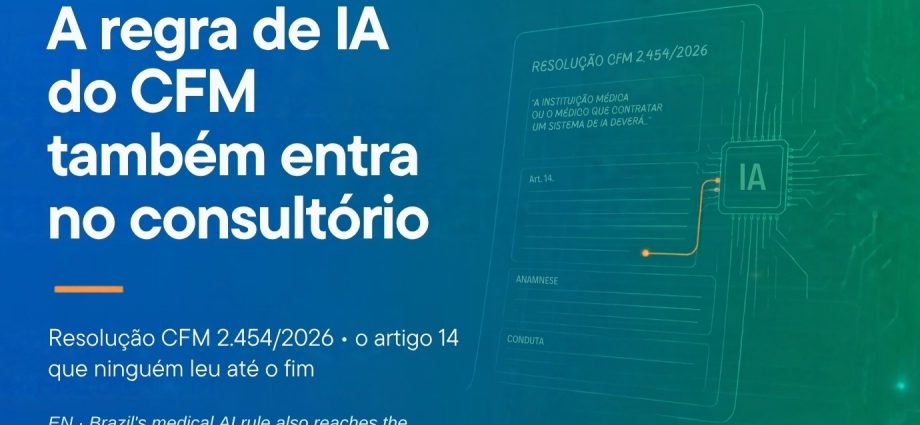
A Regra de IA do CFM Também Entra no Consultório — o Artigo 14 Que Ninguém Leu Até o Fim
A Resolução CFM nº 2.454/2026 está em vigor desde 26 de agosto e já é contestada na Justiça Federal. O debate inteiro girou em torno da Comissão de IA que os hospitais precisam montar. Mas o caput do artigo 14 alcança também o médico que contrata uma ferramenta de IA — inclusive o do consultório, sem hospital e sem comissão. E há um precedente recente sugerindo que, se a Justiça derrubar alguma parte da norma, será justamente a que fala com o estabelecimento, não a que fala com você.
📅 Publicado em 1º de outubro de 2026
Navegue pelo Artigo
Da Comissão de IA dos hospitais ao escriba de IA do consultório — o que a norma diz, o que está sendo contestado e o que sobrevive
- 1. Por Que Isso Importa Agora
- 2. O Que a Resolução Exige — e de Quem
- 3. As Datas e os Fatos, Sem Filtro
- 4. A Disputa Judicial e o Precedente da Resolução 2.444
- 5. O Consultório Também Está Dentro
- 6. Classificação de Risco — e a Categoria Que a Norma Não Definiu
- 7. A Linha do Tempo
- 8. O Que Fazer na Segunda-Feira
- 9. Considerações Finais
- 10. O Que Eu Não Verifiquei
- 11. Referências
Para quem não é da área — o essencial em 60 segundos
O CFM (Conselho Federal de Medicina) publicou em fevereiro de 2026 a primeira norma brasileira sobre uso de inteligência artificial na medicina. Ela vale desde 26 de agosto.
A ideia central é simples: a IA pode ajudar, mas quem decide é o médico — e ele responde integralmente pelo que fizer com ela. O paciente tem direito de saber quando a IA foi um apoio relevante no seu cuidado e pode recusar.
Escriba de IA é o programa que escuta a consulta e escreve a evolução no prontuário. No consultório: o médico conversa com o paciente e, ao final, o texto já está pronto para revisão. No dia a dia: é como o assistente de voz do celular que transcreve um recado — só que escrevendo um documento médico-legal.
O ponto deste artigo: todo mundo entendeu que a norma exige uma comissão nos hospitais. Pouca gente reparou que ela também cria deveres para o médico que, sozinho, contrata uma dessas ferramentas.
Por Que Isso Importa Agora
A Resolução CFM nº 2.454/2026 foi publicada no Diário Oficial da União em 27 de fevereiro de 2026 e, pelo seu artigo 23, entrou em vigor 180 dias depois — em 26 de agosto de 2026. Desde então, é norma exigível, fiscalizada pelos Conselhos Regionais. E vale também para sistemas que já estavam em uso antes dessa data (artigo 21), sem período de transição.
Às vésperas da vigência, três entidades do setor hospitalar ajuizaram ação na Justiça Federal do Distrito Federal pedindo a suspensão da resolução. Em setembro, outras dez entidades assinaram um manifesto na mesma direção. Até a data deste artigo, nenhuma decisão judicial sobre a 2.454 foi noticiada: a norma está valendo.
A cobertura pública se concentrou em um ponto: a Comissão de IA e Telemedicina que as instituições com sistemas próprios precisam criar. É um ponto importante. Mas não é o mais importante para a maioria dos médicos brasileiros, que trabalha também — ou só — em consultório.
O Que a Resolução Exige — e de Quem
Os deveres que acompanham o médico, onde quer que ele esteja
Decisão: “A decisão sobre diagnóstico, prognóstico, prescrição, ou qualquer ato médico, caberá sempre ao médico, que pode acolher ou rejeitar as sugestões da IA conforme seu julgamento” (art. 18, §2º).
Responsabilidade: o médico “permanece integralmente responsável pelos atos médicos por ele praticados mediante a utilização de modelos, sistemas e aplicações de IA” (art. 7º). Em contrapartida, tem direito de ser protegido contra responsabilização indevida por falhas atribuíveis exclusivamente ao sistema, desde que comprovado o uso diligente, crítico e ético (art. 3º, V).
Registro: é dever “registrar no prontuário do paciente o uso de sistemas de IA como apoio à decisão médica” (art. 4º, V).
Paciente: tem direito de ser informado, de forma clara e acessível, quando a IA for utilizada como apoio relevante em seu cuidado (art. 5º, §1º); e o médico deve respeitar a recusa informada (art. 5º, §3º).
Autonomia: o médico pode recusar sistemas sem validação científica adequada ou certificação regulatória pertinente (art. 3º, III), e pode não utilizar ou desligar sistemas que julgar inadequados, sem ser penalizado por não seguir a orientação da IA (art. 19).
A camada institucional
A classificação de risco — baixo, médio, alto ou inaceitável (art. 13) — é feita por avaliação preliminar das instituições “que desenvolverem ou utilizarem” sistemas de IA (art. 12). Ou seja: não é só tarefa do fornecedor; o hospital usuário também classifica.
Instituições que adotam sistemas próprios de IA precisam de uma Comissão de IA e Telemedicina, sob coordenação médica e subordinada à diretoria técnica, para assegurar o cumprimento do Anexo III (art. 14, parágrafo único). O Anexo III, por sua vez, atribui ao Diretor Técnico a responsabilidade pela fiscalização e pelas diretrizes de segurança, ética e transparência no uso da IA (item III).
O trecho que mudou a leitura deste artigo
O caput do artigo 14 diz, literalmente: “A instituição médica ou o médico que desenvolver ou contratar um modelo, sistema e/ou aplicações de IA deverá estabelecer processos internos de governança aptos a garantir a segurança, a qualidade e a ética, incluindo as seguintes medidas contidas no Anexo III.”
O parágrafo único — o da Comissão — vale para instituições com sistemas próprios. O caput vale para quem contrata. E nomeia expressamente o médico.
As Datas e os Fatos, Sem Filtro
A tabela separa o que é norma exigível, o que é disputa em curso e o que ainda é relato de imprensa. Essa separação é o método do artigo.
| Data | Ato | Origem | Situação | Leitura |
|---|---|---|---|---|
| 11/02/2026 | Resolução CFM nº 2.454 assinada | CFM | Texto oficial | → data do cabeçalho, não da publicação |
| 27/02/2026 | Publicação no DOU (Ed. 39, Seção 1, p. 158) | CFM | Publicada | ↑ marco inicial dos 180 dias |
| 05/03/2026 | Retificação no DOU (Ed. 43, Seção 1, p. 91) — art. 16 | CFM | Publicada | → retirou a menção expressa à LGPD |
| ~21/08/2026 | Ação pedindo suspensão da 2.454 · 21ª Vara Federal Cível/DF | CNSaúde, FENAESS, SBH | Pedido de urgência | → sem decisão noticiada |
| 26/08/2026 | Fim dos 180 dias — resolução passa a ser exigível | CFM | Em vigor | ⚠ vale também para sistemas já em uso |
| 11/09/2026 | Liminar teria suspendido exigências estruturais da Resolução CFM 2.444/2025 (segurança) · 3ª Vara Federal Cível/DF — mesmas autoras | Blog Dr. Finanças (ref. 4) | Relato único, não confirmado | → deveres do médico mantidos |
| Ago/2026 | STF, ADI 7.864: Conselhos de Medicina não podem interditar atividades, serviços ou estabelecimentos | Medicina S/A (ref. 7) | Relato de imprensa | → mesma direção da tese das autoras |
| Set/2026 | Manifesto de dez entidades pela suspensão total da 2.454 | ABIIS, CBDL, SindHosp e outras | Manifesto, não ação | → pressão por nova norma |
A Disputa Judicial e o Precedente da Resolução 2.444
A Confederação Nacional de Saúde (CNSaúde), a Federação Nacional dos Estabelecimentos de Serviços de Saúde (FENAESS) e o Sindicato Brasiliense de Hospitais, Casas de Saúde e Clínicas (SBH) ajuizaram ação coletiva na 21ª Vara Federal Cível da Seção Judiciária do Distrito Federal, pedindo, em caráter de urgência, a suspensão da Resolução 2.454. Os argumentos centrais, segundo a cobertura da imprensa: o CFM teria competência dirigida à conduta do médico, não à organização dos estabelecimentos; haveria sobreposição com Anvisa, ANPD e ANS; e a norma teria sido editada sem Análise de Impacto Regulatório nem consulta pública.
Em setembro, dez outras entidades — entre elas ABIIS, Abraidi, CBDL, SindHosp e Saúde Digital Brasil — assinaram manifesto pedindo a suspensão total e uma nova normatização com consulta pública. O manifesto é pressão política, não ação judicial.
⚠ O precedente que muda a aposta
Fonte: o relato abaixo vem exclusivamente do blog Dr. Finanças (“Justiça suspende parte da Resolução CFM 2.444”, setembro de 2026 — referência 4). É o único registro que localizei; o próprio autor declara não ter encontrado o número do processo nem o inteiro teor da decisão.
Segundo esse relato, em 11 de setembro de 2026 a 3ª Vara Federal Cível do DF concedeu tutela de urgência às mesmas três entidades contra outra norma do CFM — a Resolução 2.444/2025, sobre segurança em estabelecimentos de saúde. Teriam sido suspensas as exigências estruturais (câmeras, salas seguras, biometria, segurança presencial), com dois fundamentos: o CFM regula médicos, não estabelecimentos, nos termos da Lei 3.268/1957; e as exigências duplicariam normas federais já existentes.
As disposições éticas dirigidas ao médico como indivíduo teriam sido mantidas.
Há um sinal independente na mesma direção, de instância superior: segundo a Medicina S/A (24/09/2026 — referência 7), o STF concluiu em agosto de 2026 o julgamento da ADI 7.864 entendendo que os Conselhos de Medicina fiscalizam aspectos ético-profissionais, mas não podem “interditar atividades, serviços ou estabelecimentos” — a fiscalização deve se limitar a verificar irregularidades e comunicá-las às autoridades competentes. Não li o acórdão.
Se o padrão se repetir na 2.454, o que tende a cair é a camada que fala com o estabelecimento. A camada que fala com o médico — decisão, responsabilidade, registro, informação ao paciente — tende a ficar.
⚠ A ressalva metodológica
O precedente da 2.444 vem de uma fonte única e secundária — o blog Dr. Finanças — e não pôde ser confirmado em fonte oficial: não localizei o número do processo nem o inteiro teor da decisão. A ADI 7.864 é citada a partir de matéria jornalística, sem leitura do acórdão. Trata-se de tutela de urgência, não de sentença, e pode ser revista pelo Tribunal Regional Federal da 1ª Região. Quanto à 2.454, a ausência de decisão se baseia na cobertura de imprensa até 17 de setembro de 2026; o número do processo não foi divulgado, o que impediu a consulta direta ao sistema do tribunal.
Uso o precedente como indicador de tendência, não como prova do desfecho.
O Consultório Também Está Dentro
💡 O ângulo que não apareceu nas análises jurídicas
Quase toda a discussão pública sobre a 2.454 tratou de hospitais: comissão, diretoria técnica, governança institucional. Faz sentido — é ali que estão as entidades autoras da ação e os maiores contratos.
Mas o caput do artigo 14 é claro: “a instituição médica ou o médico que desenvolver ou contratar” uma solução de IA deve estabelecer processos internos de governança. O médico de consultório que assina um escriba de IA, um assistente de prescrição ou uma ferramenta de apoio diagnóstico está dentro dessa frase.
Ele não precisa de comissão — a comissão é exigência para instituições com sistemas próprios. Mas precisa de processo: saber o que usa, para quê, com que dados, com que risco, como registra e como informa o paciente.
E aqui o precedente da 2.444 ganha peso. A ação contra a 2.454 ataca a competência do CFM sobre estabelecimentos. Ela não ataca — e dificilmente atacaria — a competência do CFM sobre a conduta do médico. Se uma liminar vier, a comissão do hospital pode cair. O dever do médico de consultório, não.
Um exemplo concreto: o escriba de IA
Versão consultório: a pediatra assina um serviço de transcrição por IA que escuta a consulta e redige a evolução. Para estar em dia com a resolução, ela precisa: registrar no prontuário que a evolução foi apoiada por IA (art. 4º, V); informar a família quando esse apoio for relevante, e respeitar se ela recusar (art. 5º); revisar criticamente o texto antes de assinar, porque responde integralmente por ele (art. 7º); e ter um processo mínimo de governança daquela contratação (art. 14, caput).
Versão hospital: o mesmo escriba, contratado pelo hospital para todo o corpo clínico, entra no inventário institucional, recebe classificação de risco (art. 12 e 13) e fica sob fiscalização do Diretor Técnico (Anexo III, item III). Se o sistema for próprio, passa pela Comissão de IA e Telemedicina.
Versão dia a dia: é a diferença entre a empresa que contrata uma frota de carros e o motorista autônomo que compra o seu. A empresa precisa de setor de frota. O autônomo, não — mas continua precisando de licença, seguro e revisão em dia.
Classificação de Risco — e a Categoria Que a Norma Não Definiu
O Anexo II da resolução descreve as categorias de risco. A tabela abaixo resume o texto oficial e acrescenta exemplos do contexto de terapia intensiva pediátrica, que são meus.
| Nível | Definição (Anexo II) | Exemplos do texto oficial | Exemplos na UTI pediátrica (autor) |
|---|---|---|---|
| Baixo | Potencial de consequências negativas mínimo ou inexistente; sem influência decisória direta em diagnósticos ou tratamentos individuais | Agendamento, logística de insumos, chatbot de informação geral, sumarização de literatura para uso interno | Escala de plantão, controle de estoque de material de via aérea |
| Médio | Algum potencial de impacto adverso, mitigável por supervisão humana ativa; apoia decisões, mas não as executa | Sistemas de apoio cujos erros possam ser detectados e corrigidos pelo profissional antes do dano | Escriba de evolução com revisão obrigatória; sugestão de cálculo de diluição conferida pela equipe |
| Alto | Alto potencial de danos físicos, psíquicos ou morais; influência direta em decisões críticas ou ações automatizadas, especialmente em pacientes vulneráveis | Sistemas que influenciam diretamente decisões médicas críticas | Alerta preditivo de deterioração; triagem de gravidade no pronto-socorro pediátrico |
| Inaceitável | Não definido no Anexo II | — | — |
⚠ A lacuna normativa
O artigo 13 categoriza os sistemas em quatro níveis — “baixo, médio, alto ou inaceitável, conforme definido no anexo II”. Mas o Anexo II define apenas três: baixo, médio e alto. A palavra “inaceitável” aparece uma única vez em todo o texto, no próprio artigo 13.
Na prática, quem classifica (a instituição, pelo art. 12) não tem critério normativo para enquadrar algo como inaceitável. O que se pode afirmar com segurança é o que o próprio texto veda em outros artigos — por exemplo, que a IA restrinja ou substitua a autoridade final do médico (art. 18, §1º).
A Linha do Tempo
Fevereiro–março de 2026 · A norma nasce
Assinada em 11/02, publicada no DOU em 27/02, retificada em 05/03. A retificação altera apenas o artigo 16: onde se lia que os dados devem ser tratados “observando rigorosamente a Lei Geral de Proteção de Dados Pessoais (LGPD)”, passa a constar “observando rigorosamente a proteção geral de dados pessoais”.
Agosto de 2026 · Vigência e contestação
Às vésperas do prazo, CNSaúde, FENAESS e SBH pedem a suspensão na Justiça Federal do DF. Em 26/08, sem decisão, a resolução entra em vigor — inclusive para sistemas já em uso.
Setembro de 2026 · O precedente e o manifesto
Em 11/09, segundo o blog Dr. Finanças, as mesmas entidades obtêm liminar contra as exigências estruturais da Resolução 2.444/2025, preservados os deveres do médico (relato não confirmado em fonte oficial). Dez outras entidades assinam manifesto pela suspensão total da 2.454.
Outubro de 2026 · Onde você está agora
A 2.454 vale. A decisão judicial está pendente. Qualquer que seja o desfecho, os deveres individuais do médico — inclusive o de consultório — são a parte mais estável da norma.
O Que Fazer na Segunda-Feira
Se você atende em consultório e usa qualquer ferramenta de IA
- ☐ Escreva o seu inventário em uma página. Ferramenta, fornecedor, para que serve, que dado do paciente ela recebe, e a classificação de risco que você atribui (baixo, médio ou alto, pelo Anexo II). Esse documento é o seu “processo interno de governança” do artigo 14.
- ☐ Crie um modelo de registro no prontuário. Uma linha basta: “Evolução elaborada com apoio de ferramenta de IA [nome], revisada e validada pelo médico assistente.” É exigência do artigo 4º, inciso V.
- ☐ Defina a frase de informação ao paciente. Clara, curta, dita no início da consulta quando o apoio for relevante — e combinada com o que você faz se ele recusar (art. 5º).
- ☐ Peça ao fornecedor, por escrito: situação regulatória, onde os dados são processados e armazenados, e se as conversas são usadas para treinar o modelo. A ausência de resposta é, ela própria, um dado.
- ☐ Revise antes de assinar, sempre. A proteção do art. 3º, V, depende de uso “diligente, crítico e ético” comprovado.
Se você coordena serviço, comissão ou diretoria técnica
- ☐ Não espere a decisão judicial para fazer o inventário. Inventário e classificação de risco (arts. 12 e 13) são úteis para qualquer desfecho — e para a LGPD.
- ☐ Formalize o papel do Diretor Técnico como responsável pela fiscalização do uso de IA (Anexo III, item III).
- ☐ Se a instituição tem sistema próprio, instale a Comissão de IA e Telemedicina sob coordenação médica (art. 14, parágrafo único).
- ☐ Monitore vieses por subgrupo (Anexo III, item II). Em pediatria, o lactente costuma ser o subgrupo que a média engole.
- ☐ Prepare o acesso de órgãos de controle a relatórios e configurações dos sistemas (Anexo III, item VIII).
Governança de IA É Competência Clínica
A metodologia AIMED forma médicos que constroem — não apenas consomem — ferramentas de IA clínica. Inventário, classificação de risco, registro em prontuário e leitura crítica de desempenho fazem parte do currículo, porque o risco se materializa no leito e no consultório, não no servidor.
Considerações Finais
A Resolução CFM 2.454 está em vigor e é contestada. Essas duas frases convivem, e o médico não deveria esperar a segunda se resolver para cumprir a primeira.
A disputa judicial mira a camada institucional — e os sinais disponíveis (o relato sobre a Resolução 2.444 e a ADI 7.864 no STF) sugerem que é essa camada que corre mais risco. Mas o caput do artigo 14 e os deveres individuais dos artigos 4º, 5º, 7º e 18 alcançam cada médico, inclusive o de consultório que contrata IA sozinho. Governança de IA deixou de ser assunto apenas de hospital.
Há ainda um detalhe que pouca gente notou. A retificação de 5 de março trocou, no artigo 16, a menção expressa à LGPD por “proteção geral de dados pessoais”. A sobreposição com a ANPD é justamente um dos argumentos das entidades autoras. Não há declaração oficial sobre o motivo da troca — mas a leitura de que o CFM recuou preventivamente do terreno da proteção de dados é, no mínimo, plausível. Isto é interpretação minha, não fato documentado.
Somadas, essas peças apontam numa direção: o CFM tende a perder o que fala com o estabelecimento e manter o que fala com o médico. Quem já tem o seu processo escrito em uma página não precisa esperar o tribunal.
O Que Eu Não Verifiquei
⚠ Transparência sobre os limites deste texto
- O andamento processual da ação contra a 2.454 não foi consultado diretamente no sistema do tribunal: o número do processo não foi divulgado. A ausência de decisão se baseia na cobertura de imprensa até 17/09/2026.
- A liminar contra a Resolução 2.444/2025 é citada a partir de fonte única e secundária (blog Dr. Finanças), sem número do processo nem inteiro teor; não foi possível confirmá-la em fonte oficial.
- A decisão do STF na ADI 7.864 é citada a partir de matéria da Medicina S/A; o acórdão não foi lido.
- O conteúdo da retificação foi conferido no texto consolidado disponível no portal do CFM, não diretamente na página do DOU.
- Os exemplos de classificação de risco na UTI pediátrica são do autor, não constam da resolução.
Referências
- Conselho Federal de Medicina. Resolução CFM nº 2.454, de 11 de fevereiro de 2026 — Normatiza o uso da inteligência artificial na medicina. DOU 2026 fev 27; Ed. 39, Seção 1, p. 158. Retificação: DOU 2026 mar 5; Ed. 43, Seção 1, p. 91. (Art. 3º III e V; Art. 4º V; Art. 5º §§1º e 3º; Art. 7º; Art. 12; Art. 13; Art. 14 caput e parágrafo único; Art. 16; Art. 18 §§1º e 2º; Art. 19; Art. 21; Art. 23; Anexo II; Anexo III itens II, III e VIII) Disponível em: https://sistemas.cfm.org.br/normas/arquivos/resolucoes/BR/2026/2454_2026.pdf
- Futuro da Saúde. Ação judicial tenta suspender novas regras do CFM para inteligência artificial na medicina. 25 ago 2026 (atualizado 26 ago 2026). Disponível em: https://futurodasaude.com.br/acao-judicial-suspender-regras-cfm-inteligencia-artificial/
- Futuro da Saúde. Resolução do CFM sobre IA enfrenta nova contestação de entidades de saúde. Set 2026. Disponível em: https://futurodasaude.com.br/norma-do-cfm-sobre-ia-enfrenta-nova-contestacao-de-entidades-de-saude/
- Dr. Finanças (blog). Justiça suspende parte da Resolução CFM 2.444: o que muda nas obrigações de segurança da sua clínica. Set 2026. Fonte única do relato sobre a liminar de 11/09/2026; não confirmada em fonte oficial. Disponível em: https://drfinancas.com/blog/justica-suspende-resolucao-cfm-2444-seguranca-hospitais/
- Dr. Finanças. A regra do CFM para inteligência artificial já está valendo. 17 set 2026. Disponível em: https://drfinancas.com/blog/resolucao-cfm-2454-inteligencia-artificial-medicina/
- INOVAMED. O Software Que Muda Depois de Aprovado — e o Vão Entre o CFM e a ANVISA Que Ninguém Nomeou. 22 ago 2026. Disponível em: https://inovamed.pro/software-que-muda-depois-de-aprovado-cfm-anvisa/
- Medicina S/A. Decisão do STF limita poder dos Conselhos de Medicina sobre hospitais. 24 set 2026. (ADI 7.864) Disponível em: https://medicinasa.com.br/conselhos-de-medicina/
Texto integral da referência 1 consultado diretamente na fonte oficial em 1º de outubro de 2026. Referências 2 a 5 e 7 são cobertura de imprensa e análise setorial, citadas quanto aos fatos que relatam, conforme declarado na seção “O Que Eu Não Verifiquei”.
Brazil’s Medical AI Rule Also Reaches the Private Office — the Article 14 Clause No One Read to the End
Brazil’s Federal Council of Medicine (CFM) Resolution No. 2,454/2026 has been in force since August 26 and is already being challenged in federal court. The whole debate has revolved around the AI Committee that hospitals must set up. But the opening clause of Article 14 also reaches the physician who contracts an AI tool — including the one in private practice, with no hospital and no committee. And a recent precedent suggests that if the courts strike down any part of the rule, it will be the part addressed to institutions, not the part addressed to you.
📅 Published October 1, 2026
Navigate the Article
From the hospital AI Committee to the AI scribe in the private office — what the rule says, what is being challenged, and what survives
- 1. Why This Matters Now
- 2. What the Resolution Requires — and From Whom
- 3. Dates and Facts, Unfiltered
- 4. The Court Challenge and the Resolution 2,444 Precedent
- 5. The Private Office Is Also Covered
- 6. Risk Classification — and the Category the Rule Never Defined
- 7. Timeline
- 8. What to Do on Monday
- 9. Final Remarks
- 10. What I Did Not Verify
- 11. References
For non-specialists — the essentials in 60 seconds
The CFM (Brazil’s Federal Council of Medicine) published Brazil’s first rule on the use of artificial intelligence in medicine in February 2026. It has applied since August 26.
The core idea is simple: AI may help, but the physician decides — and remains fully responsible for what is done with it. Patients have the right to know when AI was a relevant support in their care, and may refuse it.
An AI scribe is software that listens to the consultation and drafts the clinical note. In the office: the physician talks with the patient and, at the end, the note is ready for review. In everyday life: it is like the phone assistant that transcribes a voice message — except that it writes a medico-legal document.
The point of this article: everyone understood that the rule requires a committee in hospitals. Few noticed that it also creates duties for the physician who, alone, contracts one of these tools.
Why This Matters Now
CFM Resolution No. 2,454/2026 was published in Brazil’s Official Gazette (DOU) on February 27, 2026 and, under its Article 23, came into force 180 days later — on August 26, 2026. Since then it has been enforceable and overseen by the Regional Councils. It also applies to systems already in use before that date (Article 21), with no transition period.
On the eve of that date, three hospital-sector organizations filed suit in the Federal District federal court seeking to suspend the resolution. In September, ten other organizations signed a manifesto in the same direction. As of this article, no court decision on Resolution 2,454 has been reported: the rule is in force.
Public coverage has focused on one point: the AI and Telemedicine Committee that institutions with their own systems must create. It matters. But it is not what matters most for the majority of Brazilian physicians, who also — or only — work in private practice.
What the Resolution Requires — and From Whom
The duties that follow the physician wherever they practice
Decision: “The decision on diagnosis, prognosis, prescription, or any medical act shall always rest with the physician, who may accept or reject the AI’s suggestions according to their judgment” (Art. 18, §2).
Responsibility: the physician “remains fully responsible for the medical acts performed through the use of AI models, systems and applications” (Art. 7). In return, physicians have the right to be protected against undue liability for failures attributable exclusively to the system, provided diligent, critical and ethical use is demonstrated (Art. 3, V).
Documentation: physicians must “record in the patient’s chart the use of AI systems as support for medical decisions” (Art. 4, V).
Patient: has the right to be informed clearly and accessibly when AI is used as relevant support in their care (Art. 5, §1); the physician must respect informed refusal (Art. 5, §3).
Autonomy: the physician may refuse systems lacking adequate scientific validation or appropriate regulatory certification (Art. 3, III), and may choose not to use or to switch off systems deemed inappropriate, without penalty for not following the AI’s recommendation (Art. 19).
The institutional layer
Risk classification — low, medium, high or unacceptable (Art. 13) — is carried out through a preliminary assessment by institutions that “develop or use” AI systems (Art. 12). In other words, it is not only the vendor’s job; the hospital that uses the system also classifies it.
Institutions that adopt their own AI systems need an AI and Telemedicine Committee, under medical coordination and reporting to the technical director, to ensure compliance with Annex III (Art. 14, sole paragraph). Annex III, in turn, makes the Technical Director responsible for oversight and for the safety, ethics and transparency guidelines on AI use (item III).
The clause that changed how this article reads the rule
The opening clause of Article 14 states, literally: “The medical institution or the physician who develops or contracts an AI model, system and/or application shall establish internal governance processes capable of ensuring safety, quality and ethics, including the following measures set out in Annex III.”
The sole paragraph — the Committee clause — applies to institutions with their own systems. The opening clause applies to whoever contracts. And it expressly names the physician.
Dates and Facts, Unfiltered
The table separates what is enforceable law, what is an ongoing dispute, and what is still a press report. That separation is the method of this article.
| Date | Act | Source | Status | Reading |
|---|---|---|---|---|
| 02/11/2026 | CFM Resolution No. 2,454 signed | CFM | Official text | → header date, not publication date |
| 02/27/2026 | Published in the DOU (Issue 39, Section 1, p. 158) | CFM | Published | ↑ start of the 180-day period |
| 03/05/2026 | Correction in the DOU (Issue 43, Section 1, p. 91) — Art. 16 | CFM | Published | → removed the explicit reference to the LGPD |
| ~08/21/2026 | Suit seeking suspension of Resolution 2,454 · 21st Federal Civil Court, Federal District | CNSaúde, FENAESS, SBH | Urgent relief requested | → no decision reported |
| 08/26/2026 | End of the 180 days — resolution becomes enforceable | CFM | In force | ⚠ also applies to systems already in use |
| 09/11/2026 | Injunction reportedly suspended structural requirements of CFM Resolution 2,444/2025 (security) · 3rd Federal Civil Court, Federal District — same plaintiffs | Dr. Finanças blog (ref. 4) | Single, unconfirmed report | → physician duties upheld |
| Aug/2026 | Supreme Court (STF), ADI 7,864: Medical Councils cannot shut down activities, services or establishments | Medicina S/A (ref. 7) | Press report | → same direction as the plaintiffs’ thesis |
| Sep/2026 | Manifesto by ten organizations calling for full suspension of Resolution 2,454 | ABIIS, CBDL, SindHosp and others | Manifesto, not a lawsuit | → pressure for a new rule |
The Court Challenge and the Resolution 2,444 Precedent
The National Health Confederation (CNSaúde), the National Federation of Health Service Establishments (FENAESS) and the Brasília Hospitals Union (SBH) filed a collective action in the 21st Federal Civil Court of the Federal District, seeking urgent suspension of Resolution 2,454. Their core arguments, according to press coverage: the CFM’s authority covers physician conduct, not the organization of health establishments; the rule overlaps with ANVISA, ANPD and ANS; and it was issued without a Regulatory Impact Analysis or public consultation.
In September, ten other organizations — including ABIIS, Abraidi, CBDL, SindHosp and Saúde Digital Brasil — signed a manifesto calling for full suspension and a new rule-making process with public consultation. The manifesto is political pressure, not litigation.
⚠ The precedent that changes the odds
Source: the account below comes solely from the Dr. Finanças blog (“Justiça suspende parte da Resolução CFM 2.444”, September 2026 — reference 4). It is the only record I could find; the author states that he could not locate the case number or the full text of the decision.
According to that account, on September 11, 2026 the 3rd Federal Civil Court of the Federal District granted urgent relief to the same three organizations against another CFM rule — Resolution 2,444/2025, on security in health establishments. The structural requirements (cameras, safe rooms, biometrics, on-site security) were reportedly suspended on two grounds: the CFM regulates physicians, not establishments, under Law 3,268/1957; and the requirements duplicated existing federal rules.
The ethical provisions addressed to the individual physician were reportedly upheld.
There is an independent signal in the same direction, from a higher court: according to Medicina S/A (09/24/2026 — reference 7), Brazil’s Supreme Court concluded ADI 7,864 in August 2026, holding that Medical Councils oversee ethical-professional matters but cannot “shut down activities, services or establishments” — oversight must be limited to identifying irregularities and reporting them to the competent authorities. I have not read the ruling.
If the pattern repeats with Resolution 2,454, what is likely to fall is the layer addressed to institutions. The layer addressed to the physician — decision, responsibility, documentation, patient information — is likely to remain.
⚠ Methodological caveat
The Resolution 2,444 precedent comes from a single secondary source — the Dr. Finanças blog — and could not be confirmed in an official source: I could not locate the case number or the full text of the decision. ADI 7,864 is cited from a news report, without reading the ruling. It is urgent relief, not a final judgment, and may be reviewed by the Federal Regional Court of the 1st Region. As for Resolution 2,454, the absence of a decision is based on press coverage up to September 17, 2026; the case number has not been disclosed, which prevented direct consultation of the court system.
I use the precedent as a trend indicator, not as proof of the outcome.
The Private Office Is Also Covered
💡 The angle missing from the legal analyses
Nearly all public discussion of Resolution 2,454 has been about hospitals: the committee, the technical director, institutional governance. That makes sense — that is where the plaintiffs and the largest contracts are.
But the opening clause of Article 14 is clear: “the medical institution or the physician who develops or contracts” an AI solution must establish internal governance processes. The private-practice physician who subscribes to an AI scribe, a prescribing assistant or a diagnostic support tool is inside that sentence.
They do not need a committee — the committee is required of institutions with their own systems. But they do need a process: knowing what they use, for what, with which data, at what risk, how it is documented and how the patient is informed.
This is where the Resolution 2,444 precedent gains weight. The suit against Resolution 2,454 challenges the CFM’s authority over establishments. It does not — and could hardly — challenge the CFM’s authority over the physician’s conduct. If an injunction comes, the hospital committee may fall. The private-practice physician’s duty will not.
A concrete example: the AI scribe
Office version: a pediatrician subscribes to an AI transcription service that listens to the consultation and drafts the note. To comply with the resolution, she must: record in the chart that the note was AI-assisted (Art. 4, V); inform the family when that support is relevant, and respect refusal (Art. 5); critically review the text before signing, because she is fully responsible for it (Art. 7); and have a minimal governance process for that contract (Art. 14, opening clause).
Hospital version: the same scribe, contracted by the hospital for the whole medical staff, goes into the institutional inventory, receives a risk classification (Arts. 12 and 13) and falls under the Technical Director’s oversight (Annex III, item III). If the system is the institution’s own, it goes through the AI and Telemedicine Committee.
Everyday version: it is the difference between a company that leases a fleet of cars and a self-employed driver who buys their own. The company needs a fleet department. The self-employed driver does not — but still needs a license, insurance and regular servicing.
Risk Classification — and the Category the Rule Never Defined
Annex II of the resolution describes the risk categories. The table below summarizes the official text and adds examples from pediatric intensive care, which are my own.
| Level | Definition (Annex II) | Examples in the official text | Pediatric ICU examples (author) |
|---|---|---|---|
| Low | Minimal or no potential for negative consequences; no direct decision-making influence on individual diagnoses or treatments | Scheduling, supply logistics, general health information chatbot, literature summarization for internal use | Shift rosters, airway supply inventory |
| Medium | Some potential for adverse impact, mitigable through active human oversight; supports decisions but does not execute them | Support systems whose errors can be detected and corrected by the professional before harm occurs | Note-drafting scribe with mandatory review; dilution calculation suggestion checked by the team |
| High | High potential for physical, psychological or moral harm; direct influence on critical decisions or automated actions, especially in vulnerable patients | Systems that directly influence critical medical decisions | Predictive deterioration alert; severity triage in the pediatric emergency department |
| Unacceptable | Not defined in Annex II | — | — |
⚠ The regulatory gap
Article 13 sorts systems into four levels — “low, medium, high or unacceptable, as defined in Annex II”. But Annex II defines only three: low, medium and high. The word “unacceptable” appears only once in the entire text, in Article 13 itself.
In practice, whoever classifies (the institution, under Art. 12) has no normative criterion for labeling something unacceptable. What can be stated with confidence is what the text prohibits elsewhere — for example, AI restricting or replacing the physician’s final authority (Art. 18, §1).
Timeline
February–March 2026 · The rule is born
Signed on 02/11, published in the DOU on 02/27, corrected on 03/05. The correction changes only Article 16: where it read that data must be handled “strictly observing the General Personal Data Protection Law (LGPD)”, it now reads “strictly observing general personal data protection”.
August 2026 · Entry into force and challenge
On the eve of the deadline, CNSaúde, FENAESS and SBH seek suspension in the Federal District federal court. On 08/26, with no decision, the resolution comes into force — including for systems already in use.
September 2026 · The precedent and the manifesto
On 09/11, according to the Dr. Finanças blog, the same organizations obtain an injunction against the structural requirements of Resolution 2,444/2025, with physician duties preserved (report not confirmed in an official source). Ten other organizations sign a manifesto calling for full suspension of Resolution 2,454.
October 2026 · Where you are now
Resolution 2,454 is in force. The court decision is pending. Whatever the outcome, the physician’s individual duties — including in private practice — are the most stable part of the rule.
What to Do on Monday
If you work in private practice and use any AI tool
- ☐ Write your inventory on one page. Tool, vendor, purpose, what patient data it receives, and the risk class you assign (low, medium or high, per Annex II). That document is your Article 14 “internal governance process”.
- ☐ Create a chart documentation template. One line is enough: “Note prepared with the support of AI tool [name], reviewed and validated by the attending physician.” Required by Article 4, item V.
- ☐ Define your patient information sentence. Clear, short, said at the start of the consultation when the support is relevant — together with what you do if the patient refuses (Art. 5).
- ☐ Ask the vendor, in writing: regulatory status, where data is processed and stored, and whether conversations are used to train the model. No answer is itself a data point.
- ☐ Always review before signing. The protection in Art. 3, V depends on demonstrated “diligent, critical and ethical” use.
If you run a service, committee or technical directorate
- ☐ Do not wait for the court decision to build the inventory. Inventory and risk classification (Arts. 12 and 13) are useful under any outcome — and for the LGPD.
- ☐ Formalize the Technical Director’s role as responsible for oversight of AI use (Annex III, item III).
- ☐ If the institution has its own system, set up the AI and Telemedicine Committee under medical coordination (Art. 14, sole paragraph).
- ☐ Monitor bias by subgroup (Annex III, item II). In pediatrics, infants are usually the subgroup the average swallows.
- ☐ Prepare access for oversight bodies to system reports and configurations (Annex III, item VIII).
AI Governance Is a Clinical Competence
The AIMED methodology trains physicians who build — not just consume — clinical AI tools. Inventory, risk classification, chart documentation and critical reading of performance are part of the curriculum, because risk materializes at the bedside and in the office, not on the server.
Final Remarks
CFM Resolution 2,454 is in force and under challenge. Both statements are true at once, and physicians should not wait for the second to be resolved before complying with the first.
The court challenge targets the institutional layer — and the available signals (the Resolution 2,444 report and ADI 7,864 at the Supreme Court) suggest that this is the layer most at risk. But the opening clause of Article 14 and the individual duties in Articles 4, 5, 7 and 18 reach every physician, including the private-practice physician who contracts AI alone. AI governance is no longer just a hospital matter.
There is one more detail few have noticed. The March 5 correction replaced, in Article 16, the explicit reference to the LGPD with “general personal data protection”. Overlap with the ANPD (Brazil’s data protection authority) is precisely one of the plaintiffs’ arguments. There is no official statement on why the wording changed — but reading it as a preemptive retreat by the CFM from data-protection ground is at least plausible. This is my interpretation, not a documented fact.
Taken together, these pieces point in one direction: the CFM is likely to lose what it says to institutions and keep what it says to physicians. Those who already have their process written on one page do not need to wait for the court.
What I Did Not Verify
⚠ Transparency about the limits of this text
- The procedural status of the suit against Resolution 2,454 was not checked directly in the court system: the case number has not been disclosed. The absence of a decision is based on press coverage up to 09/17/2026.
- The injunction against Resolution 2,444/2025 is cited from a single secondary source (Dr. Finanças blog), without case number or full text; it could not be confirmed in an official source.
- The Supreme Court decision in ADI 7,864 is cited from a Medicina S/A report; the ruling itself was not read.
- The content of the correction was checked against the consolidated text on the CFM portal, not directly on the DOU page.
- The pediatric ICU risk classification examples are the author’s, not part of the resolution.
References
- Federal Council of Medicine (CFM). Resolution CFM No. 2,454 of February 11, 2026 — Regulates the use of artificial intelligence in medicine. DOU 2026 Feb 27; Issue 39, Section 1, p. 158. Correction: DOU 2026 Mar 5; Issue 43, Section 1, p. 91. (Art. 3 III and V; Art. 4 V; Art. 5 §§1 and 3; Art. 7; Art. 12; Art. 13; Art. 14 opening clause and sole paragraph; Art. 16; Art. 18 §§1 and 2; Art. 19; Art. 21; Art. 23; Annex II; Annex III items II, III and VIII) Available at: https://sistemas.cfm.org.br/normas/arquivos/resolucoes/BR/2026/2454_2026.pdf
- Futuro da Saúde. Ação judicial tenta suspender novas regras do CFM para inteligência artificial na medicina [Lawsuit seeks to suspend CFM’s new AI rules in medicine]. Aug 25, 2026 (updated Aug 26, 2026). Available at: https://futurodasaude.com.br/acao-judicial-suspender-regras-cfm-inteligencia-artificial/
- Futuro da Saúde. Resolução do CFM sobre IA enfrenta nova contestação de entidades de saúde [CFM AI resolution faces new challenge from health organizations]. Sep 2026. Available at: https://futurodasaude.com.br/norma-do-cfm-sobre-ia-enfrenta-nova-contestacao-de-entidades-de-saude/
- Dr. Finanças (blog). Justiça suspende parte da Resolução CFM 2.444 [Court suspends part of CFM Resolution 2,444]. Sep 2026. Sole source for the report on the 09/11/2026 injunction; not confirmed in an official source. Available at: https://drfinancas.com/blog/justica-suspende-resolucao-cfm-2444-seguranca-hospitais/
- Dr. Finanças. A regra do CFM para inteligência artificial já está valendo [The CFM AI rule is already in force]. Sep 17, 2026. Available at: https://drfinancas.com/blog/resolucao-cfm-2454-inteligencia-artificial-medicina/
- INOVAMED. The Software That Changes After Approval — and the Gap Between CFM and ANVISA That No One Has Named. Aug 22, 2026. Available at: https://inovamed.pro/software-que-muda-depois-de-aprovado-cfm-anvisa/
- Medicina S/A. Decisão do STF limita poder dos Conselhos de Medicina sobre hospitais [Supreme Court decision limits Medical Councils’ power over hospitals]. Sep 24, 2026. (ADI 7,864) Available at: https://medicinasa.com.br/conselhos-de-medicina/
Full text of reference 1 consulted directly at the official source on October 1, 2026. References 2 to 5 and 7 are press coverage and sector analysis, cited for the facts they report, as declared in the “What I Did Not Verify” section.
◆ Novidades
- A Semana em Que a IA Começou a Agir — GPT‑6 Astra, Claude Fable 5.1 e a Fronteira Antes da AGI
- O Software Que Muda Depois de Aprovado — e o Vão Entre o CFM e a ANVISA Que Ninguém Nomeou
- Memória Inteligente: o que a ciência da aprendizagem realmente sustenta