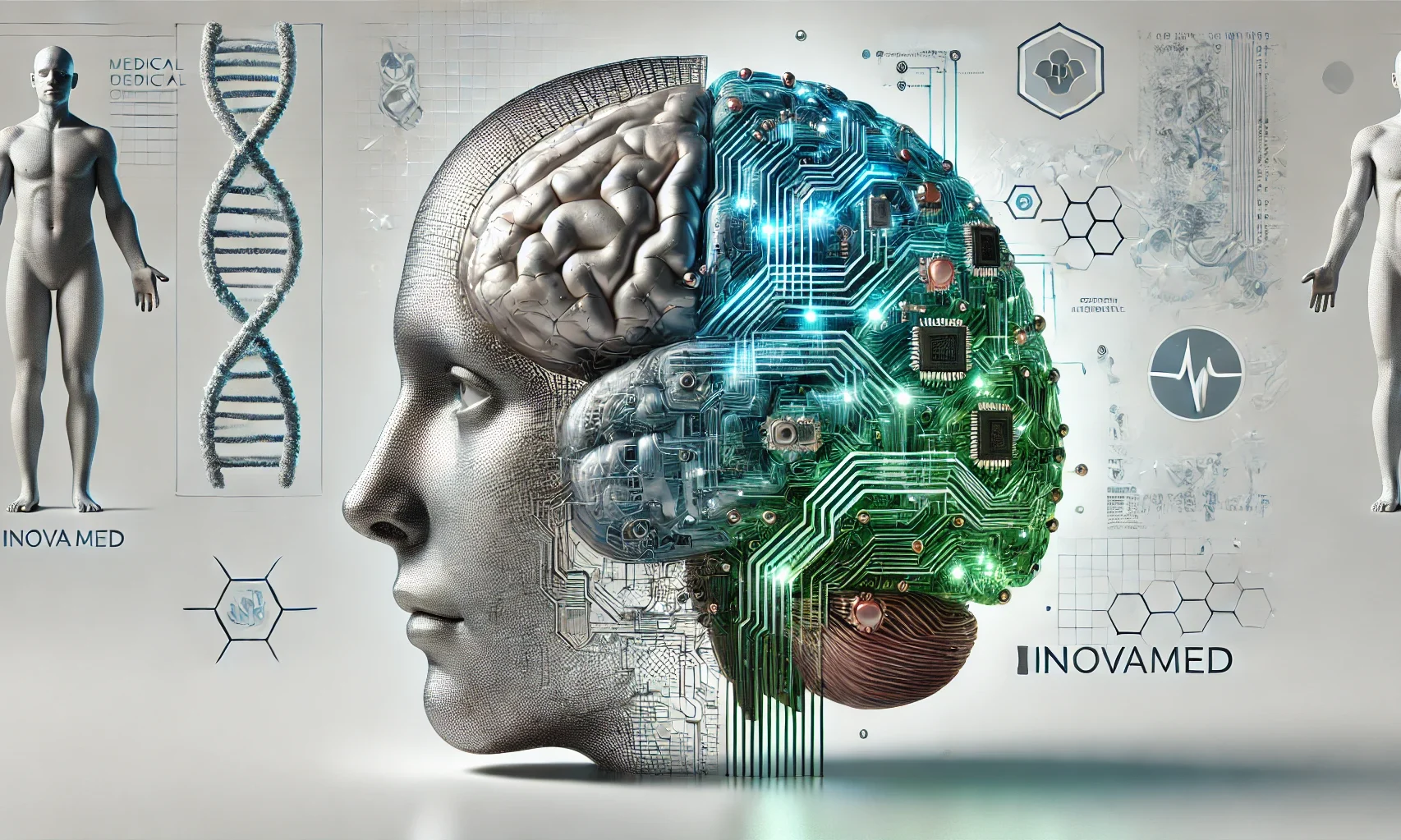

Além dos Algoritmos: Como Profissionais de Saúde Podem Redefinir o Futuro da Medicina com IA
A IA promete revolucionar diagnóstico, triagem e gestão clínica. Mas o avanço tecnológico sozinho não substitui julgamento clínico. Este artigo argumenta que o próximo salto de qualidade em saúde não vem da IA sozinha, nem do médico sozinho, mas de uma inteligência colaborativa que ainda não tem currículo, nem nome de especialidade.
📅 Publicado em 15/03/2025
Navegue pelo Artigo
Da promessa tecnológica ao trabalho real que a colaboração humano-IA exige
1. Introdução: O Elemento Humano na IA Médica
No cenário atual, onde a tecnologia avança a passos largos, a inteligência artificial surge como uma ferramenta revolucionária que complementa a expertise dos profissionais de saúde. Este artigo explora como a colaboração entre humanos e máquinas pode transformar a prática médica, melhorando a precisão dos diagnósticos e a eficiência dos tratamentos.
Buscamos, com este artigo, fomentar o diálogo e a reflexão sobre o papel da IA na medicina, apresentando desafios, oportunidades e os caminhos para uma integração efetiva da tecnologia na prática clínica.
💡 A Tese Central
“O sistema de saúde mais poderoso será aquele onde a IA amplia as capacidades humanas enquanto a expertise humana orienta o desenvolvimento da IA—uma inteligência colaborativa em vez de substituição artificial.”
2. Panorama Atual: Além do Hype
A inteligência artificial na saúde ultrapassou as teorias e hoje se integra aos sistemas médicos, atuando em diagnósticos, planejamento de tratamentos e gestão administrativa. No entanto, a implementação prática ainda enfrenta desafios consideráveis.
Áreas-Chave Onde a IA Está Transformando a Saúde
- Imagens Diagnósticas: Análise inteligente de imagens radiológicas para identificar padrões imperceptíveis.
- Análise Preditiva: Identificação precoce de riscos antes do aparecimento dos sintomas clínicos.
- Eficiência Administrativa: Automatização de processos como documentação e codificação.
- Descoberta de Medicamentos: Aceleração na triagem e validação de novos compostos terapêuticos.
- Medicina Personalizada: Adaptação dos tratamentos com base em dados genéticos e históricos médicos.
3. Desafios na Interseção
Embora promissora, a implementação da IA na saúde enfrenta desafios multifacetados, que vão desde questões éticas e interrupções no fluxo de trabalho até barreiras regulatórias. Além disso, a formação médica tradicional ainda não capacita os profissionais para interpretar e avaliar criticamente os dados gerados por sistemas de IA.
Imperativos Educacionais para a Era da IA
- Integrar ciência de dados e alfabetização em IA nos currículos médicos
- Oferecer educação continuada para a prática clínica com foco em IA
- Desenvolver funções especializadas que unam os domínios clínicos e técnicos
- Promover a colaboração entre médicos e especialistas em tecnologia
- Educar os pacientes sobre as potencialidades e limitações da IA
4. Redefinindo o Relacionamento
O futuro da medicina exige uma nova visão da relação entre profissionais de saúde e inteligência artificial. Em vez de enxergar a tecnologia como substituta, é fundamental que ela seja vista como uma aliada que, juntamente com o conhecimento clínico, eleva a qualidade do atendimento.
Nesta abordagem colaborativa, os médicos não são apenas usuários de ferramentas tecnológicas, mas participantes ativos em seu desenvolvimento, garantindo que as inovações estejam alinhadas com as necessidades reais dos pacientes.
Forças Humanas
- Intuição clínica e reconhecimento de padrões
- Comunicação empática com pacientes
- Tomada de decisão ética em cenários complexos
- Flexibilidade diante de casos atípicos
- Integração de aspectos sociais e contextuais
Forças da IA
- Análise rápida de grandes volumes de dados
- Identificação de padrões sutis
- Execução consistente de protocolos
- Monitoramento contínuo
- Análise simultânea de múltiplas variáveis
5. O Futuro: Coevolução da Medicina e IA
O futuro da saúde será definido pela integração contínua entre a prática médica e a inteligência artificial. Essa coevolução promete remodelar papéis, modelos educacionais e a forma como os cuidados são prestados, promovendo uma abordagem mais precisa e preventiva.
Os profissionais do futuro precisarão combinar experiência clínica com habilidades tecnológicas avançadas, tornando-se aptos a validar e interpretar os dados gerados pelos sistemas de IA.
Clínicos Nativos em IA
Futuros médicos serão treinados para integrar ferramentas computacionais com a prática clínica, avaliando criticamente os resultados de forma holística.
Especialistas Clínicos em IA
Emergirá uma nova especialidade dedicada ao desenvolvimento e implementação de soluções de IA personalizadas para diversas áreas médicas.
Atenção Primária Aumentada
Com a automatização de tarefas rotineiras, a IA permitirá que os médicos se concentrem em decisões clínicas complexas e na relação com os pacientes.
Você é Profissional de Saúde? Vá Além da Reflexão
Colaboração humano-IA não é conceito abstrato: é metodologia. Conheça o AIMED e veja como estruturar essa parceria na sua prática clínica, com ferramentas e protocolo — não só princípios.
6. Considerações Finais
A integração da inteligência artificial na saúde não é apenas um desafio tecnológico, mas uma oportunidade transformadora para reimaginar a prática médica. Para que essa transformação seja bem-sucedida, é imprescindível que os profissionais de saúde adotem uma abordagem colaborativa e inovadora.
Somente unindo a expertise humana à capacidade analítica da IA poderemos criar um sistema de saúde que seja verdadeiramente eficiente, ético e centrado no paciente.
Passos Rumo à Inteligência Colaborativa
- Engaje-se diretamente no desenvolvimento e validação dos sistemas de IA na sua área.
- Defenda a transparência nas decisões algorítmicas e no uso dos dados dos pacientes.
- Invista em formação contínua sobre IA e em colaboração interdisciplinar.
- Documente os resultados dos cuidados aprimorados por IA para construir uma base sólida de evidências.
- Capacite a nova geração de profissionais para integrar tecnologia e prática clínica.
O futuro da medicina será escrito por aqueles que abraçarem essa transformação. Ao unir a inteligência artificial ao conhecimento humano, podemos criar um sistema de saúde mais robusto, inovador e, acima de tudo, humano.
💡 Connecting the Dots: A tese central deste artigo — inteligência colaborativa em vez de substituição — é hoje consenso confortável em quase todo texto sobre IA em saúde. O que quase ninguém nomeia é o custo operacional dessa colaboração: cada camada de IA que se soma ao fluxo clínico não elimina trabalho humano, ela desloca o trabalho humano para um ponto diferente da cadeia — da execução para a validação. Um radiologista que usa triagem algorítmica não trabalha menos, ele passa a auditar decisões de uma caixa que erra de forma diferente de como um humano erra. Isso significa que a curva de aprendizado real da era da IA em medicina não é aprender a usar a ferramenta, é aprender a reconhecer os padrões de erro específicos de cada sistema — e essa competência ainda não está em nenhuma ementa de residência.
Beyond Algorithms: How Healthcare Professionals Could Redefine the Future of Medicine with AI
AI promises to revolutionize diagnosis, triage, and clinical management. But technological advancement alone does not replace clinical judgment. This article argues that the next real leap in quality of care will not come from AI alone, nor from the physician alone, but from a collaborative intelligence that still has no curriculum, and no specialty name.
📅 Published March 15, 2025
Table of Contents
From the technological promise to the real work human-AI collaboration demands
1. Introduction: The Human Element in Medical AI
In today’s fast-evolving world of healthcare technology, artificial intelligence is emerging as a transformative tool that enhances, rather than replaces, human expertise. This article explores how AI can empower medical professionals by augmenting their decision-making and clinical insight. By embracing a collaborative approach between technology and human judgment, we can pave the way for more efficient, ethical, and patient-centered care.
This article is designed to spark dialogue among healthcare innovators around the globe, offering insights into current challenges, future opportunities, and the evolving role of AI in medicine.
💡 The Core Thesis
“The most powerful healthcare system will be one where AI augments human capabilities while human expertise guides AI development—a collaborative intelligence rather than artificial replacement.”
2. Current Landscape: Beyond the Hype
Artificial intelligence in healthcare has moved beyond theoretical applications to become an integral component of modern medical systems. AI tools are now embedded in various aspects of diagnostics, treatment planning, and administrative workflows. Yet, a significant gap still exists between technological capability and real-world implementation.
Key Areas Where AI is Transforming Healthcare
- Diagnostic Imaging: AI systems can detect patterns in radiological images that may escape human observation.
- Predictive Analytics: Algorithms can identify patients at risk before clinical symptoms appear.
- Administrative Efficiency: AI streamlines documentation, coding, and other administrative tasks.
- Drug Discovery: Machine learning accelerates the identification and validation of new therapeutic compounds.
- Personalized Medicine: AI helps tailor treatments based on individual genetic profiles and medical histories.
3. Challenges at the Intersection
The integration of AI into clinical practice presents multifaceted challenges that extend well beyond technical considerations. Healthcare professionals must address complex ethical dilemmas, navigate workflow disruptions, and adapt to evolving regulatory frameworks while ensuring that the human touch in medicine remains at the forefront.
Moreover, traditional medical education has yet to fully equip clinicians with the skills needed to interpret and critically evaluate AI-generated insights, further compounding the challenge of effective AI adoption.
Educational Imperatives for the AI Era
- Integration of data science and AI literacy into medical school curricula
- Continuing education for practicing clinicians on AI evaluation and implementation
- Development of specialized roles bridging clinical and technical domains
- Cross-disciplinary collaboration between medical and computational experts
- Patient education on the capabilities and limitations of healthcare AI
4. Redefining the Relationship
Moving forward, a fundamental reconceptualization of the relationship between healthcare professionals and AI is essential. Rather than viewing AI as a replacement, the focus should be on a collaborative model that leverages the complementary strengths of both human and machine intelligence.
In this model, clinicians not only use AI tools but also play a key role in their development and validation, ensuring that the technology supports patient care without compromising ethical standards.
Human Strengths
- Clinical intuition and pattern recognition
- Empathetic communication with patients
- Ethical decision-making in complex scenarios
- Adaptability to unique cases
- Integration of social and contextual factors
AI Strengths
- Processing vast quantities of medical literature
- Identifying subtle patterns in large datasets
- Consistent application of established protocols
- Continuous monitoring without fatigue
- Simultaneous analysis of numerous variables
5. The Future: Co-Evolution of Medicine and AI
The future of healthcare lies in the dynamic co-evolution of medical practice and artificial intelligence. This collaborative relationship will reshape clinical roles, educational models, and care delivery systems in profound and often unexpected ways.
Healthcare professionals will need to acquire new skills that bridge clinical expertise and technological fluency. In doing so, they will become adept at validating AI outputs, detecting biases, and applying computational insights within the clinical context.
AI-Native Clinicians
Future medical graduates will seamlessly integrate computational tools with patient care, critically assessing AI outputs from a clinical perspective.
Clinical AI Specialists
A new subspecialty will emerge focused on the development, validation, and implementation of AI tools tailored to specific medical domains.
Augmented Primary Care
AI will enhance relationship-based care by automating routine monitoring and allowing clinicians to focus on complex decision-making and patient interaction.
Are You a Healthcare Professional? Go Beyond Reflection
Human-AI collaboration is not an abstract concept — it is a methodology. Discover AIMED and see how to structure this partnership in your clinical practice, with tools and protocol, not just principles.
6. Final Considerations
The integration of artificial intelligence into healthcare presents not just a technological challenge but a profound opportunity to redefine the practice of medicine. Realizing this potential will require active collaboration between clinicians and technologists, ensuring that AI serves as an extension of human expertise.
Ultimately, the future of medicine will be shaped by those who embrace a collaborative, transparent approach to technology – one that upholds the values of compassion, equity, and patient-centered care.
Steps Toward Collaborative Intelligence
- Engage directly in the development and validation of AI systems in your specialty.
- Advocate for transparency in algorithmic decision-making and patient data usage.
- Invest in AI literacy through continuing education and cross-disciplinary collaboration.
- Document clinical outcomes of AI-augmented care to build an evidence base.
- Mentor the next generation of clinicians in the thoughtful integration of technology.
The future of medicine will be written by those who actively participate in its creation. By embracing a model where AI and human expertise work hand-in-hand, healthcare professionals can ensure that technology enhances, rather than replaces, the human touch in medicine.
💡 Connecting the Dots: The central thesis of this article — collaborative intelligence rather than substitution — is by now the comfortable consensus of almost every text on AI in healthcare. What almost nobody names is the operational cost of that collaboration: every layer of AI added to the clinical workflow does not remove human work, it displaces human work to a different point in the chain — from execution to validation. A radiologist using algorithmic triage does not work less, they start auditing the decisions of a black box that fails in ways different from how a human fails. This means the real learning curve of the AI era in medicine is not learning to use the tool, it is learning to recognize the specific failure patterns of each system — and that competency is not yet in any residency curriculum.
◆ Novidades
- A Semana em Que a IA Começou a Agir — GPT‑6 Astra, Claude Fable 5.1 e a Fronteira Antes da AGI
- O Software Que Muda Depois de Aprovado — e o Vão Entre o CFM e a ANVISA Que Ninguém Nomeou
- Memória Inteligente: o que a ciência da aprendizagem realmente sustenta