
Criança bateu a cabeça e dormiu: pode deixar dormir? Quando levar ao hospital
Pode, se antes de pegar no sono ela estava agindo como sempre e acorda com facilidade. Quando uma criança bateu a cabeça, dormir não piora a pancada, e a Sociedade Brasileira de Pediatria diz com todas as letras que não é preciso acordá-la de hora em hora. A Academia Americana de Pediatria e o NHS inglês também liberam o sono. O que leva ao hospital são sinais, e eles mudam com a idade. Abaixo estão os sinais que os pronto-socorros usam, separados para bebês e para crianças maiores, com a fonte de cada número.
📅 Publicado em novembro de 2026
Navegue pelo Artigo
Da pancada no chão da sala à decisão de ir ou não ao pronto-socorro, e do que observar nas horas seguintes.
- 1. Criança bateu a cabeça: pode deixar dormir?
- 2. O filme
- 3. Quando levar ao hospital: os sinais por idade
- 4. Galo na testa ou galo do lado e atrás
- 5. Veja o crânio do bebê em 3D
- 6. Seis crenças que os números desmentem
- 7. Quanto tempo observar em casa
- 8. Bastidores: o que corrigimos antes de publicar
- 9. Perguntas frequentes
- 10. Considerações Finais
- 11. Referências
1. Criança bateu a cabeça: pode deixar dormir?
Oito da noite. Um menino de um ano e meio escorrega do sofá, bate a cabeça no chão, chora alto, mama e adormece no colo da mãe. Ela pega o celular e digita “criança bateu a cabeça pode dormir”. No autocompletar do Google, em português e em inglês, essa pergunta aparece entre as primeiras sugestões quando o assunto é pancada na cabeça. E a resposta ainda circula errada: tem texto na internet mandando manter a criança acordada por horas.
A Sociedade Brasileira de Pediatria responde à pergunta, no material para famílias de outubro de 2025, com um “Sim” seguido de “Não é necessário acordá-lo a cada hora” (12). Quando a criança acordar, os pais observam se ela age como sempre, reconhece o ambiente e responde bem.
A Academia Americana de Pediatria diz que a criança pode dormir. Na página sobre concussão, diz que não é preciso acordá-la periodicamente e manda ir ao pronto-socorro na hora se ela parecer muito sonolenta ou não conseguir ser acordada (13). Na página sobre pancada na cabeça, que vale para crianças de 2 anos ou mais, diz que o pediatra pode pedir uma checagem a cada 2 a 3 horas, para ver se ela se mexe normalmente, acorda o bastante para reconhecer os pais e responde (18). O NHS segue a mesma linha: ninguém precisa ficar acordado se estiver cansado, desde que um adulto fique junto pelo menos nas primeiras 24 horas (15).
Traduzindo para a madrugada em casa
O sono em si não faz mal. O sinal que importa é a criança que custa a acordar, ou que fica sonolenta numa hora em que estaria bem desperta. A orientação de alta para cuidadores de um hospital do NHS, o de Gateshead, dá até a medida: sonolência que dura mais de 1 hora numa hora em que a criança estaria bem desperta, ou dificuldade para acordá-la, é motivo para voltar ao pronto-socorro (16).
⚠ Uma exceção
Se a criança desmaiou, mesmo por poucos segundos, ela precisa ser avaliada antes. A página da AAP sobre perda de consciência diz que só depois dessa avaliação, quando o profissional julga improvável uma lesão mais grave, ele pode liberar o sono (14).
2. O filme
Menos de noventa segundos, em formato vertical: uma mãe ao telefone de madrugada e um pediatra de plantão respondendo, com o crânio do bebê em 3D. Se preferir ler, tudo o que o filme diz está nas seções abaixo, com a fonte de cada número.
3. Quando levar ao hospital: os sinais por idade
Os sinais desta seção vêm do PECARN, a rede americana de pesquisa em emergência pediátrica. O estudo acompanhou 42.412 crianças com menos de 18 anos que chegaram ao pronto-socorro conscientes, com Glasgow 14 ou 15 (15 é o normal), até 24 horas depois da pancada. Lesão cerebral clinicamente importante apareceu em 0,9% delas, menos de uma em cada cem, e 0,1% precisou de neurocirurgia (1). Com esses dados o grupo montou duas regras, uma para menores de 2 anos e outra para quem tem 2 anos ou mais, para reconhecer as crianças de risco muito baixo, em quem a tomografia pode ser evitada.
Em 2017 a regra foi testada de novo num estudo com 20.137 crianças de 10 serviços da Austrália e da Nova Zelândia (a regra do PECARN pôde ser aplicada em cerca de 15 mil delas) e continuou acertando: não deixou passar nenhum dos 38 casos graves em menores de 2 anos e deixou passar 1 de 98 nos maiores (2).
Bebê com menos de 2 anos: leve ao pronto-socorro se
- desmaiou, mesmo que por pouco tempo;
- está sonolento, agitado, demora para responder ou está diferente do jeito dele;
- tem um galo do lado ou atrás da cabeça (fora da testa), principalmente se for grande;
- dá para sentir um afundamento no osso, ou você não tem certeza se sente;
- caiu de mais de 90 centímetros, ou a pancada veio de um mecanismo grave (veja o quadro abaixo);
- chora sem parar, recusa mamar ou comer, ou mudou o comportamento depois da pancada (12, 13);
- tem menos de 1 ano e qualquer galo, inchaço ou corte na cabeça, inclusive na testa: no bebê pequeno, o NHS manda procurar atendimento na hora (15). Com menos de 3 meses, leve sempre para avaliar: nessa idade o risco de lesão é maior mesmo em quedas pequenas, e o PECARN pesa a idade abaixo de 3 meses na decisão sobre a tomografia (20).
Criança com 2 anos ou mais: leve ao pronto-socorro se
- desmaiou;
- vomitou: um vômito só já pede avaliação, porque o PECARN conta qualquer vômito nessa idade e o NHS orienta procurar atendimento; 3 ou mais (SBP) ou mais de 2 ou 3 (AAP) é pronto-socorro (3, 12, 15, 18);
- tem dor de cabeça forte;
- está sonolenta, confusa, agitada, faz a mesma pergunta várias vezes ou demora para responder;
- caiu de mais de 1,5 metro, ou a pancada veio de um mecanismo grave;
- sai líquido claro do nariz, sai sangue ou líquido do ouvido, ou aparece mancha roxa atrás da orelha ou em volta dos olhos.
Em qualquer idade, leve ao pronto-socorro se
- teve convulsão (12, 15, 18);
- vomitou várias vezes, inclusive o bebê: a SBP fala em 3 ou mais episódios, e a AAP, em mais de 2 ou 3 (12, 18);
- no bebê, a moleira ficou estufada (12);
- as pupilas ficaram de tamanhos diferentes (18);
- tem fraqueza num braço ou numa perna, ou passou a ver duplo (12, 15, 18);
- tem doença de coagulação ou usa remédio que afina o sangue, tem válvula (derivação) no cérebro ou tem doença neurológica prévia: essas crianças ficaram fora da construção da regra do PECARN, e o NHS pede atendimento urgente para quem usa remédio que afina o sangue (3, 15);
- há suspeita de maus-tratos, por exemplo quando a história da queda não explica a lesão: a suspeita de lesão não acidental é critério de tomografia na regra inglesa CHALICE e no NICE (3, 21).
💡 O que o PECARN chama de “mecanismo grave”
A definição é a mesma para as duas idades; só a altura da queda muda (3):
- acidente de carro com a criança arremessada para fora do veículo, morte de outro passageiro ou capotamento;
- pedestre, ou ciclista sem capacete, atingido por veículo motorizado;
- queda de mais de 0,9 m (cerca de 3 pés) antes dos 2 anos, ou de mais de 1,5 m (cerca de 5 pés) a partir dos 2 anos;
- cabeça atingida por objeto de alto impacto.
Para o colega de plantão
Menores de 2 anos (1; definições conforme a tabela do protocolo PREDICT, 3): estado mental alterado (Glasgow < 15, agitação, sonolência, pergunta repetitiva ou resposta lenta ao comando verbal), hematoma de couro cabeludo occipital, parietal ou temporal, fratura palpável ou duvidosa, perda de consciência de 5 segundos ou mais, comportamento fora do habitual segundo os pais e mecanismo grave com queda > 0,9 m.
2 anos ou mais (1, 3): estado mental alterado, sinais de fratura de base (sinal de Battle, olhos de guaxinim, hemotímpano, oto ou rinorreia de LCR), perda de consciência, vômitos, cefaleia intensa e mecanismo grave com queda > 1,5 m.
A população de derivação tinha Glasgow 14 ou 15 e trauma com até 24 horas; Glasgow 14 já conta como estado mental alterado. A divisão entre risco intermediário e alto, que orienta observação ou tomografia, está no artigo original (1). Na validação PREDICT, a sensibilidade para lesão clinicamente importante foi de 100% (IC95% 90,7–100; 38/38) abaixo de 2 anos e de 99,0% (IC95% 94,4–100; 97/98) a partir dos 2 anos, com valor preditivo negativo acima de 99% (2).
Excluídos do PECARN: mecanismo trivial, trauma penetrante, tumor cerebral, doença neurológica prévia que atrapalhe a avaliação e neuroimagem prévia em outro hospital. Crianças com derivação ventricular, distúrbio de coagulação ou Glasgow < 14 foram incluídas, mas analisadas à parte e fora da derivação da regra (3). Suspeita de trauma não acidental segue protocolo próprio; na CHALICE e no NICE é critério de tomografia (3, 21). Abaixo de 1 ano, a CHALICE também usa hematoma, edema ou laceração > 5 cm na cabeça (3), e no risco intermediário do PECARN a idade < 3 meses pesa a favor da tomografia (20).
⚠ Dois cuidados com os números
Os limiares de altura do PECARN são 0,9 m e 1,5 m. Resumos que arredondam para “1 m e 2 m” estão errados, e “queda de mais de 3 m” é critério de outra regra, o CHALICE (3). O NHS, escrevendo para os pais, usa um limite mais baixo e igual para todas as idades: queda de mais de 1 metro ou de 5 degraus (15). São regras diferentes, feitas para fins diferentes: o PECARN separa quem precisa de tomografia entre crianças já no pronto-socorro; o NHS diz quando a família deve chamar ajuda. Na dúvida, vale o limite mais baixo.
A regra foi feita para o médico decidir sobre a tomografia no pronto-socorro, não para os pais aplicarem em casa. Para a família, vale a lista de sinais acima. O texto é educativo: a decisão sobre cada criança é do médico que a examina.
4. Galo na testa ou galo do lado e atrás
A pergunta “galo na testa é perigoso?” também aparece entre as sugestões do autocompletar quando os pais pesquisam pancada na cabeça. Nos dados, o lugar do galo pesa mais do que o tamanho que ele aparenta no espelho.
Greenes e Schutzman estudaram 422 bebês de 0 a 24 meses sem sintomas depois de uma pancada. Galos parietais e temporais se associaram fortemente a fratura; os frontais, não. O risco subia com o tamanho do galo e, discretamente, quanto mais novo o bebê (7).
O próprio PECARN analisou 2.998 crianças com menos de 24 meses cujo único achado era o galo. Lesão cerebral clinicamente importante apareceu em 0,4%, e nenhuma precisou de neurocirurgia. Quando havia lesão na tomografia, ela se associava a menor idade, galo fora da testa, galo maior e mecanismo grave (4).
E a espessura do osso?
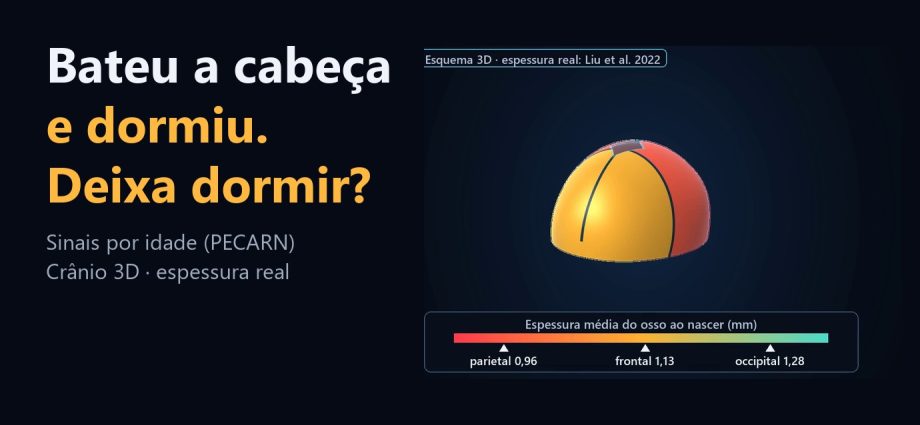
Liu e colaboradores mediram a calota craniana em tomografias de 2.068 crianças de 0 a 10 anos. Ao nascer, em meninos, o osso tem estas espessuras médias (8):
| Onde está o galo | Espessura do osso ao nascer (meninos) | O que os dados mostram | Fonte | Leitura |
|---|---|---|---|---|
| Testa (frontal) | 1,13 ± 0,25 mm | Em bebês sem sintomas, não se associou a fratura (Greenes). Abaixo de 1 ano, qualquer galo merece avaliação (NHS) | Greenes 2001; NHS; Liu 2022 | ↓ menos associado a fratura |
| Lado (parietal) | 0,96 ± 0,21 mm | Fortemente associado a fratura; conta na regra do PECARN abaixo de 2 anos | Greenes 2001; Kuppermann 2009; Liu 2022 | ↑ avaliar |
| Lado, sobre a orelha (temporal) | fora do modelo de Liu (só frontal, parietal e occipital) | Fortemente associado a fratura; conta na regra do PECARN abaixo de 2 anos | Greenes 2001; Kuppermann 2009 | ↑ avaliar |
| Atrás (occipital) | 1,28 ± 0,27 mm | Conta na regra do PECARN abaixo de 2 anos | Kuppermann 2009; Liu 2022 | ↑ avaliar |
💡 O osso de trás é o mais grosso dos três
Do lado, o osso do recém-nascido tem cerca de 1 mm. Atrás, ele é mais espesso que na testa. Então a espessura, sozinha, não explica por que o galo atrás da cabeça entra na lista de alerta. O que sustenta a regra é a associação observada nos dados do PECARN e de Greenes, e ela é de dois tipos: o galo do lado vem mais vezes junto com fratura (Greenes), e o galo fora da testa, incluindo o de trás, vem mais vezes junto com lesão na tomografia (PECARN). Por que isso acontece ainda não foi demonstrado nesses estudos.
E a moleira?
A moleira da frente fecha em idades muito diferentes de criança para criança. Numa série de 464 tomografias, ela estava fechada em 3 a 5% dos bebês aos 5 a 6 meses, em 16% aos 10 meses, em 53% aos 16 meses e em 88% aos 20 meses (17). A de trás costuma fechar até 1 a 2 meses de vida (19). Isso faz parte do motivo de o bebê ter uma regra própria. Moleira estufada depois de uma pancada é sinal para ir ao pronto-socorro (12).
5. Veja o crânio do bebê em 3D
O palco abaixo mostra a calota de um recém-nascido construída a partir das medidas reais de espessura do estudo de Liu, com a moleira e os lugares do galo que a regra do PECARN usa. Gire com o dedo ou com o mouse.
Abrir o palco 3D em tela cheia ↗
Modelo didático: a forma da calota é esquemática, desenhada para o episódio; as espessuras por osso e por idade são reais, da referência normativa de Liu e colaboradores (cuMIP, licença MIT, 8). Não é exame de paciente.
6. Seis crenças que os números desmentem
“Tem que acordar a criança de hora em hora”
A SBP diz que não, e a AAP e o NHS liberam o sono (12, 13, 15). Se o pediatra pedir checagens, a AAP fala em intervalos de 2 a 3 horas, não de hora em hora (18). Acordar a criança a noite toda não protege o cérebro e ainda atrapalha a única observação que importa: ver como ela acorda.
“Vomitou uma vez, precisa de tomografia”
Entre crianças do PECARN cujo único achado era ter vomitado, lesão clinicamente importante apareceu em 0,2%: 2 de 815 (5). Um vômito só não obriga tomografia, mas pede avaliação: o PECARN o conta a partir dos 2 anos e o NHS orienta procurar atendimento (3, 15). O alerta maior é o vômito que se repete (a SBP fala em 3 ou mais; a AAP, em mais de 2 ou 3 vezes) ou que vem junto com outro sinal da lista (12, 18).
“Galo grande é sinal de sangramento no cérebro”
Galo isolado em menores de 2 anos: 0,4% de lesão clinicamente importante e nenhuma neurocirurgia em 2.998 crianças (4). Entre 1 e 2 anos, o galo na testa preocupa menos (7); o que merece avaliação nessa idade é o galo grande do lado ou atrás da cabeça. Abaixo de 1 ano, qualquer galo na cabeça, inclusive na testa, deve ser avaliado (15).
“Desmaiou um segundo, tomografia obrigatória”
Quando a perda de consciência era o único achado, lesão clinicamente importante apareceu em 0,5%: 13 de 2.780 crianças (6). Isso diz que a tomografia nem sempre é necessária. Não diz que a criança pode ficar em casa: quem desmaiou precisa ser avaliado por médico (12, 14).
“Queda baixa não machuca”
Numa série de 50 bebês com menos de 1 ano com hematoma epidural (sangue entre o osso e a membrana que envolve o cérebro), 96% tinham caído de menos de 1 metro, e o sinal mais comum foi irritabilidade ou choro diferente do habitual, em 88% (9). Em outra série, metade dos hematomas epidurais isolados (51,4%) veio de quedas de menos de meio metro (10). A altura serve para estimar o risco; ela não garante que está tudo bem.
“Se está bem agora, está tudo bem”
Entre 106 crianças com hematoma epidural, 40% chegaram ao hospital com Glasgow 15, 4% sem nenhum sintoma e 3% só com o galo (11). É por isso que a observação continua depois que a criança parece ótima.
7. Quanto tempo observar em casa
O NHS pede um adulto junto da criança pelo menos nas primeiras 24 horas (15), e a orientação de alta do hospital do NHS em Gateshead diz para não deixá-la sozinha em casa nesse período (16). A SBP vai além: as primeiras 24 a 48 horas são as mais críticas, com um adulto em condições de levar a criança ao hospital a qualquer momento (12). A AAP também pede um adulto junto nas primeiras 24 horas e atenção por alguns dias, porque os sinais de uma lesão mais grave podem demorar a aparecer (18).
Sintomas leves, como dor de cabeça discreta, podem durar até 2 semanas; se passarem disso, procure o pediatra (15). Remédio para dormir ou sedativo, só com prescrição (15).
⚠ Volte ao pronto-socorro na hora se aparecer
- sonolência fora do normal ou dificuldade para acordar;
- vômitos: a orientação de alta do NHS de Gateshead manda voltar com qualquer vômito; a SBP fala em 3 ou mais e a AAP, em mais de 2 ou 3 vezes;
- convulsão;
- dor de cabeça que piora e não passa;
- confusão, irritação importante, fala enrolada, não reconhecer pessoas ou lugares;
- fraqueza ou dormência num braço ou numa perna, desequilíbrio, dificuldade para andar;
- visão dupla ou pupilas de tamanhos diferentes;
- sangue ou líquido claro saindo do nariz ou do ouvido;
- no bebê: choro inconsolável, recusa de mamar, mudança de comportamento, moleira estufada.
Lista reunida da SBP, da AAP e da orientação de alta do NHS de Gateshead (12, 13, 16, 18).
A linha do tempo da pancada
Da queda ao fim da observação, sem acordar ninguém à toa.
8. Bastidores: o que corrigimos antes de publicar
As vozes do filme foram gravadas duas vezes. Na primeira tomada, o pediatra dizia que “do lado e atrás o osso do bebê é mais fino”. Ao conferir os números no texto completo do estudo de Liu, a frase não se sustentou: ao nascer, o osso de trás tem 1,28 mm, mais que a testa (1,13 mm) e que o lado (0,96 mm). Descartamos as duas tomadas, PT e EN, e regravamos a fala sem a explicação do osso fino. O galo do lado ou atrás continua na lista de alerta pelo que os estudos observaram: no lado, mais fratura (Greenes); fora da testa, incluindo atrás, mais lesão na tomografia (PECARN).
O rascunho do roteiro também dizia “sangue saindo do nariz” como sinal de fratura da base do crânio. O sinal da regra é outro: líquido claro saindo do nariz, ou sangue ou líquido saindo do ouvido. Corrigido.
A terceira correção foi tirar uma explicação. A imagem clássica da artéria que se rompe embaixo do osso fino da têmpora vem do adulto, e não a confirmamos em fonte primária como o mecanismo típico do bebê. Ela saiu do filme e do 3D. Ficou o achado do PECARN, que mede uma associação e não explica a causa.
Por fim, o “menos de uma em cada cem” vale para crianças que chegaram ao pronto-socorro acordadas, com Glasgow 14 ou 15. O filme diz isso com essas palavras.
9. Perguntas frequentes
Criança bateu a cabeça e dormiu: pode deixar dormir?
Pode, se antes de dormir ela estava agindo normalmente e acorda com facilidade. SBP, AAP e NHS liberam o sono; a SBP diz que não é preciso acordar a cada hora. O sinal de alerta é a dificuldade para acordar ou uma sonolência fora do normal numa hora em que ela estaria bem desperta. Se a criança desmaiou, ela deve ser avaliada por médico antes.
Preciso acordar a criança de hora em hora depois que ela bateu a cabeça?
Não. A Sociedade Brasileira de Pediatria diz que não é necessário acordar a cada hora, e a Academia Americana de Pediatria e o NHS liberam o sono. Se o pediatra pedir checagens, a AAP fala em intervalos de 2 a 3 horas. Quando a criança acordar, observe se ela age como sempre, reconhece o ambiente e responde bem.
Bebê caiu da cama e bateu a cabeça: quando levar ao hospital?
Leve ao pronto-socorro se o bebê desmaiou, teve convulsão, ficou sonolento, agitado ou diferente do normal, tem galo do lado ou atrás da cabeça, tem um afundamento que dá para sentir, está com a moleira estufada, chora sem parar, recusa mamar, vomita repetidamente ou caiu de mais de 90 centímetros. Com menos de 1 ano, qualquer galo, inchaço ou corte na cabeça já é motivo para avaliação, e com menos de 3 meses leve sempre. Sem nenhum sinal, observe em casa com um adulto junto por pelo menos 24 horas. Queda baixa não garante que está tudo bem: os sinais valem mais que a altura.
Criança bateu a cabeça e vomitou: é grave?
Um vômito isolado, sem nenhum outro sinal, raramente indica lesão importante: no estudo PECARN, isso aconteceu em 2 de 815 crianças (0,2%). Mesmo assim, um vômito só pede avaliação: a partir dos 2 anos ele conta na regra do PECARN, e o NHS orienta procurar atendimento. Vômitos repetidos (a SBP fala em 3 ou mais; a AAP, em mais de 2 ou 3), ou vômito junto com sonolência, dor de cabeça forte ou outro sinal de alerta, são motivo para ir ao pronto-socorro.
Galo na testa é perigoso? E galo atrás da cabeça?
Entre 1 e 2 anos, o galo na testa preocupa menos que o do lado ou de trás. Abaixo de 1 ano, qualquer galo na cabeça deve ser avaliado. Galo do lado, principalmente se for grande, aparece mais vezes junto com fratura, e galo fora da testa, incluindo o de trás, aparece mais vezes junto com lesão na tomografia; os dois merecem avaliação médica. Galo isolado, sem outros sinais, teve lesão importante em 0,4% de quase 3 mil bebês, e nenhum precisou de cirurgia.
Quanto tempo devo observar a criança depois de bater a cabeça?
Pelo menos 24 horas com um adulto junto, segundo o NHS e a AAP. A SBP considera as primeiras 24 a 48 horas as mais críticas. Sintomas leves podem durar até 2 semanas; se passarem disso, procure o pediatra.
Quer construir material assim, com fonte em cada número?
A Metodologia AIMED ensina médicos a usar IA para criar aulas, filmes e ferramentas clínicas com rastreabilidade, do roteiro à conferência final.
10. Considerações Finais
Quase toda pancada na cabeça de criança é leve, e a maioria não precisa de tomografia. A criança pode dormir. O trabalho dos pais nas horas seguintes é olhar para os sinais certos, e o do médico é saber quais deles mudam a conduta em cada idade.
Este é o terceiro episódio da série AIMED 3D Bio. O anterior tratava de outra dúvida de pronto-socorro, a moeda engolida e a bateria de botão.
💡 Connecting the Dots: o número que circula é o de 42 mil crianças e menos de uma em cada cem com lesão grave. O dado que menos gente traduz está nas séries de hematoma epidural: quase todos os bebês caíram de menos de um metro, e 40% das crianças chegaram ao hospital com Glasgow 15. A regra do PECARN acerta porque olha altura, lugar do galo e comportamento ao mesmo tempo: a ausência de um sinal não tranquiliza sozinha, e a presença de qualquer um deles já pede avaliação. Quando o médico explica isso à família em linguagem de casa, ela troca o despertador de hora em hora por uma lista curta de sinais, e passa a observar aquilo que de fato muda a conduta.
Referências
- Kuppermann N, Holmes JF, Dayan PS, Hoyle JD, Atabaki SM, Holubkov R, et al. Identification of children at very low risk of clinically-important brain injuries after head trauma: a prospective cohort study. Lancet. 2009;374(9696):1160-1170. PMID 19758692. DOI: 10.1016/S0140-6736(09)61558-0
- Babl FE, Borland ML, Phillips N, Kochar A, Dalton S, McCaskill M, et al. (PREDICT). Accuracy of PECARN, CATCH, and CHALICE head injury decision rules in children: a prospective cohort study. Lancet. 2017;389(10087):2393-2402. PMID 28410792. DOI: 10.1016/S0140-6736(17)30555-X
- Babl FE, Lyttle MD, Bressan S, et al. (PREDICT). A prospective observational study to assess the diagnostic accuracy of clinical decision rules for children presenting to emergency departments after head injuries (protocol): the Australasian Paediatric Head Injury Rules Study (APHIRST). BMC Pediatr. 2014;14:148. PMID 24927811. DOI: 10.1186/1471-2431-14-148. Tabelas 1 e 2: PMC4074143
- Dayan PS, Holmes JF, Schutzman S, Schunk J, Lichenstein R, Foerster LA, et al. (PECARN). Risk of traumatic brain injuries in children younger than 24 months with isolated scalp hematomas. Ann Emerg Med. 2014;64(2):153-162. PMID 24635991. DOI: 10.1016/j.annemergmed.2014.02.003
- Dayan PS, Holmes JF, Atabaki S, Hoyle J, Tunik MG, Lichenstein R, et al. (PECARN). Association of traumatic brain injuries with vomiting in children with blunt head trauma. Ann Emerg Med. 2014;63(6):657-665. PMID 24559605. DOI: 10.1016/j.annemergmed.2014.01.009
- Lee LK, Monroe D, Bachman MC, Glass TF, Mahajan PV, Cooper A, et al. (PECARN). Isolated loss of consciousness in children with minor blunt head trauma. JAMA Pediatr. 2014;168(9):837-843. PMID 25003654. DOI: 10.1001/jamapediatrics.2014.361
- Greenes DS, Schutzman SA. Clinical significance of scalp abnormalities in asymptomatic head-injured infants. Pediatr Emerg Care. 2001;17(2):88-92. PMID 11334100. DOI: 10.1097/00006565-200104000-00002
- Liu J, Elkhill C, LeBeau S, French B, Lepore N, Linguraru MG, et al. Data-driven normative reference of pediatric cranial bone development. Plast Reconstr Surg Glob Open. 2022;10(8):e4457. PMID 35983543. DOI: 10.1097/GOX.0000000000004457
- Baş NS, Karacan M, Doruk E, Karagoz Guzey F. Management of traumatic epidural hematoma in infants younger than one year: 50 cases. Single center experience. Pediatr Neurosurg. 2021;56(3):213-220. PMID 33831866. DOI: 10.1159/000514810
- Browne GJ, Lam LT. Isolated extradural hematoma in children presenting to an emergency department in Australia. Pediatr Emerg Care. 2002;18(2):86-90. PMID 11973498. DOI: 10.1097/00006565-200204000-00006
- Cremonini C, Lewis M, Wong MD, Benjamin ER, Inaba K, Demetriades D. Traumatic epidural hematomas in the pediatric population: clinical characteristics and diagnostic pitfalls. J Pediatr Surg. 2020;55(9):1773-1778. PMID 32553454. DOI: 10.1016/j.jpedsurg.2020.05.011
- Sociedade Brasileira de Pediatria, Departamento Científico de Emergência Pediátrica. Traumatismo cranioencefálico leve na infância. Pediatria para Famílias, outubro de 2025; consultado em 16/11/2026. Disponível em: sbp.com.br/pediatria-para-familias
- American Academy of Pediatrics. Concussions. HealthyChildren.org, atualizado em 05/12/2024; consultado em 16/11/2026. Disponível em: healthychildren.org
- American Academy of Pediatrics. Loss of Consciousness. HealthyChildren.org, atualizado em 30/07/2024; consultado em 16/11/2026. Disponível em: healthychildren.org
- NHS. Head injury and concussion. Revisado em 29/05/2025; consultado em 16/11/2026. Disponível em: nhs.uk
- Gateshead Health NHS Foundation Trust. Head Injury Advice for Carers of Children Under 16 Years Old (orientação de alta para cuidadores). Atualizado em 22/04/2025; consultado em 16/11/2026. Disponível em: gatesheadhealth.nhs.uk
- Pindrik J, Ye X, Ji BG, Pendleton C, Ahn ES. Anterior fontanelle closure and size in full-term children based on head computed tomography. Clin Pediatr (Phila). 2014;53(12):1149-1157. PMID 24920348. DOI: 10.1177/0009922814538492
- American Academy of Pediatrics. Head Injury. HealthyChildren.org, atualizado em 10/12/2024; consultado em 16/11/2026. Disponível em: healthychildren.org
- MedlinePlus (U.S. National Library of Medicine). Cranial sutures. Medical Encyclopedia, revisado em 01/01/2025; consultado em 16/11/2026. Disponível em: medlineplus.gov
- Da Dalt L, Parri N, Amigoni A, Nocerino A, Selmin F, Manara R, et al. Italian guidelines on the assessment and management of pediatric head injury in the emergency department. Ital J Pediatr. 2018;44(1):7. PMID 29334996. DOI: 10.1186/s13052-017-0442-0
- National Institute for Health and Care Excellence. Head injury: assessment and early management (NG232). 2023. Disponível em: nice.org.uk/guidance/ng232
My child hit their head and fell asleep: can I let them sleep? When to go to the hospital
Yes, if before falling asleep the child was acting as usual and wakes up easily. When a child has hit their head, sleep does not make the injury worse, and the Brazilian Society of Pediatrics states plainly that there is no need to wake them every hour. The American Academy of Pediatrics and England’s NHS also say sleep is fine. What sends a child to hospital is a set of signs, and those signs change with age. Below are the signs emergency departments use, split for babies and for older children, with the source of every number.
📅 Published November 2026
Table of Contents
From the bump on the living-room floor to the decision about the ER, and what to watch in the hours that follow.
- 1. Child hit their head: can I let them sleep?
- 2. The film
- 3. When to go to the hospital: signs by age
- 4. A bump on the forehead or on the side and back
- 5. See the baby’s skull in 3D
- 6. Six beliefs the numbers disprove
- 7. How long to watch at home
- 8. Behind the scenes: what we fixed before publishing
- 9. Frequently asked questions
- 10. Final Considerations
- 11. References
1. Child hit their head: can I let them sleep?
Eight in the evening. An 18-month-old boy slips off the couch, hits his head on the floor, cries loudly, nurses and falls asleep in his mother’s arms. She picks up her phone and types “toddler hit head can he sleep”. In Google’s autocomplete, in Portuguese and in English, this question shows up among the first suggestions about head bumps. And the wrong answer still circulates: some pages online tell parents to keep the child awake for hours.
The Brazilian Society of Pediatrics (SBP) answers the question in its October 2025 material for families with a “Yes”, followed by “there is no need to wake him every hour” (12). When the child wakes up, parents check that they act as usual, recognize their surroundings and respond well.
The American Academy of Pediatrics says the child can sleep. Its page on concussion says you won’t have to wake your child periodically and sends you to the emergency department right away if the child looks very drowsy or cannot be awakened (13). Its page on head injury, meant for children aged 2 and older, says your child’s doctor may recommend a check every 2 to 3 hours, to make sure they move normally, wake enough to recognize you and respond (18). The NHS says the same: nobody needs to stay awake if they are tired, as long as an adult stays with the child for at least the first 24 hours (15).
Translating this to the middle of the night at home
Sleep itself does no harm. The sign that matters is a child who is hard to wake, or who becomes drowsy at a time they would normally be wide awake. The discharge advice for carers from one NHS hospital, Gateshead, even gives a measure: drowsiness lasting more than 1 hour when the child would normally be wide awake, or difficulty waking them, is a reason to go back to the emergency department (16).
⚠ One exception
If the child passed out, even for a few seconds, they need to be assessed first. The AAP page on loss of consciousness says that only after that assessment, when the clinician judges a more serious injury unlikely, may they say it is fine to let the child sleep (14).
2. The film
Under ninety seconds, in vertical format: a mother on the phone in the middle of the night and an on-call pediatrician answering, with the baby’s skull in 3D. If you prefer to read, everything the film says is in the sections below, with the source of every number.
3. When to go to the hospital: signs by age
The signs in this section come from PECARN, the US pediatric emergency care research network. The study followed 42,412 children under 18 who reached the emergency department conscious, with a Glasgow score of 14 or 15 (15 is normal), within 24 hours of the injury. Clinically important brain injury occurred in 0.9% of them, fewer than one in a hundred, and 0.1% needed neurosurgery (1). From these data the group built two rules, one for children under 2 and another for those aged 2 and older, to identify children at very low risk in whom a CT scan can be avoided.
In 2017 the rule was tested again in a study of 20,137 children at 10 centers in Australia and New Zealand (the PECARN rule could be applied to about 15,000 of them) and kept performing: it missed none of the 38 serious cases under age 2 and missed 1 of 98 in older children (2).
Baby under 2: go to the emergency department if they
- passed out, even briefly;
- are drowsy, agitated, slow to respond or not their usual self;
- have a bump on the side or back of the head (not the forehead), especially a large one;
- have a dent in the bone you can feel, or you are not sure whether you feel one;
- fell from higher than 90 centimeters (about 3 feet), or the injury came from a severe mechanism (see the box below);
- cry nonstop, refuse to feed or eat, or have changed their behavior since the bump (12, 13);
- are under 1 year old and have any bump, swelling or cut on the head, including the forehead: for young babies the NHS says to get help right away (15). Under 3 months, always get them checked: at that age the risk of injury is higher even after small falls, and PECARN weighs age under 3 months in the CT decision (20).
Child aged 2 or older: go to the emergency department if they
- passed out;
- vomited: a single episode already calls for a check, because PECARN counts any vomiting at this age and the NHS advises getting help; 3 or more times (SBP) or more than 2 or 3 times (AAP) means the emergency department (3, 12, 15, 18);
- have a severe headache;
- are drowsy, confused, agitated, keep asking the same question or are slow to respond;
- fell from higher than 1.5 meters (about 5 feet), or the injury came from a severe mechanism;
- have clear fluid coming from the nose, blood or fluid coming from the ear, or bruising behind the ear or around the eyes.
At any age, go to the emergency department if they
- had a seizure (12, 15, 18);
- vomited several times, babies included: SBP says 3 or more episodes, and AAP, more than 2 or 3 (12, 18);
- in a baby, have a bulging soft spot (12);
- have pupils of different sizes (18);
- have weakness in an arm or a leg, or started seeing double (12, 15, 18);
- have a bleeding disorder or take blood-thinning medicine, have a shunt (valve) in the brain or have a pre-existing neurological condition: these children were left out when the PECARN rule was built, and the NHS asks for urgent help for anyone on blood thinners (3, 15);
- may have been abused, for example when the story of the fall does not explain the injury: suspected non-accidental injury is a CT criterion in the English CHALICE rule and in NICE (3, 21).
💡 What PECARN calls a “severe mechanism”
The definition is the same for both ages; only the fall height changes (3):
- motor vehicle crash with the child ejected, death of another passenger or rollover;
- pedestrian, or cyclist without a helmet, struck by a motorized vehicle;
- fall of more than 0.9 m (about 3 feet) under age 2, or more than 1.5 m (about 5 feet) from age 2;
- head struck by a high-impact object.
For the colleague on call
Under 2 years (1; definitions as in the PREDICT protocol table, 3): altered mental status (Glasgow < 15, agitation, somnolence, repetitive questioning or slow response to verbal communication), occipital, parietal or temporal scalp hematoma, palpable or unclear skull fracture, loss of consciousness of 5 seconds or more, not acting normally per parent, and severe mechanism with a fall > 0.9 m.
2 years and older (1, 3): altered mental status, signs of basilar skull fracture (Battle’s sign, raccoon eyes, hemotympanum, CSF otorrhea or rhinorrhea), loss of consciousness, vomiting, severe headache, and severe mechanism with a fall > 1.5 m.
The derivation population had Glasgow 14 or 15 and injuries within 24 hours; Glasgow 14 already counts as altered mental status. The split between intermediate and high risk, which guides observation versus CT, is in the original article (1). In the PREDICT validation, sensitivity for clinically important injury was 100% (95% CI 90.7–100; 38/38) under 2 years and 99.0% (95% CI 94.4–100; 97/98) from 2 years, with negative predictive value above 99% (2).
Excluded from PECARN: trivial mechanism, penetrating trauma, brain tumor, pre-existing neurological disorder complicating assessment and prior neuroimaging at another hospital. Children with a ventricular shunt, a bleeding disorder or GCS < 14 were enrolled but analyzed separately and kept out of the rule derivation (3). Suspected non-accidental trauma follows its own protocol; in CHALICE and NICE it is a CT criterion (3, 21). Under 1 year, CHALICE also uses bruise, swelling or laceration > 5 cm on the head (3), and in PECARN’s intermediate-risk group age < 3 months weighs in favor of CT (20).
⚠ Two cautions about the numbers
PECARN’s height thresholds are 0.9 m and 1.5 m. Summaries that round them to “1 m and 2 m” are wrong, and “a fall of more than 3 m” belongs to another rule, CHALICE (3). The NHS, writing for parents, uses a lower cutoff for every age: a fall from more than 1 metre or 5 stairs (15). These are different rules built for different jobs: PECARN sorts which children already in the emergency department need a CT scan; the NHS tells families when to call for help. When in doubt, the lower cutoff applies.
The rule was built for the physician deciding on a CT scan in the emergency department, not for parents to apply at home. For families, the list of signs above is what counts. This text is educational: the decision about each child belongs to the physician who examines them.
4. A bump on the forehead or on the side and back
“Is a bump on the forehead dangerous?” also shows up among autocomplete suggestions when parents search for head bumps. In the data, where the bump is weighs more than how big it looks in the mirror.
Greenes and Schutzman studied 422 infants aged 0 to 24 months with no symptoms after a head injury. Parietal and temporal bumps were strongly associated with skull fracture; frontal ones were not. The risk rose with the size of the bump and, slightly, the younger the baby (7).
PECARN itself analyzed 2,998 children under 24 months whose only finding was the bump. Clinically important brain injury occurred in 0.4%, and none needed neurosurgery. When there was injury on CT, it was associated with younger age, a bump away from the forehead, a larger bump and a severe mechanism (4).
What about bone thickness?
Liu and colleagues measured the skull vault on CT scans of 2,068 children aged 0 to 10 years. At birth, in boys, the bone has these mean thicknesses (8):
| Where the bump is | Bone thickness at birth (boys) | What the data show | Source | Reading |
|---|---|---|---|---|
| Forehead (frontal) | 1.13 ± 0.25 mm | In infants without symptoms, not associated with fracture (Greenes). Under 1 year, any bump needs a check (NHS) | Greenes 2001; NHS; Liu 2022 | ↓ less linked to fracture |
| Side (parietal) | 0.96 ± 0.21 mm | Strongly associated with fracture; part of the PECARN rule under age 2 | Greenes 2001; Kuppermann 2009; Liu 2022 | ↑ get it checked |
| Side, above the ear (temporal) | outside Liu’s model (frontal, parietal and occipital only) | Strongly associated with fracture; part of the PECARN rule under age 2 | Greenes 2001; Kuppermann 2009 | ↑ get it checked |
| Back (occipital) | 1.28 ± 0.27 mm | Part of the PECARN rule under age 2 | Kuppermann 2009; Liu 2022 | ↑ get it checked |
💡 The bone at the back is the thickest of the three
On the side, a newborn’s skull is about 1 mm thick. At the back, it is thicker than at the forehead. So thickness alone does not explain why a bump on the back of the head is on the warning list. What supports the rule is the association observed in the PECARN and Greenes data, and it comes in two kinds: a bump on the side comes with a fracture more often (Greenes), and a bump away from the forehead, including the back, comes with injury on CT more often (PECARN). Why that happens has not been shown in these studies.
And the soft spot?
The front soft spot closes at very different ages from one child to another. In a series of 464 CT scans, it was closed in 3 to 5% of babies at 5 to 6 months, 16% at 10 months, 53% at 16 months and 88% at 20 months (17). The back one usually closes by 1 to 2 months of age (19). That is part of the reason babies have their own rule. A bulging soft spot after a head bump is a reason to go to the emergency department (12).
5. See the baby’s skull in 3D
The stage below shows a newborn’s skull vault built from the real thickness measurements in Liu’s study, with the soft spot and the bump locations the PECARN rule uses. Rotate it with your finger or mouse.
Open the 3D stage full screen ↗
Teaching model: the shape of the skull cap is schematic, drawn for this episode; the bone thickness by bone and by age is real, from the normative reference by Liu and colleagues (cuMIP, MIT license, 8). It is not a patient scan.
6. Six beliefs the numbers disprove
“You have to wake the child every hour”
SBP says you don’t, and the AAP and NHS say sleep is fine (12, 13, 15). If the pediatrician asks for checks, the AAP talks about every 2 to 3 hours, not every hour (18). Waking a child all night does not protect the brain, and it gets in the way of the one observation that matters: seeing how they wake up.
“Vomited once, needs a CT scan”
Among PECARN children whose only finding was vomiting, clinically important injury occurred in 0.2%: 2 of 815 (5). A single episode does not mean a CT scan, but it does call for a check: PECARN counts it from age 2 and the NHS advises getting help (3, 15). The bigger warning sign is vomiting that repeats (SBP says 3 or more times; AAP, more than 2 or 3 times) or that comes with another sign on the list (12, 18).
“A big bump means bleeding in the brain”
Isolated bump in children under 2: 0.4% clinically important injury and no neurosurgery in 2,998 children (4). Between 1 and 2 years, a bump on the forehead is less worrying (7); what deserves a check at that age is a large bump on the side or back of the head. Under 1 year, any bump on the head, including the forehead, should be checked (15).
“Passed out for a second, CT scan required”
When loss of consciousness was the only finding, clinically important injury occurred in 0.5%: 13 of 2,780 children (6). That means a CT scan is not always needed. It does not mean the child can stay home: a child who passed out needs to be seen by a doctor (12, 14).
“A low fall can’t hurt”
In a series of 50 babies under 1 year with an epidural hematoma (blood between the bone and the membrane around the brain), 96% had fallen less than 1 meter, and the most common sign was irritability or unusual crying, in 88% (9). In another series, half of isolated epidural hematomas (51.4%) came from falls of less than half a meter (10). Height helps estimate risk; it does not guarantee that all is well.
“If they’re fine now, they’re fine”
Among 106 children with an epidural hematoma, 40% arrived at hospital with Glasgow 15, 4% had no symptoms at all and 3% had only the bump (11). That is why observation continues after the child seems perfectly well.
7. How long to watch at home
The NHS asks for an adult to stay with the child for at least the first 24 hours (15), and the discharge advice from the NHS hospital in Gateshead says not to leave the child alone at home during that time (16). SBP goes further: the first 24 to 48 hours are the most critical, with an adult able to take the child to hospital at any moment (12). The AAP also asks for an adult to stay with the child for the first 24 hours and for close watching over a few days, because signs of a more serious injury can be delayed (18).
Mild symptoms, such as a slight headache, can last up to 2 weeks; if they go on longer, see the pediatrician (15). Sleeping pills or sedatives only with a prescription (15).
⚠ Go back to the emergency department right away if you see
- unusual drowsiness or difficulty waking up;
- vomiting: the Gateshead NHS discharge advice says to come back with any vomiting; SBP says 3 or more times and AAP, more than 2 or 3 times;
- a seizure;
- a headache that gets worse and won’t go away;
- confusion, marked irritability, slurred speech, not recognizing people or places;
- weakness or numbness in an arm or leg, loss of balance, difficulty walking;
- double vision or pupils of different sizes;
- blood or clear fluid coming from the nose or ear;
- in babies: inconsolable crying, refusing to feed, a change in behavior, a bulging soft spot.
Combined list from SBP, the AAP and the Gateshead NHS discharge advice (12, 13, 16, 18).
The timeline of a head bump
From the fall to the end of observation, without waking anyone for nothing.
8. Behind the scenes: what we fixed before publishing
The film’s voices were recorded twice. In the first take, the pediatrician said that “on the side and at the back, a baby’s bone is thinner”. When we checked the numbers against the full text of Liu’s study, the sentence did not hold up: at birth, the bone at the back is 1.28 mm, thicker than the forehead (1.13 mm) and the side (0.96 mm). We discarded both takes, PT and EN, and re-recorded the line without the thin-bone explanation. A bump on the side or back stays on the warning list because of what the studies observed: on the side, more fractures (Greenes); away from the forehead, including the back, more injury on CT (PECARN).
The script draft also listed “blood from the nose” as a sign of skull base fracture. The sign in the rule is different: clear fluid from the nose, or blood or fluid from the ear. Fixed.
The third correction was removing an explanation. The classic picture of an artery tearing under the thin bone of the temple comes from adults, and we did not confirm in a primary source that it is the typical mechanism in babies. It came out of the film and the 3D. What stayed is the PECARN finding, which measures an association and does not explain the cause.
Finally, “fewer than one in a hundred” applies to children who reached the emergency department awake, with Glasgow 14 or 15. The film says so in those words.
9. Frequently asked questions
My child hit their head and fell asleep: can I let them sleep?
Yes, if before falling asleep the child was acting normally and wakes up easily. SBP, AAP and NHS say sleep is fine; SBP says there is no need to wake the child every hour. The warning sign is difficulty waking up, or unusual drowsiness at a time they would normally be wide awake. If the child passed out, a doctor should assess them first.
Do I need to wake my child every hour after a head bump?
No. The Brazilian Society of Pediatrics says there is no need to wake the child every hour, and the American Academy of Pediatrics and the NHS say sleep is fine. If the pediatrician asks for checks, the AAP talks about every 2 to 3 hours. When the child wakes up, check that they act as usual, recognize their surroundings and respond well.
Baby fell off the bed and hit their head: when should I go to the hospital?
Go to the emergency department if the baby passed out, had a seizure, became drowsy, agitated or not their usual self, has a bump on the side or back of the head, has a dent you can feel, has a bulging soft spot, cries nonstop, refuses to feed, vomits repeatedly or fell from higher than 90 centimeters (about 3 feet). Under 1 year, any bump, swelling or cut on the head is reason for a check, and under 3 months always get them checked. With no signs, watch at home with an adult close by for at least 24 hours. A low fall does not guarantee that all is well: the signs matter more than the height.
My child hit their head and threw up: is it serious?
A single episode of vomiting, with no other sign, rarely points to a significant injury: in the PECARN study, that happened in 2 of 815 children (0.2%). Even so, a single episode calls for a check: from age 2 it counts in the PECARN rule, and the NHS advises getting help. Repeated vomiting (SBP says 3 or more times; AAP, more than 2 or 3), or vomiting together with drowsiness, a severe headache or another warning sign, is a reason to go to the emergency department.
Is a bump on the forehead dangerous? What about a bump on the back of the head?
Between 1 and 2 years, a bump on the forehead is less worrying than one on the side or back. Under 1 year, any bump on the head should be checked. A bump on the side, especially a large one, comes with a fracture more often, and a bump away from the forehead, including the back, comes with injury on CT more often; both deserve a medical check. An isolated bump, with no other signs, came with a significant injury in 0.4% of nearly 3,000 babies, and none needed surgery.
How long should I watch my child after a head bump?
At least 24 hours with an adult close by, according to the NHS and the AAP. SBP considers the first 24 to 48 hours the most critical. Mild symptoms can last up to 2 weeks; if they go on longer, see the pediatrician.
Want to build material like this, with a source for every number?
The AIMED Methodology teaches physicians to use AI to create lessons, films and clinical tools with traceability, from script to final check.
10. Final Considerations
Almost every head bump in a child is minor, and most do not need a CT scan. The child can sleep. The parents’ job in the following hours is to look for the right signs, and the physician’s job is to know which of them change management at each age.
This is the third episode of the AIMED 3D Bio series. The previous one dealt with another emergency-room question, the swallowed coin and the button battery.
💡 Connecting the Dots: the number that gets shared is 42,000 children and fewer than one in a hundred with a serious injury. The figure fewer people translate sits in the epidural hematoma series: almost all the babies fell less than one meter, and 40% of the children reached hospital with Glasgow 15. The PECARN rule works because it looks at height, bump location and behavior together: the absence of one sign does not reassure on its own, and the presence of any of them calls for a medical check. When the physician explains this to the family in everyday language, they swap the hourly alarm clock for a short list of signs, and start watching for what actually changes management.
References
- Kuppermann N, Holmes JF, Dayan PS, Hoyle JD, Atabaki SM, Holubkov R, et al. Identification of children at very low risk of clinically-important brain injuries after head trauma: a prospective cohort study. Lancet. 2009;374(9696):1160-1170. PMID 19758692. DOI: 10.1016/S0140-6736(09)61558-0
- Babl FE, Borland ML, Phillips N, Kochar A, Dalton S, McCaskill M, et al. (PREDICT). Accuracy of PECARN, CATCH, and CHALICE head injury decision rules in children: a prospective cohort study. Lancet. 2017;389(10087):2393-2402. PMID 28410792. DOI: 10.1016/S0140-6736(17)30555-X
- Babl FE, Lyttle MD, Bressan S, et al. (PREDICT). A prospective observational study to assess the diagnostic accuracy of clinical decision rules for children presenting to emergency departments after head injuries (protocol): the Australasian Paediatric Head Injury Rules Study (APHIRST). BMC Pediatr. 2014;14:148. PMID 24927811. DOI: 10.1186/1471-2431-14-148. Tables 1 and 2: PMC4074143
- Dayan PS, Holmes JF, Schutzman S, Schunk J, Lichenstein R, Foerster LA, et al. (PECARN). Risk of traumatic brain injuries in children younger than 24 months with isolated scalp hematomas. Ann Emerg Med. 2014;64(2):153-162. PMID 24635991. DOI: 10.1016/j.annemergmed.2014.02.003
- Dayan PS, Holmes JF, Atabaki S, Hoyle J, Tunik MG, Lichenstein R, et al. (PECARN). Association of traumatic brain injuries with vomiting in children with blunt head trauma. Ann Emerg Med. 2014;63(6):657-665. PMID 24559605. DOI: 10.1016/j.annemergmed.2014.01.009
- Lee LK, Monroe D, Bachman MC, Glass TF, Mahajan PV, Cooper A, et al. (PECARN). Isolated loss of consciousness in children with minor blunt head trauma. JAMA Pediatr. 2014;168(9):837-843. PMID 25003654. DOI: 10.1001/jamapediatrics.2014.361
- Greenes DS, Schutzman SA. Clinical significance of scalp abnormalities in asymptomatic head-injured infants. Pediatr Emerg Care. 2001;17(2):88-92. PMID 11334100. DOI: 10.1097/00006565-200104000-00002
- Liu J, Elkhill C, LeBeau S, French B, Lepore N, Linguraru MG, et al. Data-driven normative reference of pediatric cranial bone development. Plast Reconstr Surg Glob Open. 2022;10(8):e4457. PMID 35983543. DOI: 10.1097/GOX.0000000000004457
- Baş NS, Karacan M, Doruk E, Karagoz Guzey F. Management of traumatic epidural hematoma in infants younger than one year: 50 cases. Single center experience. Pediatr Neurosurg. 2021;56(3):213-220. PMID 33831866. DOI: 10.1159/000514810
- Browne GJ, Lam LT. Isolated extradural hematoma in children presenting to an emergency department in Australia. Pediatr Emerg Care. 2002;18(2):86-90. PMID 11973498. DOI: 10.1097/00006565-200204000-00006
- Cremonini C, Lewis M, Wong MD, Benjamin ER, Inaba K, Demetriades D. Traumatic epidural hematomas in the pediatric population: clinical characteristics and diagnostic pitfalls. J Pediatr Surg. 2020;55(9):1773-1778. PMID 32553454. DOI: 10.1016/j.jpedsurg.2020.05.011
- Sociedade Brasileira de Pediatria (Brazilian Society of Pediatrics), Scientific Department of Pediatric Emergency. Traumatismo cranioencefálico leve na infância (Mild head injury in childhood). Pediatria para Famílias, October 2025; accessed 16 Nov 2026. Available at: sbp.com.br/pediatria-para-familias
- American Academy of Pediatrics. Concussions. HealthyChildren.org, updated 5 Dec 2024; accessed 16 Nov 2026. Available at: healthychildren.org
- American Academy of Pediatrics. Loss of Consciousness. HealthyChildren.org, updated 30 Jul 2024; accessed 16 Nov 2026. Available at: healthychildren.org
- NHS. Head injury and concussion. Reviewed 29 May 2025; accessed 16 Nov 2026. Available at: nhs.uk
- Gateshead Health NHS Foundation Trust. Head Injury Advice for Carers of Children Under 16 Years Old (discharge advice for carers). Updated 22 Apr 2025; accessed 16 Nov 2026. Available at: gatesheadhealth.nhs.uk
- Pindrik J, Ye X, Ji BG, Pendleton C, Ahn ES. Anterior fontanelle closure and size in full-term children based on head computed tomography. Clin Pediatr (Phila). 2014;53(12):1149-1157. PMID 24920348. DOI: 10.1177/0009922814538492
- American Academy of Pediatrics. Head Injury. HealthyChildren.org, updated 10 Dec 2024; accessed 16 Nov 2026. Available at: healthychildren.org
- MedlinePlus (U.S. National Library of Medicine). Cranial sutures. Medical Encyclopedia, reviewed 1 Jan 2025; accessed 16 Nov 2026. Available at: medlineplus.gov
- Da Dalt L, Parri N, Amigoni A, Nocerino A, Selmin F, Manara R, et al. Italian guidelines on the assessment and management of pediatric head injury in the emergency department. Ital J Pediatr. 2018;44(1):7. PMID 29334996. DOI: 10.1186/s13052-017-0442-0
- National Institute for Health and Care Excellence. Head injury: assessment and early management (NG232). 2023. Available at: nice.org.uk/guidance/ng232
◆ Novidades
- Engoliu uma moeda. Aonde ela vai?NOVO
- Um ventrículo, três idades: o ventrículo único em corações reaisNOVO
- Cateter à esquerda da coluna: mal posicionado ou cava esquerda?