
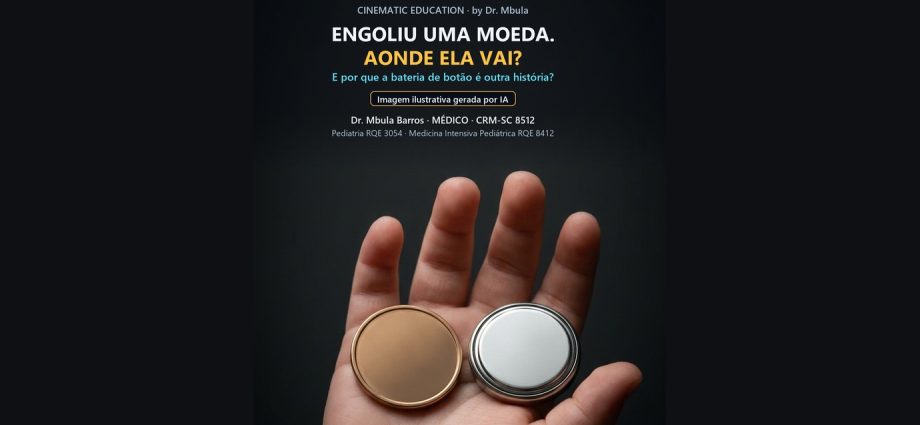
Engoliu uma moeda. Aonde ela vai?
A moeda e a bateria de botão têm quase o mesmo tamanho, o mesmo brilho e chegam ao pronto-socorro com a mesma frase dos pais: “acho que ela engoliu uma moeda”. A moeda costuma travar no primeiro estreitamento do esôfago e dá tempo de agir com calma. A bateria de lítio de 20 mm não dá: em cerca de duas horas ela pode queimar o esôfago, sem vazar nada. Abri o caminho em 3D para mostrar onde cada uma para, como separar as duas no raio X e o que fazer no carro, a caminho do hospital.
📅 Publicado em novembro de 2026
Navegue pelo Artigo
Da sala de casa ao endoscópio: o trajeto da moeda, o relógio da bateria e a decisão no raio X.
1. A frase que chega ao pronto-socorro
Domingo à tarde. Uma criança de dois anos estava brincando no chão da sala, perto do controle remoto e do pote de moedas. A mãe chega à emergência com ela no colo e diz: “acho que engoliu uma moeda, mas ela está bem”. Quem já deu plantão de pediatria ouviu essa frase dezenas de vezes, e na maioria delas era mesmo uma moeda.
A moeda é o corpo estranho que crianças mais engolem. Nos Estados Unidos, o relatório da NASPGHAN conta mais de 250.000 ingestões e 20 mortes em um período de 10 anos (1). O problema é que a bateria de botão de lítio, do controle remoto, da balança e da chave do carro, tem quase o mesmo diâmetro. Quando ninguém viu o que a criança pôs na boca, as duas começam com a mesma história e terminam em relógios muito diferentes.
Este texto acompanha o episódio 2 da série AIMED 3D Bio. Serve ao colega de plantão e também aos pais: está escrito para os dois.
2. O filme
Menos de noventa segundos, em formato vertical, com o modelo 3D, o raio X esquemático e o protocolo do mel. Se preferir ler, tudo o que o filme diz está nas seções abaixo, com a fonte de cada número.
3. O caminho da moeda
O esôfago da criança tem três estreitamentos fisiológicos, e é neles que a moeda e outros objetos rombos costumam parar (1):
- Cricofaríngeo, na entrada do tórax (esfíncter esofágico superior). É onde a moeda mais para.
- Arco aórtico, no esôfago médio, onde a aorta cruza por trás.
- Junção esofagogástrica, logo antes do estômago.
Moedas maiores que 23,5 mm têm chance bem maior de ficar presas, principalmente em crianças com menos de 5 anos (1).
O prazo depende de onde ela está e de como a criança está
A NASPGHAN usa três janelas para a endoscopia: emergente (menos de 2 horas, mesmo sem jejum), urgente (menos de 24 horas, respeitando o jejum) e eletiva (mais de 24 horas) (1). Para a moeda, a tabela fica assim:
| Onde está | Como está a criança | Conduta | Fonte | Leitura |
|---|---|---|---|---|
| Moeda no esôfago | Sem sintomas | Retirada endoscópica urgente, em menos de 24 h | Kramer 2015, Tabela 1 | → urgente |
| Moeda no esôfago | Com sintomas: salivação, não engole a saliva, dor, vômitos, desconforto respiratório | Retirada emergente, em menos de 2 h | Kramer 2015, Tabela 1 | ↑ emergente |
| Moeda no estômago | Sem sintomas | A maioria passa sozinha. Pais observam as fezes, raio X a cada 1 a 2 semanas; retirada eletiva só se continuar no estômago depois de 2 a 4 semanas ou se surgirem sintomas | Kramer 2015, seção Coins e Tabela 1 | ↓ expectante |
| Bateria de botão no esôfago | Com ou sem sintomas | Retirada emergente, em menos de 2 h | Kramer 2015, Tabela 1; NCPC item 5e | ⚠ emergência |
💡 Traduzindo a tabela para os pais
Se a moeda já desceu para o estômago e a criança está comendo, brincando e sem dor, quase sempre basta esperar e acompanhar. Se ela ficou no esôfago, alguém vai precisar tirar, e quanto mais sintomas, mais cedo. A última linha é o motivo deste episódio: bateria no esôfago não espera, com ou sem sintoma.
4. Por que a bateria queima sem vazar
Muita gente imagina que a bateria faz mal porque vaza ácido. A bateria de lítio em formato de moeda não precisa vazar. Quando ela encosta na mucosa úmida do esôfago, a própria mucosa fecha um circuito elétrico externo entre os dois polos. A corrente faz eletrólise dos líquidos do tecido e acumula hidróxido, que é alcalino, no polo negativo, o lado mais estreito da bateria (2, 4). O resultado é uma necrose de liquefação que avança enquanto a bateria estiver ali.
A bateria mais envolvida nas lesões graves de esôfago é a célula de lítio de 20 mm e 3 V, o dobro da tensão de uma pilha alcalina comum de 1,5 V (2, 4). A lesão é mais intensa no tecido encostado ao polo negativo (4).
O relógio
Litovitz e colaboradores descreveram queimaduras graves, com sequela, em 2 a 2,5 horas (2). O guia do National Capital Poison Center resume em “2 horas” (4). No filme e no 3D usamos “~2 horas”, a forma mais conservadora. A lesão pode continuar avançando mesmo depois da retirada, com perfuração, fístula traqueoesofágica e fístula para a aorta descritas na série de Litovitz (2).
Um exemplo concreto: o mesmo disco, dois comportamentos
Pense numa moeda de 21 mm e numa bateria de 20 mm presas no mesmo ponto do esôfago. A moeda é metal parado: machuca por pressão, devagar. A bateria é uma pilha ligada, com a mucosa fazendo o papel do fio. Por isso a tabela da seção anterior dá até 24 horas para uma moeda sem sintomas e menos de 2 horas para qualquer bateria no esôfago.
⚠ Quem mais se machuca
Na série de Litovitz, os piores desfechos se concentraram em células de lítio de 20 mm ou mais e em crianças com menos de 4 anos. A proporção de desfechos graves ou fatais cresceu 6,7 vezes entre 1985 e 2009, e as células de lítio passaram de 1,3% para 24% das baterias engolidas entre 1990 e 2008 (2).
5. No raio X, a bateria se passa por moeda
Aqui está a armadilha. Na série de Litovitz, 92% das mortes e 56% dos casos graves não tiveram a ingestão testemunhada, e o diagnóstico inicial estava errado em pelo menos 27% dos casos graves e 54% dos fatais (2).
Sempre duas incidências: frente (AP) e perfil
A NASPGHAN recomenda radiografia em dois planos, AP e perfil, de pescoço, tórax e abdome na suspeita de corpo estranho radiopaco (1). O NCPC repete: para bateria no esôfago, AP e perfil (4).
Esôfago ou traqueia
No raio X de frente, um disco no esôfago costuma aparecer aberto, como um círculo inteiro. Na traqueia, que fica na frente e tem anéis em C, ele tende a aparecer de perfil, como uma linha (1). É um padrão típico, não uma regra absoluta, e é por isso que o perfil confirma.
Moeda ou bateria
- De frente (AP): a moeda tem borda única e densidade uniforme. A bateria mostra um duplo contorno, um anel dentro do outro, o sinal do duplo halo (1, 4).
- De perfil: a moeda tem borda reta e simétrica. A bateria mostra um degrau (step-off) entre os dois polos. O lado do degrau é o polo negativo, onde a lesão é mais profunda (1, 4).
O NCPC pede para dar zoom na borda de todo disco (4). Para estimar o tamanho, compara com a moeda americana de 1 centavo (19 mm) e a de 5 centavos (21 mm): a bateria de 20 mm fica entre as duas (4).
Traduzindo para o chão do plantão
Todo disco no esôfago de criança é bateria até que o zoom na borda e o perfil provem que é moeda. Ler só o raio X de frente, achar o círculo e escrever “moeda” é o atalho que o perfil e o zoom na borda existem para impedir.
Outro raio X de tórax que engana quem lê com pressa está no episódio sobre o cateter à esquerda da coluna.
6. Gire o esôfago em 3D
O palco abaixo mostra o tórax esquemático de uma criança de 2 a 3 anos, em cinco passos: os três estreitamentos, a moeda presa no esôfago e a moeda que chegou ao estômago, o raio X esquemático de frente e de perfil, o mecanismo da bateria no relógio de ~2 horas e a conduta a caminho do pronto-socorro. Gire com o dedo ou com o mouse.
Abrir o palco 3D em tela cheia ↗
Modelo esquemático, construído em código: não é anatomia de paciente. O raio X é um diagrama educativo, não um exame.
7. A caminho do pronto-socorro
⚠ Se pode ter sido uma bateria de botão
Vá para o pronto-socorro agora. Não induza vômito (4). Fora o mel descrito abaixo, nada pela boca até o raio X mostrar que a bateria não está no esôfago (4).
O mel: quando dar
O guia do National Capital Poison Center orienta dar mel imediatamente, já no trajeto, quando todas as condições abaixo estiverem presentes (4):
☐ Os cinco critérios do NCPC
A dose
10 mL de mel (2 colheres de chá) pela boca a cada 10 minutos, até 6 doses, sem atrasar a chegada ao hospital (4).
Por que funciona, e até onde
O mel reveste a bateria e reduz a formação local de hidróxido, o que atrasa a queimadura alcalina (4). A base é o estudo de Anfang e colaboradores, em esôfago de porco com bateria de lítio de 3 V (CR2032): irrigações de 10 mL a cada 10 minutos com mel ou sucralfato reduziram de forma significativa a lesão de espessura total e a necrose muscular profunda (P < 0,05) (3). O mel atrasa a lesão, mas não a impede, e não substitui a retirada imediata da bateria no esôfago (4).
Para o colega, já no hospital
O NCPC também prevê sucralfato (1 g/10 mL), 10 mL pela boca a cada 10 minutos, até 3 doses, ou mel nas mesmas condições de idade, deglutição e tempo. Nenhum dos dois se a bateria pode estar no esôfago há mais de 12 horas. E a retirada não é adiada porque a criança comeu há pouco ou recebeu mel ou sucralfato (4).
O relógio da bateria
Da sala de casa ao endoscópio, sem paradas desnecessárias.
8. Bastidores: dois erros que corrigimos
Cada número deste episódio foi conferido, linha por linha, contra as quatro fontes publicadas. Dois erros apareceram nessa conferência e eu prefiro contar.
O primeiro estava no relógio. A primeira versão do desenho saiu com “2–2,5 h”, que é o intervalo de Litovitz. O guia do NCPC fala em “2 horas” nos itens que orientam a conduta. Como o relógio é um alerta, e alerta tem de ser lido de relance, padronizamos tudo para “~2 horas” e gravamos o desenho de novo antes de fechar o vídeo.
O segundo estava no palco 3D. O texto dizia que o cricofaríngeo é o local mais comum de impactação “de moedas e baterias”. O relatório da NASPGHAN sustenta isso só para moedas. Restringimos a frase às moedas, em português e em inglês, e o mesmo ajuste entrou no texto do LinkedIn, que punha os dois discos no cricofaríngeo e agora diz apenas “no esôfago”.
O modelo tem 22 malhas 3D paramétricas, com 597.558 vértices, geradas em Python. As vozes são sintéticas, do Google AI Studio. Nenhum dado de pesquisa não publicada entrou aqui: só as quatro fontes da lista de referências.
Quer construir material assim, com fonte em cada número?
A Metodologia AIMED ensina médicos a usar IA para criar aulas, filmes e ferramentas clínicas com rastreabilidade, do roteiro à conferência final.
Considerações Finais
Na maioria das vezes, a criança engoliu mesmo uma moeda, e a moeda vai para o estômago ou para no cricofaríngeo, com tempo para resolver. O episódio existe por causa da minoria: o disco que parece moeda, chega sem testemunha e queima em cerca de duas horas.
💡 Connecting the Dots: o número que todo mundo lembra é “duas horas”. O dado que pesa mais está em outra linha da mesma série: em mais da metade das mortes por bateria, o primeiro diagnóstico estava errado. A lesão começa na mucosa, e um dos lugares onde o atraso pode começar é a leitura do raio X, quando o disco de frente é chamado de moeda sem o perfil e sem o zoom na borda. Ensinar o duplo halo e o degrau a quem lê o primeiro filme, e ensinar aos pais os cinco critérios do mel, mexe no ponto da cadeia em que o relógio ainda está a favor da criança.
Referências
- Kramer RE, Lerner DG, Lin T, Manfredi M, Shah M, Stephen TC, et al. Management of ingested foreign bodies in children: a clinical report of the NASPGHAN Endoscopy Committee. J Pediatr Gastroenterol Nutr. 2015;60(4):562-574. PMID 25611037. DOI: 10.1097/MPG.0000000000000729
- Litovitz T, Whitaker N, Clark L, White NC, Marsolek M. Emerging battery-ingestion hazard: clinical implications. Pediatrics. 2010;125(6):1168-1177. PMID 20498173. DOI: 10.1542/peds.2009-3037
- Anfang RR, Jatana KR, Linn RL, Rhoades K, Fry J, Jacobs IN. pH-neutralizing esophageal irrigations as a novel mitigation strategy for button battery injury. Laryngoscope. 2019;129(1):49-57. PMID 29889306. DOI: 10.1002/lary.27312
- National Capital Poison Center. Button Battery Ingestion Triage and Treatment Guideline. Revisado em 9/2016 e 6/2018; consultado em 15/11/2026. Disponível em: https://www.poison.org/battery/guideline
Swallowed a coin. Where does it go?
A coin and a button battery are almost the same size, share the same shine and reach the ER with the same sentence from the parents: “I think she swallowed a coin”. A coin usually catches at the first narrowing of the esophagus, and there is time to act calmly. A 20 mm lithium battery gives no such time: in about two hours it can burn the esophagus without leaking anything. I opened the path in 3D to show where each one stops, how to tell them apart on X-ray and what to do in the car on the way to the hospital.
📅 Published November 2026
Table of Contents
From the living room to the endoscope: the coin’s path, the battery’s clock and the decision on the X-ray.
1. The sentence that reaches the ER
Sunday afternoon. A two-year-old was playing on the living-room floor, near the remote control and the jar of coins. The mother walks into the emergency department carrying her and says: “I think she swallowed a coin, but she’s fine”. Anyone who has worked pediatric shifts has heard that sentence dozens of times, and most of the time it really was a coin.
Coins are the foreign body children swallow most. In the United States, the NASPGHAN report counts more than 250,000 ingestions and 20 deaths over a 10-year period (1). The problem is that the lithium button battery, the one in remote controls, bathroom scales and car keys, has almost the same diameter. When nobody saw what went into the child’s mouth, both start with the same story and end on very different clocks.
This article accompanies episode 2 of the AIMED 3D Bio series. It is meant for the colleague on call and for parents alike: it is written for both.
2. The film
Under ninety seconds, vertical format, with the 3D model, the schematic X-ray and the honey protocol. If you prefer to read, everything the film says is in the sections below, with the source of every number.
3. The path of a coin
A child’s esophagus has three physiological narrowings, and that is where coins and other blunt objects usually stop (1):
- Cricopharyngeus, at the thoracic inlet (upper esophageal sphincter). This is where coins stop most often.
- Aortic arch, in the mid-esophagus, where the aorta crosses behind it.
- Gastroesophageal junction, just before the stomach.
Coins larger than 23.5 mm are much more likely to lodge, especially in children under 5 years of age (1).
The deadline depends on where it is and how the child is doing
NASPGHAN uses three windows for endoscopy: emergent (under 2 hours, regardless of fasting), urgent (under 24 hours, following usual fasting rules) and elective (over 24 hours) (1). For coins, the table looks like this:
| Where it is | How the child is doing | Management | Source | Reading |
|---|---|---|---|---|
| Coin in the esophagus | No symptoms | Urgent endoscopic removal, within 24 h | Kramer 2015, Table 1 | → urgent |
| Coin in the esophagus | Symptoms: drooling, unable to handle saliva, pain, vomiting, respiratory distress | Emergent removal, under 2 h | Kramer 2015, Table 1 | ↑ emergent |
| Coin in the stomach | No symptoms | Most pass on their own. Parents watch the stools, X-ray every 1 to 2 weeks; elective removal only if it is still in the stomach after 2 to 4 weeks or if symptoms appear | Kramer 2015, Coins section and Table 1 | ↓ watchful |
| Button battery in the esophagus | With or without symptoms | Emergent removal, under 2 h | Kramer 2015, Table 1; NCPC item 5e | ⚠ emergency |
💡 The table, in words for parents
If the coin has already gone down to the stomach and the child is eating, playing and pain-free, waiting and watching is almost always enough. If it stayed in the esophagus, someone will need to take it out, and the more symptoms, the sooner. The last row is the reason for this episode: a battery in the esophagus does not wait, with or without symptoms.
4. Why a battery burns without leaking
Many people picture a battery doing harm because it leaks acid. A lithium coin cell does not need to leak. When it touches the moist esophageal mucosa, the mucosa itself closes an external electric circuit between the two poles. The current electrolyzes tissue fluids and builds up hydroxide, which is alkaline, at the negative pole, the narrower side of the battery (2, 4). The result is liquefactive necrosis that keeps advancing while the battery stays there.
The cell most often involved in severe esophageal injury is the 20 mm, 3 V lithium coin cell, twice the voltage of a common 1.5 V alkaline cell (2, 4). Damage is worse in the tissue next to the negative pole (4).
The clock
Litovitz and colleagues described severe burns with sequelae in 2 to 2.5 hours (2). The National Capital Poison Center guideline puts it as “2 hours” (4). In the film and in the 3D stage we use “~2 hours”, the more conservative wording. Injury can keep progressing even after removal, with perforation, tracheoesophageal fistula and aortic fistula described in the Litovitz series (2).
A concrete example: the same disc, two behaviors
Picture a 21 mm coin and a 20 mm battery stuck at the same point in the esophagus. The coin is inert metal: it hurts by pressure, slowly. The battery is a live cell, with the mucosa acting as the wire. That is why the table in the previous section allows up to 24 hours for a symptom-free coin and under 2 hours for any battery in the esophagus.
⚠ Who gets hurt most
In the Litovitz series, the worst outcomes clustered in lithium cells of 20 mm or larger and in children under 4 years of age. The proportion of severe or fatal outcomes rose 6.7-fold between 1985 and 2009, and lithium cells went from 1.3% to 24% of swallowed batteries between 1990 and 2008 (2).
5. On X-ray, a battery passes for a coin
Here is the trap. In the Litovitz series, 92% of deaths and 56% of severe cases had no witnessed ingestion, and the initial diagnosis was wrong in at least 27% of severe cases and 54% of fatal ones (2).
Always two views: frontal (AP) and lateral
NASPGHAN recommends biplane radiographs, AP and lateral, of the neck, chest and abdomen when a radiopaque foreign body is suspected (1). The NCPC repeats it: for a battery in the esophagus, AP and lateral (4).
Esophagus or trachea
On a frontal X-ray, a disc in the esophagus usually appears en face, as a full circle. In the trachea, which lies in front and has C-shaped rings, it tends to appear edge-on, as a line (1). This is a typical pattern, not an absolute rule, which is why the lateral view confirms it.
Coin or battery
- Frontal (AP): a coin has a single rim and uniform density. A battery shows a double contour, one ring inside another: the double-halo sign (1, 4).
- Lateral: a coin has a straight, symmetrical edge. A battery shows a step-off between the two poles. The step-off side is the negative pole, where injury goes deepest (1, 4).
The NCPC asks readers to zoom in on the rim of every disc (4). To estimate size, it compares the disc with a U.S. penny (19 mm) and nickel (21 mm): the 20 mm battery falls between them (4).
Translating it to the shift floor
Every disc in a child’s esophagus is a battery until the rim zoom and the lateral view prove it is a coin. Reading only the frontal film, seeing a circle and writing “coin” is the shortcut that the lateral view and the rim zoom exist to prevent.
Another chest X-ray that fools a hurried reader is in the episode on the catheter to the left of the spine.
6. Rotate the esophagus in 3D
The stage below shows the schematic chest of a 2- to 3-year-old child in five steps: the three narrowings, the coin stuck in the esophagus and the coin that reached the stomach, the schematic frontal and lateral X-ray, the battery mechanism on the ~2-hour clock and the steps on the way to the ER. Rotate it with your finger or mouse.
Open the 3D stage full screen ↗
Schematic model built in code: it is not patient anatomy. The X-ray is an educational diagram, not a scan.
7. On the way to the ER
⚠ If it may have been a button battery
Go to the ER now. Do not induce vomiting (4). Apart from the honey described below, nothing by mouth until an X-ray shows the battery is not in the esophagus (4).
Honey: when to give it
The National Capital Poison Center guideline advises giving honey immediately, already on the way, when all of the conditions below are met (4):
☐ The five NCPC criteria
The dose
10 mL of honey (2 teaspoons) by mouth every 10 minutes, up to 6 doses, without delaying arrival at the hospital (4).
Why it works, and how far it goes
Honey coats the battery and reduces local hydroxide formation, which delays the alkaline burn (4). The evidence is the study by Anfang and colleagues in pig esophagus with a 3 V lithium battery (CR2032): irrigations of 10 mL every 10 minutes with honey or sucralfate significantly reduced full-thickness injury and deep muscle necrosis (P < 0.05) (3). Honey slows the injury but does not stop it, and it is not a substitute for immediate removal of a battery lodged in the esophagus (4).
For colleagues, once in hospital
The NCPC also provides for sucralfate (1 g/10 mL), 10 mL by mouth every 10 minutes, up to 3 doses, or honey under the same age, swallowing and time conditions. Neither is given if the battery may have been in the esophagus for more than 12 hours. And removal is not delayed because the child ate recently or received honey or sucralfate (4).
The battery clock
From the living room to the endoscope, with no unnecessary stops.
8. Behind the scenes: two mistakes we fixed
Every number in this episode was checked, line by line, against the four published sources. Two mistakes turned up during that check, and I would rather tell you about them.
The first was on the clock. The first version of the drawing read “2–2.5 h”, which is the Litovitz range. The NCPC guideline says “2 hours” in the items that guide management. Since the clock is a warning, and a warning has to be read at a glance, we standardized everything to “~2 hours” and redrew it before locking the video.
The second was in the 3D stage. The text said the cricopharyngeus is the most common site of impaction “for coins and batteries”. The NASPGHAN report supports that for coins only. We restricted the sentence to coins, in Portuguese and English, and the same fix went into the LinkedIn text, which placed both discs at the cricopharyngeus and now says only “in the esophagus”.
The model has 22 parametric 3D meshes, with 597,558 vertices, generated in Python. The voices are synthetic, from Google AI Studio. No unpublished research data went into this: only the four sources in the reference list.
Want to build material like this, with a source behind every number?
The AIMED Methodology teaches physicians to use AI to create lectures, films and clinical tools with traceability, from the script to the final check.
Final Considerations
Most of the time, the child really did swallow a coin, and the coin either goes to the stomach or stops at the cricopharyngeus, with time to sort it out. This episode exists because of the minority: the disc that looks like a coin, arrives with no witness and burns in about two hours.
💡 Connecting the Dots: the number everyone remembers is “two hours”. The figure that weighs more sits on another line of the same series: in more than half of battery deaths, the first diagnosis was wrong. The injury starts in the mucosa, and one place where the delay can start is the X-ray reading, when the frontal disc is called a coin without the lateral view and without the rim zoom. Teaching the double halo and the step-off to whoever reads the first film, and teaching parents the five honey criteria, acts on the link in the chain where the clock is still on the child’s side.
References
- Kramer RE, Lerner DG, Lin T, Manfredi M, Shah M, Stephen TC, et al. Management of ingested foreign bodies in children: a clinical report of the NASPGHAN Endoscopy Committee. J Pediatr Gastroenterol Nutr. 2015;60(4):562-574. PMID 25611037. DOI: 10.1097/MPG.0000000000000729
- Litovitz T, Whitaker N, Clark L, White NC, Marsolek M. Emerging battery-ingestion hazard: clinical implications. Pediatrics. 2010;125(6):1168-1177. PMID 20498173. DOI: 10.1542/peds.2009-3037
- Anfang RR, Jatana KR, Linn RL, Rhoades K, Fry J, Jacobs IN. pH-neutralizing esophageal irrigations as a novel mitigation strategy for button battery injury. Laryngoscope. 2019;129(1):49-57. PMID 29889306. DOI: 10.1002/lary.27312
- National Capital Poison Center. Button Battery Ingestion Triage and Treatment Guideline. Revised 9/2016 and 6/2018; accessed 15 Nov 2026. Available at: https://www.poison.org/battery/guideline
◆ Novidades
- Um ventrículo, três idades: o ventrículo único em corações reaisNOVO
- Cateter à esquerda da coluna: mal posicionado ou cava esquerda?
- Por que apertar a artéria de um bebê? A bandagem da pulmonar num coração real