
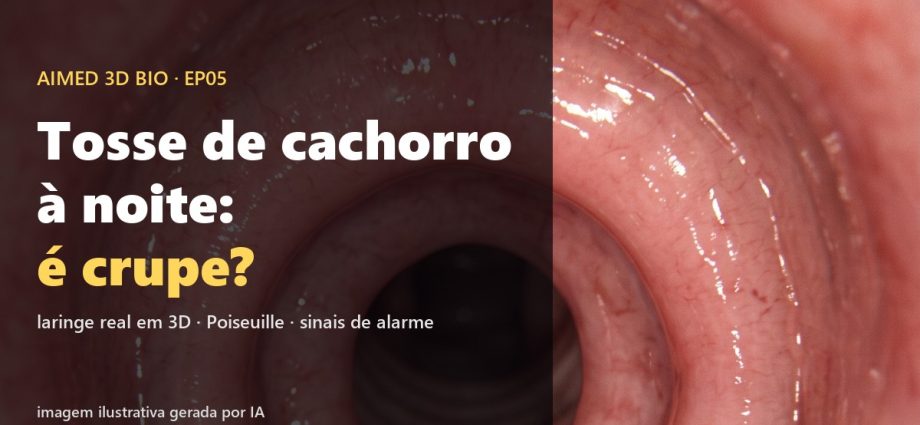
Tosse de cachorro à noite: é crupe?
Na maioria das vezes, sim. A tosse de cachorro, seca e rouca como um latido, junto com um chiado agudo quando a criança puxa o ar, é o retrato do crupe: um vírus inflama a laringe e a traqueia e incha a via aérea logo abaixo das cordas vocais. Em geral a criança melhora sem internar; só 1% a 5% precisam ficar no hospital. Aqui você vê por que um milímetro de inchaço pesa tanto num bebê, quais sinais pedem pronto-socorro agora e de onde vem cada número.
📅 Publicado em novembro de 2026
Navegue pelo Artigo
Do som que acorda a casa às três da manhã até a alta do pronto-socorro, com a física de um milímetro no meio do caminho.
- 1. O que é o crupe e por que a tosse parece latido
- 2. O filme
- 3. Por que 1 milímetro pesa tanto na criança
- 4. Veja a via aérea em 3D
- 5. Sinais de alarme: pronto-socorro agora ou SAMU 192
- 6. Em casa: o que ajuda e o que não ajuda
- 7. O que a equipe faz no pronto-socorro
- 8. Quando a tosse não é crupe
- 9. Bastidores: o que corrigimos antes de publicar
- 10. Perguntas frequentes
- 11. Considerações Finais
- 12. Referências e créditos
1. O que é o crupe e por que a tosse parece latido
Três da manhã. Do quarto ao lado vem um som que os pais nunca tinham ouvido: uma tosse seca e rouca, parecida com o latido de um cachorro ou de uma foca. Entre uma tossida e outra, a criança faz um chiado agudo cada vez que puxa o ar. A mãe grava o som no celular e digita a dúvida no Google.
Na maioria das vezes, a resposta é crupe, o nome popular da laringotraqueíte viral. Um vírus inflama a laringe e a traqueia, e o inchaço se concentra na subglote, o trecho logo abaixo das cordas vocais (1, 2). Os dois sons saem desse mesmo lugar: a tosse que lembra latido e o chiado da inspiração, que os médicos chamam de estridor.
Estridor não é o chiado da asma
O estridor aparece quando a criança puxa o ar. É o som do ar passando por um trecho estreito da garganta. O chiado da asma e da bronquiolite vem do peito e costuma aparecer quando a criança solta o ar. Se der, grave um vídeo curto do som para mostrar à equipe.
Quem pega e quando
O crupe é mais comum entre 6 meses e 3 anos (2, 3). As diretrizes canadenses do TREKK estendem a faixa até os 5 anos, com pico por volta dos 2 (4). Num acompanhamento de 11 anos em consultório pediátrico, com 951 casos, a taxa mais alta ficou no segundo ano de vida, a taxa entre os meninos foi 1,43 vez a das meninas, e o vírus parainfluenza respondeu por 74% dos vírus isolados (6).
Nos estudos do hemisfério norte, os casos se concentram no fim do outono e no começo do inverno (2, 6). No Brasil essas estações caem entre abril e agosto, mas não encontramos estudo brasileiro sobre a época do crupe, e por isso não afirmamos um mês de pico por aqui.
Como a causa é um vírus (6), antibiótico não ajuda (4).
⚠ Para quem é este texto
Pais, cuidadores e médicos que acompanham a série. Material educativo, sem imagem nem som de paciente. As decisões são sempre do médico que examina a criança.
2. O filme
Um filme curto, em formato vertical: uma mãe acordada de madrugada, um médico respondendo e a via aérea da criança vista por dentro, apertando a cada tossida. Se preferir ler, tudo o que o filme diz está nas seções abaixo, com a fonte de cada número.
3. Por que 1 milímetro pesa tanto na criança
No filme, a mãe diz o que quase todo pai pensa: “mas é só um pouquinho de inchaço”. O médico responde com uma conta de física. Para um tubo reto, com o ar correndo em fluxo laminar, a resistência à passagem do ar depende do raio elevado à quarta potência (lei de Poiseuille). Se o raio cai pela metade, a resistência sobe 16 vezes e, com a mesma força para puxar o ar, passa 1/16 do ar que passava antes (7).
Agora o mesmo milímetro de inchaço em dois tubos. Um milímetro de mucosa inchada em toda a volta tira 1 mm do raio e 2 mm do diâmetro:
| Exemplo ilustrativo | Diâmetro antes | Diâmetro com 1 mm de inchaço | Ar que passa, mesma pressão | Resistência |
|---|---|---|---|---|
| Criança pequena | 4 mm (raio 2) | 2 mm (raio 1) | (1/2)4 = 1/16, cerca de 6% | 16 vezes maior |
| Adulto | 8 mm (raio 4) | 6 mm (raio 3) | (3/4)4 ≈ 1/3, cerca de 32% | cerca de 3 vezes maior |
Como ler a tabela
O inchaço é o mesmo nos dois. No adulto, ainda passa cerca de um terço do ar; na criança pequena, o mesmo milímetro deixa passar só um dezesseis avos do ar. Quando a criança chora, o fluxo fica turbulento e a resistência passa a depender do raio na quinta potência: no mesmo exemplo, 32 vezes maior (7). Por isso acalmar a criança faz parte do cuidado.
⚠ O que esta conta não diz
Os diâmetros de 4 e 8 mm são um exemplo ilustrativo. A conta aparece numa figura didática do livro Pediatric Critical Care Medicine (7), que não cita a medida original, e não encontramos uma fonte primária que meça exatamente esses valores. A conta também supõe um tubo reto e rígido, a mesma pressão e fluxo laminar. A via aérea real não é um tubo reto, e no trecho estreito, sobretudo no choro, o fluxo tende a ficar turbulento, o que piora a perda (7). Os números servem para mostrar a ordem de grandeza, não para medir uma criança.
O anel que não estica
Logo abaixo das cordas vocais, a via aérea passa por dentro da cartilagem cricoide, um anel fechado e rígido. O inchaço ali não tem para onde ir: não empurra a parede para fora, só cresce para dentro e fecha por igual, em toda a volta, o espaço por onde o ar passa.
Muitos livros antigos dizem que a cricoide é o ponto mais estreito da via aérea da criança. Exames de ressonância em 99 crianças de 2 meses a 13 anos, sedadas e respirando sozinhas, mostraram outra coisa: os pontos mais estreitos foram a glote e o trecho logo abaixo das cordas vocais, não a cricoide (8). Em outro estudo com 128 crianças, a área da cricoide foi de 48,9 mm² e a da glote, de 30 mm² (9). O que pesa no crupe é a rigidez da cricoide.

4. Veja a via aérea em 3D
A laringe e a traqueia do palco vêm de um atlas anatômico real (BodyParts3D), em tamanho real. Neste atlas de adulto, a abertura dentro da cricoide mede 12,9 mm, medida no próprio modelo. A mucosa e o inchaço são modelo didático desenhado sobre essas medidas.
Em oito passos, você gira a laringe, desce com a câmera até a subglote e vê a abertura fechar por dentro, corta a via aérea com régua, faz o inchaço crescer de 0 a 1 mm em tubos de 4, 8 e 12,9 mm, compara criança e adulto na mesma escala e testa o efeito da nebulização. No fim, há um teste rápido.
5. Sinais de alarme: pronto-socorro agora ou SAMU 192
A maior parte dos crupes é leve: tosse de latido e estridor só quando a criança chora ou se agita. Quando o estridor aparece com a criança calma, em repouso, e o peito afunda a cada respiração, o quadro já é moderado (4). Os sinais abaixo vêm das diretrizes canadenses para equipes de emergência (3, 4) e do material da Sociedade Canadense de Pediatria para famílias (5).
⚠ Ligue para o SAMU 192 se
- Os lábios ou a pele ficam roxos.
- A criança fica largada, sonolenta, difícil de acordar ou confusa.
- Baba muito, não consegue engolir e fica sentada inclinada para a frente para respirar, principalmente com febre alta que começou de repente. Pode não ser crupe, e é emergência.
Cor arroxeada e alteração da consciência são sinais de que a respiração pode estar falhando (2, 4).
⚠ Vá ao pronto-socorro agora se
- Há estridor com a criança calma, sem chorar.
- A pele entre as costelas, abaixo delas ou na base do pescoço afunda a cada respiração (tiragem).
- A respiração está rápida ou difícil, ou a criança não consegue deitar por falta de ar.
- A criança está muito agitada, angustiada para respirar.
- Recusa engolir ou baba mais que o normal.
- É um bebê com menos de 6 meses com tosse de latido, estridor ou febre.
- A febre já dura mais de 72 horas.
E se for leve?
Mesmo no crupe leve, vale levar a criança para ser examinada no mesmo dia. Num ensaio com 720 crianças com crupe leve, uma dose de dexametasona pela boca reduziu os retornos ao médico de 15,3% para 7,3%, com menos perda de sono e menos estresse para os pais (15). Crupe que volta muitas vezes, que dura mais que o esperado ou que foge do padrão também precisa de avaliação (3).
6. Em casa: o que ajuda e o que não ajuda
Ar frio de fora: pode aliviar um pouco
A evidência contra o vapor é antiga. A do ar frio é recente: um ensaio de 2023, em Genebra, testou o ar frio de verdade. Foram 118 crianças com crupe atendidas no pronto-socorro, todas tratadas com dexametasona pela boca. Metade ficou 30 minutos ao ar livre, com temperatura abaixo de 10 °C; a outra metade ficou dentro do hospital. O escore de gravidade caiu 2 pontos ou mais em 49,2% das crianças que foram para fora e em 23,7% das que ficaram dentro, com efeito maior no crupe moderado (13). O folheto da Sociedade Canadense de Pediatria para pais também sugere levar a criança para fora alguns minutos num dia frio (5).
Três ressalvas: foi um único centro, sem cegamento, e o ar frio veio somado ao corticoide, não no lugar dele. Ar frio não substitui o atendimento. E abrir o freezer para a criança respirar nunca foi estudado.
Vapor do chuveiro e nebulização úmida: não mostraram benefício
Uma revisão Cochrane reuniu três estudos de ar umidificado no pronto-socorro, com 135 crianças, e não encontrou diferença em nenhum desfecho (11). Um ensaio com 140 crianças com crupe moderado a grave comparou 100% de umidade, 40% de umidade e névoa soprada perto do rosto: o resultado foi o mesmo em 30 e em 60 minutos (12). Não encontramos estudo que tenha testado o chuveiro quente em casa; o ar úmido, testado no hospital, não ajudou. A Sociedade Canadense de Pediatria lembra ainda que a tenda de névoa afasta a criança dos pais e pode espalhar fungos (3).
Antibiótico: não
O crupe é causado por vírus. Antibiótico não ajuda (4).
A frase que mais ajuda os pais
O que trata o crupe é uma dose de corticoide receitada pelo médico. O ar frio pode somar um pouco; o vapor não mostrou benefício. Se aparecer qualquer sinal de alarme, não espere o efeito de nada em casa.
7. O que a equipe faz no pronto-socorro
Medir a gravidade
Muitos serviços usam o escore de Westley, criado em 1978 (18). Ele vai de 0 a 17 e soma o nível de consciência, a cor da pele, o estridor, a entrada de ar e a tiragem; cianose e alteração da consciência são os itens que mais pesam. Os cortes entre leve, moderado e grave variam entre as diretrizes, mas quase todas chamam de leve o escore até 2.
Dexametasona em dose única
É o tratamento de base, para todas as crianças com crupe atendidas no pronto-socorro (4). A revisão Cochrane mais recente reuniu 45 ensaios e 5.888 crianças: o corticoide melhora o escore em 2 horas e reduz internações, tempo no hospital e retornos ao serviço (14). Em geral é uma dose única pela boca. A melhora começa em 2 a 3 horas e dura de 24 a 48 horas (3).
A dose pode ser menor do que se usava. Num ensaio australiano com 1.252 crianças, a maioria com crupe leve, 0,15 mg/kg de dexametasona não foi inferior a 0,6 mg/kg (16). A Cochrane de 2023 concluiu que a dose menor pode ser tão eficaz quanto a maior, e que faltam ensaios para fechar a questão (14).
Adrenalina na nebulização
Quando o esforço para respirar está grande, a equipe pode fazer adrenalina por nebulização. Ela age rápido, em 10 a 30 minutos, e o efeito dura pelo menos 1 hora e some em cerca de 2 horas (3). Na revisão Cochrane, a melhora em 30 minutos foi clara, mas em 2 e em 6 horas já não era significativa (17).
Quando o remédio deixa de agir, os sintomas da doença podem voltar. Por isso a criança fica em observação: pelo menos 2 horas segundo o TREKK (4), de 2 a 4 horas após a dexametasona e a adrenalina segundo a Sociedade Canadense de Pediatria, com alta se os sintomas não voltarem (3). Num estudo antigo, 50 crianças foram liberadas após 2 horas de observação e só uma voltou (19); em outro, a alta após 3 horas foi segura (20).
Quem fica internado
O TREKK indica internar quando o estridor em repouso e o esforço para respirar continuam mais de 4 horas depois do tratamento (4). Isso é raro: entre 1% e 5% das crianças com crupe são internadas, menos de 3% das internadas precisam de intubação, e a morte acontece em no máximo 1 a cada 30 mil casos (2). Nos dados da Sociedade Canadense de Pediatria, menos de 6% das crianças atendidas no pronto-socorro internam, e a intubação ocorre em 0,4% a 1,4% das internadas (3).
Da casa à alta
Para o médico: doses e evidência
| Ponto | O que a evidência mostra | Fonte |
|---|---|---|
| Dexametasona, dose | Dose única VO de 0,15 a 0,6 mg/kg, máximo 12 mg, para todas as crianças com crupe no PS. A CPS mantém 0,6 mg/kg e considera incerta a equivalência de 0,15 a 0,3 mg/kg. | TREKK 2023 (4); CPS (3) |
| 0,15 × 0,6 mg/kg | Sem diferença no escore em 2 h (2 ECRs, 861 crianças, certeza alta) nem nos retornos (RR 0,91, certeza alta). Melhor em 24 h com 0,6 mg/kg num único ECR de 72 crianças (certeza moderada). | Cochrane 2023 (14) |
| Dose baixa e prednisolona | 1.252 crianças acima de 6 meses e até 20 kg, todas VO: dexametasona 0,6 × 0,15 mg/kg × prednisolona 1 mg/kg. Westley em 1 h sem diferença; retorno em 7 dias 17,8% / 19,5% / 21,7% (sem significância). Não inferioridade. População leve (Westley basal médio de 1,4 a 1,5). | Parker & Cooper 2019 (16) |
| Crupe leve | Dexametasona 0,6 mg/kg VO × placebo em 720 crianças com Westley ≤2: retorno 7,3% × 15,3%. | Bjornson 2004 (15) |
| Corticoide × placebo | 45 ECRs, 5.888 crianças. Escore melhor em 2 h (SMD −0,65, certeza baixa); menos internação, tempo de hospital e retornos. | Cochrane 2023 (14) |
| Adrenalina nebulizada | 8 ECRs, 225 crianças: SMD −0,94 em 30 min; sem efeito significativo em 2 e 6 h. L-adrenalina equivale à racêmica. Início em 10 a 30 min, some em cerca de 2 h. A dose não faz parte das fontes conferidas para este texto: seguir o protocolo do serviço. | Cochrane 2013 (17); CPS (3) |
| Observação | Pelo menos 2 h após a adrenalina (TREKK); 2 a 4 h após dexametasona + adrenalina (CPS). Internar se estridor em repouso e esforço persistirem mais de 4 h após o tratamento. | (3, 4, 19, 20) |
| Ar frio | ECR aberto, unicêntrico, 118 crianças com Westley ≥2, todas com dexametasona VO: 30 min de ar externo abaixo de 10 °C × ar interno. Queda ≥2 pontos em 30 min em 49,2% × 23,7% (diferença de 25,4 pontos percentuais; p = 0,007). Há uma errata de 2024 que não conferimos. | Siebert 2023 (13) |
| Umidificação | 3 estudos no PS, 135 crianças: SMD −0,14 (IC 95% −0,75 a 0,47). Umidade 100% × 40% × blow-by sem diferença em 30 e 60 min (140 crianças). | Cochrane 2006 (11); Scolnik 2006 (12) |
8. Quando a tosse não é crupe
Epiglotite
A criança costuma não ter a tosse de latido. A febre alta começa de repente, ela baba, tem dificuldade para engolir e fica sentada, inclinada para a frente, com o queixo projetado, para conseguir respirar (3). É emergência: SAMU 192.
Traqueíte bacteriana
Começa parecida com o crupe, mas a criança fica muito doente, com febre, e melhora pouco com a adrenalina na nebulização (2). É a equipe que levanta essa suspeita.
O que foge do padrão
Cara de muito doente (criança abatida, prostrada, o que os médicos chamam de aspecto toxêmico), baba e dificuldade para engolir são sinais de alerta. Bebês com menos de 6 meses e crianças com crupe que volta muitas vezes, dura mais que o esperado ou tem uma apresentação diferente precisam de avaliação para procurar outra causa (3).
9. Bastidores: o que corrigimos antes de publicar
A primeira imagem do inchaço, gerada pelo Gemini, saiu com a abertura da via aérea em forma de fenda vertical. Ficou bonita e errada: parecia a glote, o espaço entre as cordas vocais. No crupe o inchaço é igual em toda a volta, por dentro de um anel, e é ele que desenha a torre na radiografia. Pedimos outra imagem, com a mesma câmera e o inchaço igual em toda a volta.
Depois medimos com régua de pixels. Na imagem aberta, o raio da abertura tinha cerca de 385 pixels; na imagem com inchaço, a abertura cabia num círculo de raio de 192 pixels, quase exatamente a metade. O ajuste fino na edição deixou o raio em 0,50 do original, porque é isso que sustenta o “1/16” do contador que aparece na tela. Uma primeira versão do contador oscilava e parava em 7%; foi refeita para terminar fixa em 6%.
O “4 mm × 8 mm” chegou ao roteiro atribuído a um livro clássico de anestesia pediátrica. Na conferência, não achamos a medida original. A conta aparece numa figura didática de um livro de terapia intensiva pediátrica (7), sem fonte primária, e por isso virou “exemplo ilustrativo” na tela e neste texto. A mesma figura diz que, no adulto, a área do tubo cai 25%. Pela conta, cai 44%; o que cai 25% é o diâmetro. Não repetimos o número do livro.
A pesquisa também derrubou uma frase do primeiro roteiro: “ar frio não funciona”. O ensaio de Genebra, de 2023, mostrou benefício do ar frio somado à dexametasona (13). O que segue sem evidência é o vapor e a nebulização úmida.
A fala do médico foi enxugada. Na primeira gravação, o segundo gancho do filme, a comparação entre adulto e criança, caía aos 26 segundos. Cortamos “logo abaixo das cordas vocais” e “agora olha esse mesmo milímetro num adulto”, porque a imagem já mostra o adulto, e o gancho passou a cair aos 19 segundos.
Por fim, o som. A tosse de latido do filme é um leão-marinho de verdade, com o tom subido, misturado a uma tosse encenada por um adulto; o estridor também é encenado. Nenhuma criança foi gravada.
10. Perguntas frequentes
Tosse de cachorro à noite é crupe?
Na maioria das vezes. Tosse que lembra latido, com um chiado agudo quando a criança puxa o ar (estridor), é o quadro típico do crupe, uma infecção viral que incha a via aérea logo abaixo das cordas vocais. É mais comum entre 6 meses e 3 anos.
Quando levar ao pronto-socorro?
Na hora, se houver estridor com a criança calma, peito ou pescoço afundando a cada respiração, respiração rápida ou difícil, agitação intensa, baba ou recusa para engolir, idade abaixo de 6 meses ou febre há mais de 72 horas. Lábios roxos, criança largada ou sonolenta: SAMU 192.
Vapor do chuveiro ajuda no crupe?
Os estudos com ar úmido e nebulização não mostraram benefício. Ar frio de fora, por alguns minutos, pode aliviar um pouco quando somado ao corticoide, mas não substitui o atendimento.
Crupe precisa de antibiótico?
Não. O crupe é causado por vírus, principalmente o parainfluenza. O tratamento é uma dose de corticoide receitada pelo médico.
Por que a criança fica em observação depois da nebulização?
A adrenalina na nebulização age em minutos, mas o efeito passa em cerca de 2 horas e os sintomas podem voltar. A observação de 2 a 4 horas serve para conferir, ainda no hospital, se os sintomas voltam quando o remédio deixa de agir.
Crupe leve também precisa de remédio?
Uma dose de dexametasona reduziu pela metade os retornos ao médico mesmo no crupe leve. Vale levar a criança para ser examinada no mesmo dia.
Quer construir material assim, com fonte em cada número?
A Metodologia AIMED ensina médicos a usar IA para criar aulas, filmes e ferramentas clínicas com rastreabilidade, do roteiro à conferência final.
11. Considerações Finais
O crupe assusta pelo som, e quase sempre termina bem: uma dose de corticoide, às vezes uma nebulização e algumas horas de observação. O que a família precisa levar deste texto é curto. Tosse de latido com estridor é crupe até que se prove o contrário; estridor em repouso, peito afundando, lábios roxos ou criança largada pedem pronto-socorro agora ou SAMU 192.
Este é o quinto episódio da série AIMED 3D Bio. O anterior tratava de outra dúvida de madrugada, a dor no testículo que não pode esperar o dia amanhecer. Todos os episódios estão na coleção Cinematic Education.
💡 Connecting the Dots: a frase “é só um pouquinho de inchaço” está certa para um adulto e errada para um bebê, e a diferença cabe numa potência de quatro. Por isso, em casa, não adianta tentar adivinhar o tamanho do inchaço. O que conta é o esforço da criança para respirar: estridor com ela calma, peito afundando, a cor e o quanto ela está alerta.
Referências
- Bjornson CL, Johnson DW. Croup. Lancet. 2008;371(9609):329-339. PMID 18295000. DOI: 10.1016/S0140-6736(08)60170-1
- Bjornson CL, Johnson DW. Croup in children. CMAJ. 2013;185(15):1317-1323. PMID 23939212. DOI: 10.1503/cmaj.121645
- Ortiz-Alvarez O; Canadian Paediatric Society, Acute Care Committee. Acute management of croup in the emergency department. Parecer de 2017, atualizado em 06/03/2026. Disponível em: cps.ca
- TREKK (Translating Emergency Knowledge for Kids). Bottom Line Recommendations: Croup. Versão 4.0, agosto de 2023. Disponível em: trekk.ca
- Canadian Paediatric Society. Croup. Caring for Kids, 2019. Disponível em: caringforkids.cps.ca
- Denny FW, Murphy TF, Clyde WA Jr, Collier AM, Henderson FW. Croup: an 11-year study in a pediatric practice. Pediatrics. 1983;71(6):871-876. PMID 6304611.
- Wheeler DS. Life-threatening diseases of the upper respiratory tract. In: Wheeler DS, et al., eds. Pediatric Critical Care Medicine. Springer; 2014. Cap. 2, Fig. 2.1. DOI: 10.1007/978-1-4471-6356-5_2
- Litman RS, Weissend EE, Shibata D, Westesson PL. Developmental changes of laryngeal dimensions in unparalyzed, sedated children. Anesthesiology. 2003;98(1):41-45. PMID 12502977. DOI: 10.1097/00000542-200301000-00010
- Dalal PG, Murray D, Messner AH, Feng A, McAllister J, Molter D. Pediatric laryngeal dimensions: an age-based analysis. Anesth Analg. 2009;108(5):1475-1479. PMID 19372324. DOI: 10.1213/ane.0b013e31819d1d99
- Yang WC, Hsu YL, Chen CY, Peng YC, Chen JN, Fu YC, et al. Initial radiographic tracheal ratio in predicting clinical outcomes in croup in children. Sci Rep. 2019;9:17893. DOI: 10.1038/s41598-019-54140-y
- Moore M, Little P. Humidified air inhalation for treating croup. Cochrane Database Syst Rev. 2006;(3):CD002870 (pub2). PMID 16855994. Versão em periódico: Fam Pract. 2007;24(4):295-301. PMID 17602176. DOI: 10.1093/fampra/cmm022
- Scolnik D, Coates AL, Stephens D, Da Silva Z, Lavine E, Schuh S. Controlled delivery of high vs low humidity vs mist therapy for croup in emergency departments: a randomized controlled trial. JAMA. 2006;295(11):1274-1280. PMID 16537737. DOI: 10.1001/jama.295.11.1274
- Siebert JN, Salomon C, Taddeo I, Gervaix A, Combescure C, Lacroix L. Outdoor cold air versus room temperature exposure for croup symptoms: a randomized controlled trial. Pediatrics. 2023;152(3):e2023061365. PMID 37525974. DOI: 10.1542/peds.2023-061365
- Aregbesola A, Tam CM, Kothari A, Lê ML, Ragheb M, Klassen TP. Glucocorticoids for croup in children. Cochrane Database Syst Rev. 2023;1:CD001955. PMID 36626194. DOI: 10.1002/14651858.CD001955.pub5
- Bjornson CL, Klassen TP, Williamson J, Brant R, Mitton C, Plint A, et al. A randomized trial of a single dose of oral dexamethasone for mild croup. N Engl J Med. 2004;351(13):1306-1313. PMID 15385657. DOI: 10.1056/NEJMoa033534
- Parker CM, Cooper MN. Prednisolone versus dexamethasone for croup: a randomized controlled trial. Pediatrics. 2019;144(3):e20183772. PMID 31416827. DOI: 10.1542/peds.2018-3772
- Bjornson C, Russell K, Vandermeer B, Klassen TP, Johnson DW. Nebulized epinephrine for croup in children. Cochrane Database Syst Rev. 2013;(10):CD006619. PMID 24114291. DOI: 10.1002/14651858.CD006619.pub3
- Westley CR, Cotton EK, Brooks JG. Nebulized racemic epinephrine by IPPB for the treatment of croup: a double-blind study. Am J Dis Child. 1978;132(5):484-487. PMID 347921. DOI: 10.1001/archpedi.1978.02120300044008
- Kelley PB, Simon JE. Racemic epinephrine use in croup and disposition. Am J Emerg Med. 1992;10(3):181-183. PMID 1375027. DOI: 10.1016/0735-6757(92)90204-B
- Ledwith CA, Shea LM, Mauro RD. Safety and efficacy of nebulized racemic epinephrine in conjunction with oral dexamethasone and mist in the outpatient treatment of croup. Ann Emerg Med. 1995;25(3):331-337. PMID 7864472. DOI: 10.1016/s0196-0644(95)70290-3
Créditos de imagem e som
- Vistas internas da via aérea no filme: imagem ilustrativa gerada por IA (Google Gemini), editada.
- Radiografia com sinal da torre: Yang WC, Hsu YL, Chen CY et al., Initial radiographic tracheal ratio in predicting clinical outcomes in croup in children, Sci Rep 2019;9:17893, doi:10.1038/s41598-019-54140-y, Fig. 2. Licença CC BY 4.0. Imagem recortada.
- Estridor: “Pepper Spray Coughing” by qubodup (freesound.org/s/739416), licensed under CC BY 4.0. Trechos recortados e filtrados.
- Tosse de latido: “Sea Lion 1.wav”, nifvimp (freesound.org/s/680733), CC0 1.0, com o tom alterado; “Person coughing”, Sadiquecat (freesound.org/s/806703), CC0 1.0. Créditos por cortesia.
- Vozes sintéticas: Gemini TTS (Google AI Studio).
Barking cough at night: is it croup?
Most of the time, yes. A barking cough, dry and hoarse, together with a high-pitched noise when the child breathes in, is the classic picture of croup: a virus inflames the larynx and trachea and swells the airway just below the vocal cords. Children usually recover without a hospital stay; only 1% to 5% are admitted. Here you’ll see why one millimeter of swelling matters so much in a baby, which signs mean you should go to the ER right away, and where every number comes from.
📅 Published November 2026
Article Contents
From the sound that wakes the house at 3 a.m. to discharge from the ER, with the physics of one millimeter along the way.
- 1. What croup is, and why the cough sounds like a bark
- 2. The film
- 3. Why 1 millimeter matters so much in a child
- 4. See the airway in 3D
- 5. Warning signs: ER now, or call an ambulance
- 6. At home: what helps and what doesn’t
- 7. What the ER team does
- 8. When the cough isn’t croup
- 9. Behind the scenes: what we fixed before publishing
- 10. Frequently asked questions
- 11. Final Thoughts
- 12. References and credits
1. What croup is, and why the cough sounds like a bark
It’s 3 a.m. From the next room comes a sound the parents have never heard before: a harsh, dry cough, like a dog barking or a seal. Between coughs, the child makes a high-pitched squeak every time they breathe in. Mom records it on her phone and types the question into Google.
Most of the time, the answer is croup, or viral laryngotracheitis. A virus inflames the larynx and trachea, and the swelling is worst in the subglottis, the stretch just below the vocal cords (1, 2). Both sounds come from that same spot: the barking cough and the noise on the in-breath, which doctors call stridor.
Stridor isn’t the wheeze of asthma
Stridor happens when the child breathes in. It’s the sound of air squeezing through a narrow spot in the throat. The wheeze of asthma or bronchiolitis comes from the chest and is usually heard when the child breathes out. If you can, take a short video of the sound to show the team.
Who gets it, and when
Croup is most common between 6 months and 3 years of age (2, 3). Canada’s TREKK guidelines stretch the range to 5 years, with a peak around age 2 (4). In an 11-year study of 951 cases in a pediatric practice, the highest rate was in the second year of life, boys got croup 1.43 times as often as girls, and parainfluenza accounted for 74% of the viruses isolated (6).
In Northern Hemisphere studies, cases cluster in late fall and early winter (2, 6). In Brazil, those seasons fall between April and August, but we didn’t find a Brazilian study on when croup peaks, so we don’t name a peak month there.
Because it’s caused by a virus (6), antibiotics don’t help (4).
⚠ Who this is for
Parents, caregivers and the physicians who follow the series. Educational material, with no patient images or recordings. Decisions always belong to the physician examining the child.
2. The film
A short film in vertical format: a mother awake in the middle of the night, a doctor answering, and the child’s airway seen from the inside, tightening with every cough. If you’d rather read, everything the film says is in the sections below, with a source for every number.
3. Why 1 millimeter matters so much in a child
In the film, the mother says what almost every parent thinks: “But it’s just a little swelling.” The doctor answers with physics. In a straight tube with smooth (laminar) airflow, resistance depends on the radius to the fourth power (Poiseuille’s law). Halve the radius and resistance goes up 16-fold: with the same effort, only 1/16 of the air gets through (7).
Now put the same millimeter of swelling in two tubes. One millimeter of swollen lining all the way around takes 1 mm off the radius and 2 mm off the diameter:
| Illustrative example | Diameter before | Diameter with 1 mm of swelling | Air that gets through, same pressure | Resistance |
|---|---|---|---|---|
| Young child | 4 mm (radius 2) | 2 mm (radius 1) | (1/2)4 = 1/16, about 6% | 16 times higher |
| Adult | 8 mm (radius 4) | 6 mm (radius 3) | (3/4)4 ≈ 1/3, about 32% | about 3 times higher |
How to read the table
The swelling is identical. In an adult, about a third of the air still gets through; in a small child, the same millimeter cuts the air down to one sixteenth. When the child cries, airflow turns turbulent and resistance depends on the radius to the fifth power: in the same example, 32 times higher (7). That’s why keeping the child calm is part of the care.
⚠ What this math doesn’t tell you
The 4 mm and 8 mm diameters are an illustrative example. The calculation comes from a teaching figure in the textbook Pediatric Critical Care Medicine (7), which doesn’t cite an original measurement, and we couldn’t find a primary source that measured exactly those values. The math also assumes a straight, rigid tube, the same pressure and laminar flow. A real airway isn’t a straight tube, and through a narrow segment, especially with crying, flow tends to turn turbulent, which makes things worse (7). The numbers show the order of magnitude; they don’t measure any particular child.
The ring that can’t stretch
Just below the vocal cords, the airway runs through the cricoid cartilage, a closed, rigid ring. Swelling there has nowhere to go. It can’t push the wall outward, so it grows inward, closing the opening evenly all the way around.
Many older textbooks say the cricoid is the narrowest point of a child’s airway. MRI scans of 99 children aged 2 months to 13 years, sedated and breathing on their own, told a different story: the narrowest points were the glottis and the area just below the vocal cords, not the cricoid (8). In another study of 128 children, the cricoid area was 48.9 mm² and the glottic area 30 mm² (9). What matters in croup is that the cricoid can’t give.
4. See the airway in 3D
The larynx and trachea on the stage come from a real anatomical atlas (BodyParts3D), at true size. In this adult atlas, the opening inside the cricoid measures 12.9 mm, measured on the model itself. The lining and the swelling are a teaching model drawn on those measurements.
In eight steps, you rotate the larynx, ride the camera down to the subglottis and watch the opening close from the inside, cut the airway with a ruler, grow the swelling from 0 to 1 mm in 4, 8 and 12.9 mm tubes, compare a child and an adult at the same scale and test what the nebulizer does. A short quiz closes it.
5. Warning signs: ER now, or call an ambulance
Most croup is mild: a barking cough, with stridor only when the child cries or gets upset. Once stridor shows up while the child is calm and resting, and the chest pulls in with each breath, it’s moderate croup (4). The signs below come from Canadian guidelines for emergency teams (3, 4) and the Canadian Paediatric Society’s advice for families (5).
⚠ Call your local emergency number for an ambulance (SAMU 192 in Brazil) if
- The lips or skin turn blue.
- The child is limp, drowsy, hard to wake or confused.
- The child is drooling a lot, can’t swallow and sits leaning forward to breathe, especially with a high fever that came on suddenly. This may not be croup, and it’s an emergency.
A bluish color and a change in alertness are signs that breathing may be failing (2, 4).
⚠ Go to the ER now if
- There’s stridor while the child is calm and not crying.
- The skin between or below the ribs, or at the base of the neck, pulls in with each breath (retractions).
- Breathing is fast or hard, or the child can’t lie down because of trouble breathing.
- The child is very agitated and struggling to breathe.
- The child refuses to swallow or is drooling more than usual.
- The baby is under 6 months old and has a barking cough, stridor or a fever.
- Fever has lasted more than 72 hours.
And if it’s mild?
Even with mild croup, it’s worth having the child seen the same day. In a trial of 720 children with mild croup, a single oral dose of dexamethasone cut return visits to the doctor from 15.3% to 7.3%, with less lost sleep and less stress for parents (15). Croup that keeps coming back, lasts longer than expected or doesn’t follow the usual pattern also needs to be checked (3).
6. At home: what helps and what doesn’t
Cold outdoor air: it may help a little
The evidence against steam is old. The evidence on cold air is recent: a 2023 trial in Geneva actually tested it. It enrolled 118 children with croup seen in the ER, all of them treated with oral dexamethasone. Half spent 30 minutes outdoors in air below 10 °C (50 °F); the other half stayed indoors at the hospital. The severity score dropped by 2 points or more in 49.2% of the children who went outside and in 23.7% of those who stayed in, with a bigger effect in moderate croup (13). The Canadian Paediatric Society’s handout for parents also suggests taking the child outside for a few minutes on a cold day (5).
Three caveats: it was a single center, unblinded, and the cold air was given on top of the steroid, not instead of it. Cold air doesn’t replace medical care. And holding a child up to an open freezer has never been studied.
Shower steam and humidified mist: no benefit shown
A Cochrane review pooled three studies of humidified air in the ER, with 135 children, and found no difference in any outcome (11). A trial of 140 children with moderate to severe croup compared 100% humidity, 40% humidity and mist blown near the face: results were the same at 30 and 60 minutes (12). We found no study that tested a hot shower at home; humid air, tested in the hospital, didn’t help. The Canadian Paediatric Society also notes that mist tents separate children from their parents and can spread mold (3).
Antibiotics: no
Croup is caused by a virus. Antibiotics don’t help (4).
The one line that helps parents most
What treats croup is a dose of steroid prescribed by a doctor. Cold air may add a little; steam hasn’t shown any benefit. If any warning sign shows up, don’t wait to see whether something at home works.
7. What the ER team does
Scoring severity
Many hospitals use the Westley score, created in 1978 (18). It runs from 0 to 17 and adds up level of consciousness, skin color, stridor, air entry and retractions; cyanosis and altered consciousness carry the most weight. Cutoffs for mild, moderate and severe differ between guidelines, but nearly all of them call a score of 2 or less mild.
A single dose of dexamethasone
This is the backbone of treatment, for every child with croup seen in the ER (4). The latest Cochrane review pooled 45 trials and 5,888 children: steroids improve the score within 2 hours and reduce admissions, time in hospital and return visits (14). It’s usually a single dose by mouth. Improvement starts within 2 to 3 hours and lasts 24 to 48 hours (3).
The dose may be lower than we used to give. In an Australian trial of 1,252 children, most with mild croup, 0.15 mg/kg of dexamethasone was non-inferior to 0.6 mg/kg (16). The 2023 Cochrane review concluded that the lower dose may be as effective as the higher one, and that more trials are needed to settle it (14).
Nebulized epinephrine
When the child is working hard to breathe, the team may give epinephrine (adrenaline) by nebulizer. It works fast, within 10 to 30 minutes, lasts at least an hour and wears off after about 2 hours (3). In the Cochrane review, the improvement at 30 minutes was clear, but by 2 and 6 hours it was no longer significant (17).
Once the drug wears off, the symptoms of the illness can come back. That’s why the child is observed: at least 2 hours according to TREKK (4), and 2 to 4 hours after dexamethasone and epinephrine according to the Canadian Paediatric Society, with discharge if symptoms don’t return (3). In an older study, 50 children were sent home after 2 hours of observation and only one came back (19); in another, discharge after 3 hours was safe (20).
Who gets admitted
TREKK recommends admission when stridor at rest and labored breathing persist more than 4 hours after treatment (4). That’s uncommon: 1% to 5% of children with croup are admitted, fewer than 3% of those admitted need a breathing tube, and deaths occur in no more than 1 in 30,000 cases (2). In Canadian Paediatric Society figures, fewer than 6% of children seen in the ER are admitted, and 0.4% to 1.4% of admitted children are intubated (3).
From home to discharge
For clinicians: doses and evidence
| Topic | What the evidence shows | Source |
|---|---|---|
| Dexamethasone dose | Single oral dose of 0.15 to 0.6 mg/kg, maximum 12 mg, for every child with croup in the ED. The CPS keeps 0.6 mg/kg and considers equivalence of 0.15 to 0.3 mg/kg uncertain. | TREKK 2023 (4); CPS (3) |
| 0.15 vs. 0.6 mg/kg | No difference in score at 2 h (2 RCTs, 861 children, high certainty) or in return visits (RR 0.91, high certainty). Better at 24 h with 0.6 mg/kg in a single RCT of 72 children (moderate certainty). | Cochrane 2023 (14) |
| Low dose and prednisolone | 1,252 children over 6 months and up to 20 kg, all oral: dexamethasone 0.6 vs. 0.15 mg/kg vs. prednisolone 1 mg/kg. No difference in Westley score at 1 h; 7-day return 17.8% / 19.5% / 21.7% (not significant). Non-inferior. Mild population (mean baseline Westley 1.4 to 1.5). | Parker & Cooper 2019 (16) |
| Mild croup | Oral dexamethasone 0.6 mg/kg vs. placebo in 720 children with Westley ≤2: return visits 7.3% vs. 15.3%. | Bjornson 2004 (15) |
| Steroid vs. placebo | 45 RCTs, 5,888 children. Better score at 2 h (SMD −0.65, low certainty); fewer admissions, shorter stays and fewer return visits. | Cochrane 2023 (14) |
| Nebulized epinephrine | 8 RCTs, 225 children: SMD −0.94 at 30 min; no significant effect at 2 and 6 h. L-epinephrine is equivalent to racemic epinephrine. Onset 10 to 30 min, gone in about 2 h. Dosing is outside the sources checked for this article: follow your local protocol. | Cochrane 2013 (17); CPS (3) |
| Observation | At least 2 h after epinephrine (TREKK); 2 to 4 h after dexamethasone plus epinephrine (CPS). Admit if stridor at rest and increased work of breathing persist more than 4 h after treatment. | (3, 4, 19, 20) |
| Cold air | Open-label, single-center RCT, 118 children with Westley ≥2, all given oral dexamethasone: 30 min of outdoor air below 10 °C vs. indoor air. Drop of ≥2 points at 30 min in 49.2% vs. 23.7% (difference 25.4 percentage points; p = 0.007). A 2024 erratum was published; we have not reviewed it. | Siebert 2023 (13) |
| Humidification | 3 ED studies, 135 children: SMD −0.14 (95% CI −0.75 to 0.47). 100% vs. 40% humidity vs. blow-by: no difference at 30 and 60 min (140 children). | Cochrane 2006 (11); Scolnik 2006 (12) |
8. When the cough isn’t croup
Epiglottitis
There’s usually no barking cough. A high fever comes on suddenly, and the child drools, has trouble swallowing and sits leaning forward, chin out, to be able to breathe (3). It’s an emergency: call an ambulance.
Bacterial tracheitis
It can start out looking like croup, but the child becomes very sick, with fever, and responds poorly to nebulized epinephrine (2). Spotting it is the medical team’s job.
When the pattern is off
Looking very ill (what doctors call a toxic appearance), drooling and trouble swallowing are warning signs. Babies under 6 months, and children whose croup keeps coming back, lasts longer than expected or looks unusual, need a workup for another cause (3).
9. Behind the scenes: what we fixed before publishing
The first image of the swelling, generated with Gemini, showed the airway opening as a vertical slit. It looked good and it was wrong: that’s the glottis, the gap between the vocal cords. In croup the swelling is even all the way around, inside a ring, and that’s what draws the steeple on an X-ray. We asked for a new image, with the same camera angle and the swelling even all the way around.
Then we measured it with a pixel ruler. In the open image, the radius of the opening was about 385 pixels; in the swollen one, the opening fit inside a circle with a 192-pixel radius, almost exactly half. Fine-tuning in the edit brought the radius to 0.50 of the original, because that’s what backs up the “1/16” on the on-screen counter. An early version of the counter wobbled and stopped at 7%; we rebuilt it to land steady on 6%.
The “4 mm vs. 8 mm” figure first entered the script credited to a classic pediatric anesthesia textbook. When we checked, we couldn’t find the original measurement. The calculation appears in a teaching figure in a pediatric critical care textbook (7), with no primary source, so it became an “illustrative example” on screen and in this article. The same figure says that in the adult, the tube’s cross-sectional area drops 25%. Do the math and it drops 44%; it’s the diameter that drops 25%. We didn’t repeat the book’s number.
The research also knocked out a line from the first script: “cold air doesn’t work.” The 2023 Geneva trial showed a benefit from cold air on top of dexamethasone (13). Steam and humidified mist still have no evidence behind them.
The doctor’s lines were trimmed. In the first recording, the film’s second hook, the adult-versus-child comparison, landed at 26 seconds. We cut “just below the vocal cords” and “now watch that same millimeter in an adult”, since the picture already shows the adult, and the hook moved to 19 seconds.
Finally, the sound. The barking cough in the film is a real sea lion, pitched up and layered over a cough acted out by an adult; the stridor is staged too. No child was recorded.
10. Frequently asked questions
Is a barking cough at night croup?
Most of the time. A cough that sounds like a bark, with a high-pitched noise when the child breathes in (stridor), is the typical picture of croup, a viral infection that swells the airway just below the vocal cords. It’s most common between 6 months and 3 years.
When should I go to the ER?
Go right away if your child has stridor while calm, if the chest or neck pulls in with each breath, if breathing is fast or hard, if your child is very agitated, drooling or refusing to swallow, if your baby is under 6 months old, or if the fever has lasted more than 72 hours. Blue lips, or a limp or drowsy child: call your local emergency number for an ambulance.
Does shower steam help croup?
Studies of humidified air and mist showed no benefit. A few minutes of cold outdoor air may help a little on top of a steroid, but it doesn’t replace medical care.
Does croup need antibiotics?
No. Croup is caused by a virus, most often parainfluenza. The treatment is a dose of steroid prescribed by a doctor.
Why does my child have to stay for observation after the nebulizer?
Nebulized epinephrine works within minutes, but it wears off after about 2 hours and the symptoms can come back. Two to four hours of observation let the team check, before you go home, whether symptoms come back as the drug wears off.
Does mild croup need medicine too?
A single dose of dexamethasone cut return visits to the doctor in half, even in mild croup. It’s worth having the child seen the same day.
Want to build material like this, with a source for every number?
The AIMED Methodology teaches physicians to use AI to create lessons, films and clinical tools with full traceability, from script to final check.
11. Final Thoughts
Croup is frightening to hear, and it almost always ends well: one dose of steroid, sometimes a nebulizer, and a few hours of observation. What a family needs to take from this article is short. A barking cough with stridor is croup until proven otherwise; stridor at rest, a chest that pulls in, blue lips or a limp child mean it’s time to go to the ER right away, or to call an ambulance.
This is the fifth episode of AIMED 3D Bio. The previous one covered another middle-of-the-night question, testicle pain that can’t wait until morning. Every episode is in the Cinematic Education collection.
💡 Connecting the Dots: “it’s just a little swelling” is true for an adult and false for a baby, and the difference fits inside a fourth power. That’s why, at home, there’s no point trying to guess how big the swelling is. What counts is how hard the child is working to breathe: stridor while calm, a chest that pulls in, skin color and how alert the child is.
References
- Bjornson CL, Johnson DW. Croup. Lancet. 2008;371(9609):329-339. PMID 18295000. DOI: 10.1016/S0140-6736(08)60170-1
- Bjornson CL, Johnson DW. Croup in children. CMAJ. 2013;185(15):1317-1323. PMID 23939212. DOI: 10.1503/cmaj.121645
- Ortiz-Alvarez O; Canadian Paediatric Society, Acute Care Committee. Acute management of croup in the emergency department. Position statement, 2017, updated March 6, 2026. Available at: cps.ca
- TREKK (Translating Emergency Knowledge for Kids). Bottom Line Recommendations: Croup. Version 4.0, August 2023. Available at: trekk.ca
- Canadian Paediatric Society. Croup. Caring for Kids, 2019. Available at: caringforkids.cps.ca
- Denny FW, Murphy TF, Clyde WA Jr, Collier AM, Henderson FW. Croup: an 11-year study in a pediatric practice. Pediatrics. 1983;71(6):871-876. PMID 6304611.
- Wheeler DS. Life-threatening diseases of the upper respiratory tract. In: Wheeler DS, et al., eds. Pediatric Critical Care Medicine. Springer; 2014. Ch. 2, Fig. 2.1. DOI: 10.1007/978-1-4471-6356-5_2
- Litman RS, Weissend EE, Shibata D, Westesson PL. Developmental changes of laryngeal dimensions in unparalyzed, sedated children. Anesthesiology. 2003;98(1):41-45. PMID 12502977. DOI: 10.1097/00000542-200301000-00010
- Dalal PG, Murray D, Messner AH, Feng A, McAllister J, Molter D. Pediatric laryngeal dimensions: an age-based analysis. Anesth Analg. 2009;108(5):1475-1479. PMID 19372324. DOI: 10.1213/ane.0b013e31819d1d99
- Yang WC, Hsu YL, Chen CY, Peng YC, Chen JN, Fu YC, et al. Initial radiographic tracheal ratio in predicting clinical outcomes in croup in children. Sci Rep. 2019;9:17893. DOI: 10.1038/s41598-019-54140-y
- Moore M, Little P. Humidified air inhalation for treating croup. Cochrane Database Syst Rev. 2006;(3):CD002870 (pub2). PMID 16855994. Journal version: Fam Pract. 2007;24(4):295-301. PMID 17602176. DOI: 10.1093/fampra/cmm022
- Scolnik D, Coates AL, Stephens D, Da Silva Z, Lavine E, Schuh S. Controlled delivery of high vs low humidity vs mist therapy for croup in emergency departments: a randomized controlled trial. JAMA. 2006;295(11):1274-1280. PMID 16537737. DOI: 10.1001/jama.295.11.1274
- Siebert JN, Salomon C, Taddeo I, Gervaix A, Combescure C, Lacroix L. Outdoor cold air versus room temperature exposure for croup symptoms: a randomized controlled trial. Pediatrics. 2023;152(3):e2023061365. PMID 37525974. DOI: 10.1542/peds.2023-061365
- Aregbesola A, Tam CM, Kothari A, Lê ML, Ragheb M, Klassen TP. Glucocorticoids for croup in children. Cochrane Database Syst Rev. 2023;1:CD001955. PMID 36626194. DOI: 10.1002/14651858.CD001955.pub5
- Bjornson CL, Klassen TP, Williamson J, Brant R, Mitton C, Plint A, et al. A randomized trial of a single dose of oral dexamethasone for mild croup. N Engl J Med. 2004;351(13):1306-1313. PMID 15385657. DOI: 10.1056/NEJMoa033534
- Parker CM, Cooper MN. Prednisolone versus dexamethasone for croup: a randomized controlled trial. Pediatrics. 2019;144(3):e20183772. PMID 31416827. DOI: 10.1542/peds.2018-3772
- Bjornson C, Russell K, Vandermeer B, Klassen TP, Johnson DW. Nebulized epinephrine for croup in children. Cochrane Database Syst Rev. 2013;(10):CD006619. PMID 24114291. DOI: 10.1002/14651858.CD006619.pub3
- Westley CR, Cotton EK, Brooks JG. Nebulized racemic epinephrine by IPPB for the treatment of croup: a double-blind study. Am J Dis Child. 1978;132(5):484-487. PMID 347921. DOI: 10.1001/archpedi.1978.02120300044008
- Kelley PB, Simon JE. Racemic epinephrine use in croup and disposition. Am J Emerg Med. 1992;10(3):181-183. PMID 1375027. DOI: 10.1016/0735-6757(92)90204-B
- Ledwith CA, Shea LM, Mauro RD. Safety and efficacy of nebulized racemic epinephrine in conjunction with oral dexamethasone and mist in the outpatient treatment of croup. Ann Emerg Med. 1995;25(3):331-337. PMID 7864472. DOI: 10.1016/s0196-0644(95)70290-3
Image and sound credits
- Views inside the airway in the film: AI-generated illustration (Google Gemini), edited.
- Steeple-sign X-ray: Yang WC, Hsu YL, Chen CY et al., Initial radiographic tracheal ratio in predicting clinical outcomes in croup in children, Sci Rep 2019;9:17893, doi:10.1038/s41598-019-54140-y, Fig. 2. Licensed under CC BY 4.0. Cropped.
- Stridor: “Pepper Spray Coughing” by qubodup (freesound.org/s/739416), licensed under CC BY 4.0. Excerpts trimmed and filtered.
- Barking cough: “Sea Lion 1.wav” by nifvimp (freesound.org/s/680733), CC0 1.0, pitch-shifted; “Person coughing” by Sadiquecat (freesound.org/s/806703), CC0 1.0. Credited as a courtesy.
- Synthetic voices: Gemini TTS (Google AI Studio).
◆ Novidades
- Dor no testículo de madrugada: dá para esperar amanhecer?NOVO
- Por que passar a pulmonar pela frente da aorta?NOVO
- Criança bateu a cabeça e dormiu: pode deixar dormir? Quando levar ao hospital