
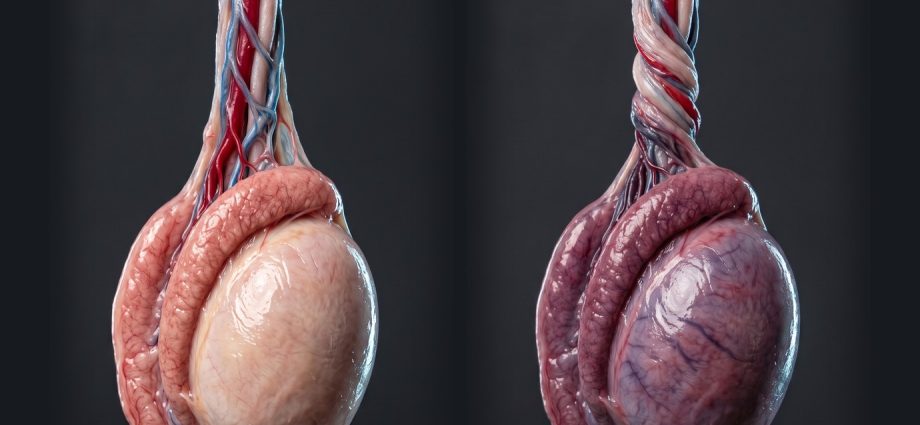
Dor no testículo de madrugada: dá para esperar amanhecer?
Não. Dor forte e de repente no testículo de um menino pede pronto-socorro na mesma hora, porque pode ser torção testicular: o cordão que leva sangue ao testículo gira sobre si mesmo e o sangue para de chegar. Numa revisão com mais de mil casos, 97,2% dos testículos tratados nas primeiras seis horas foram preservados. Depois de um dia, foram menos de um em quatro. Abaixo estão o mecanismo, os sinais que os pais conseguem ver em casa, o que a equipe faz no hospital e a fonte de cada número.
📅 Publicado em novembro de 2026
Navegue pelo Artigo
Da dor que acorda o menino às três da manhã até a mesa de cirurgia, com o relógio contado em horas.
- 1. Dor no testículo de madrugada: dá para esperar?
- 2. O filme
- 3. O que acontece dentro do cordão
- 4. Veja a torção em 3D
- 5. O relógio: quanto cada hora pesa
- 6. Os sinais que dá para ver em casa
- 7. Quando a queixa é só dor na barriga
- 8. O que a equipe faz no pronto-socorro
- 9. Quatro crenças que atrasam o atendimento
- 10. Bastidores: o que corrigimos antes de publicar
- 11. Perguntas frequentes
- 12. Considerações Finais
- 13. Referências
1. Dor no testículo de madrugada: dá para esperar?
Três e sete da manhã. Um menino de 13 anos acorda a mãe dizendo que está com dor de barriga e vontade de vomitar. Ela dá um remédio, ele volta para a cama e não dorme. Meia hora depois, com vergonha, ele conta onde dói de verdade: no testículo, e a dor começou de repente. A mãe pega o celular e pergunta se dá para esperar o pediatra de manhã.
Não dá. A Academia Americana de Pediatria orienta levar a criança com dor no testículo a um pronto-socorro imediatamente e trata toda dor forte na bolsa escrotal como emergência (2). A diretriz da Associação Europeia de Urologia recomenda que, na suspeita de torção, a exploração cirúrgica seja feita com urgência e que nenhum exame a atrase (3).
Traduzindo para a madrugada em casa
Dor forte e de repente no testículo, com ou sem vômito: pronto-socorro agora, mesmo que a dor tenha melhorado no caminho. Ao chegar, diga que a dor começou de repente e a hora em que começou. Essa hora é a informação que a equipe mais precisa.
⚠ Para quem é este texto
Pais, cuidadores e quem orienta famílias. Material educativo, sem imagem de paciente. As decisões são sempre do médico que examina a criança.
2. O filme
Pouco mais de um minuto, em formato vertical: uma mãe acordada de madrugada e um médico respondendo, com o cordão do testículo em 3D girando até o sangue parar de passar. Se preferir ler, tudo o que o filme diz está nas seções abaixo, com a fonte de cada número.
3. O que acontece dentro do cordão
O testículo fica pendurado pelo cordão espermático, que carrega a artéria, as veias e o ducto deferente. Na maioria dos meninos, o testículo está preso por trás à parede da bolsa e quase não gira.
A anomalia em badalo de sino
Em alguns meninos, a membrana que envolve o testículo (túnica vaginal) cobre também o epidídimo e um trecho do cordão. O testículo fica solto dentro dela, como o badalo dentro de um sino, e pode girar. Uma revisão sistemática das peças de autópsia encontrou essa anomalia em 4,9% a 16% dos testículos na bolsa, e dos dois lados em 66% a 100% dos casos (4). Por isso, quando o cirurgião fixa o testículo que torceu, costuma fixar também o outro (3).
A sequência da torção
Quando o testículo gira, o cordão torce. As veias, de parede fina, se fecham primeiro: o sangue entra e não sai, e o testículo incha. Depois a artéria também deixa de passar. Numa série de 186 cirurgias, a mediana foi de 360 graus de torção nos testículos salvos e de 540 graus nos que precisaram ser retirados, com casos de até 1.080 graus (5).
Por que a idade importa
A torção tem dois picos: no primeiro ano de vida e no início da adolescência. Numa base nacional americana com 2.443 meninos e 152 recém-nascidos operados, a incidência foi de 3,8 por 100 mil meninos menores de 18 anos por ano (6). No recém-nascido o mecanismo costuma ser outro, com a torção acontecendo fora da túnica (3). Este episódio trata da torção do menino maior, a mais comum no pronto-socorro.
4. Veja a torção em 3D
Gire a peça, compare a fixação normal com o badalo de sino na mesma escala, torça o cordão de 0 a 720 graus e corte-o ao vivo para ver as veias se fecharem antes da artéria. A anatomia do testículo, do epidídimo e da artéria vem do atlas BodyParts3D (anatomia de referência adulta); túnica, veias e badalo de sino são modelo didático.
5. O relógio: quanto cada hora pesa
A revisão sistemática de Mellick e colegas reuniu 30 séries e 2.116 pacientes. No subgrupo de 1.283 pacientes em que o tempo foi publicado em faixas de 6 horas, a proporção de testículos preservados caiu assim (1):
| Horas desde o início da dor até o tratamento | Testículos preservados |
|---|---|
| 0 a 6 h | 97,2% |
| 7 a 12 h | 79,3% |
| 13 a 18 h | 61,3% |
| 19 a 24 h | 42,5% |
| 25 a 48 h | 24,4% |
| Mais de 48 h | 7,4% |
Como ler a tabela
A cada faixa de 6 horas, cerca de 18 pontos a menos. “Preservado” quer dizer que o testículo não foi retirado na cirurgia, mas não garante que ele vá funcionar bem: numa série de adolescentes operados, 25,7% dos testículos fixados atrofiaram depois (7). O mesmo estudo calculou que, com 15 horas de sintomas, a chance de salvar o testículo cai para cerca de metade (7).
⚠ Seis horas não é prazo para esperar
O número das seis horas aparece em quase todo texto sobre o assunto e é fácil de ler ao contrário, como se houvesse seis horas de folga. Não há. As seis horas contam desde o início da dor, e o caminho até o hospital, a triagem e o centro cirúrgico também gastam tempo. Na outra ponta, a mesma revisão mostra que ainda se salvam testículos depois de 24 horas (1). Quem chega tarde também deve ir. A orientação é uma só: vá agora.
6. Os sinais que dá para ver em casa
A AAP lista, na página para famílias, dor na bolsa escrotal (geralmente de um lado, súbita e forte), bolsa inchada, vermelha e dolorida, testículo aumentado, dor abdominal e náusea ou vômito (2).
Nas séries de pronto-socorro, os achados que mais apontam para torção são os mesmos que os pais percebem primeiro. Numa coorte de 342 meninos com dor escrotal aguda, entre os que tinham torção, 88% contaram dor de início súbito e 86% tinham o testículo em posição anormal (8). Num estudo prospectivo alemão, dor com menos de 24 horas, náusea ou vômito, reflexo cremastérico alterado e testículo alto, juntos, identificaram todos os casos de torção (9).
⚠ Vá ao pronto-socorro agora se
O menino tem dor forte e de repente no testículo ou na bolsa, mesmo sem vômito. Ou tem dor no testículo com náusea ou vômito. Ou um testículo parece mais alto, inchado ou numa posição diferente. Ou teve uma dor dessas que melhorou sozinha: a AAP explica que o testículo pode torcer e destorcer, que a dor pode sumir tão de repente quanto veio, e que dor no testículo que vai e volta ainda precisa ser avaliada (2).
O reflexo cremastérico é sinal do médico
Ao tocar a parte interna da coxa, o músculo puxa o testículo para cima. Na torção, esse reflexo costuma desaparecer: faltou em 91% dos meninos com torção na coorte canadense (8). É um teste para o exame clínico, não para os pais fazerem em casa.
7. Quando a queixa é só dor na barriga
Muitos adolescentes não falam do testículo. Uma série chinesa reuniu nove meninos de 10 a 17 anos cuja única queixa foi dor abdominal aguda (10). Sete deles não tiveram a genitália examinada na primeira consulta e foram tratados como dor de barriga comum. Nos sete, o testículo estava necrosado quando enfim operaram, com média de 37 horas entre o início dos sintomas e o diagnóstico. Nos dois meninos que tiveram a bolsa examinada logo na chegada, a média foi de 4 horas, e os dois testículos foram salvos (10).
Uma série turca com 11 adolescentes operados por torção mostrou o outro lado: eles tinham passado por um a seis atendimentos antes do diagnóstico, e só dois tinham contado que sentiam dor no testículo (11). A autora aponta duas causas: o paciente esconde a queixa por constrangimento e o exame genital não é feito.
A frase que mais ajuda os pais
Menino com dor forte de repente na barriga, principalmente se vomita: pergunte do testículo. A pergunta leva cinco segundos e pode mudar a conduta.
8. O que a equipe faz no pronto-socorro
O escore TWIST
Muitos serviços usam um escore clínico de 7 pontos para separar o risco: testículo inchado (2 pontos), testículo endurecido (2), reflexo cremastérico ausente (1), náusea ou vômito (1) e testículo alto (1) (12). No estudo original (feito em Boston, com 338 meninos), os cortes foram 0 a 2 para risco baixo, 3 a 4 intermediário e 5 a 7 alto (12). Uma metanálise de cinco estudos pediátricos, com 1.060 pacientes e 199 torções, encontrou sensibilidade de 98,4% no corte de risco baixo e especificidade de 97,5% no de risco alto (13). Um estudo de validação mostrou que socorristas treinados conseguem aplicar o escore com precisão (14).
O ultrassom com Doppler
No risco intermediário, o ultrassom ajuda. Mas o Doppler pode enganar: num estudo multicêntrico europeu com 208 torções confirmadas na cirurgia, o fluxo dentro do testículo estava ausente em só 76% delas (15). Na mesma série, o ultrassom de alta resolução viu o cordão em espiral em 96%. Por isso a diretriz europeia diz que o exame de imagem não deve atrasar a cirurgia quando a suspeita clínica é alta (3).
A destorção manual
Enquanto o centro cirúrgico é preparado, um médico treinado pode tentar girar o testículo de volta. Num hospital pediátrico americano, a manobra funcionou em 65% das 141 tentativas e devolveu o fluxo cerca de 105 minutos antes do que a cirurgia sozinha (16). Mas a manobra não substitui a operação: numa série de 53 tentativas, 32% dos testículos ainda estavam torcidos quando o cirurgião abriu (5). Uma metanálise de 2026 encontrou menos testículos retirados quando a manobra foi tentada, com certeza baixa e risco de viés importante (17). A exploração cirúrgica e a fixação continuam indicadas (3).
Da casa ao centro cirúrgico
9. Quatro crenças que atrasam o atendimento
“A dor passou, então não era nada”
O testículo pode torcer e destorcer sozinho, e a dor pode sumir tão de repente quanto veio. A AAP pede avaliação mesmo assim (2).
“Dá para esperar o pediatra de manhã”
Entre as primeiras 6 horas e o intervalo de 7 a 12 horas, a proporção de testículos preservados cai de 97,2% para 79,3% (1). Uma noite de espera pode custar o testículo.
“Ele só reclamou da barriga”
Dor abdominal pode ser a primeira e a única queixa, e o constrangimento faz o adolescente esconder o resto (10, 11).
“Passou do prazo, não adianta mais”
Ainda se preservam testículos depois de 24 horas (1). Quem percebe tarde deve ir do mesmo jeito.
10. Bastidores: o que corrigimos antes de publicar
Este episódio foi um teste: a pré-produção foi feita pelo Codex, outro agente de IA, e conferida por Claude antes de passar pela revisão médica. A primeira ideia de abertura usava “cerca de 90% de salvamento até seis horas”, número citado de memória. A conferência na revisão de Mellick mostrou 97,2% nas primeiras seis horas. O filme ficou com o número da fonte.
A segunda correção foi tirar o “6 horas” da abertura. Sozinho no primeiro quadro, ele dava a entender que havia tempo para esperar. A abertura passou a ser a pergunta da mãe, e a primeira resposta do médico virou “vá agora”.
As fontes também discordam entre si, e mantivemos as duas. A página da AAP para famílias fala em mais de 90% de chance até seis horas e menos de 10% depois de 24 horas (2). A revisão de Mellick, com mais de mil pacientes, encontrou 24,4% entre 25 e 48 horas (1). O filme usa a revisão porque ela mostra os dados de cada faixa.
Na conferência das referências, uma delas estava com a revista errada no rascunho: o estudo com dor súbita em 88% dos casos é de Liang e colegas, no AJR de 2013, e não de uma revista de urologia pediátrica. Corrigido. A voz em português foi gravada duas vezes: na primeira, o sussurro da mãe soava como afirmação e não como pergunta.
11. Perguntas frequentes
Dor no testículo de madrugada: posso esperar até de manhã?
Não. Dor forte e de repente no testículo de um menino pede pronto-socorro na hora, porque pode ser torção testicular. Numa revisão com mais de mil casos, 97,2% dos testículos tratados nas primeiras seis horas foram preservados; entre 7 e 12 horas, 79,3%.
Quais são os sinais de torção testicular?
Dor súbita e forte no testículo ou na bolsa, geralmente de um lado, náusea ou vômito, bolsa inchada e vermelha, testículo mais alto ou em posição diferente e, às vezes, só dor na barriga. Qualquer um desses sinais pede pronto-socorro.
A dor no testículo passou sozinha. Ainda preciso levar ao hospital?
Sim. O testículo pode torcer e destorcer, e a dor pode sumir de repente. A Academia Americana de Pediatria orienta avaliar mesmo a dor que vai e volta.
Meu filho só reclama de dor na barriga. Pode ser torção?
Pode. Em alguns adolescentes, a dor abdominal é a primeira e a única queixa, e muitos não contam da dor no testículo por vergonha. Menino com dor forte e de repente na barriga, principalmente com vômito: pergunte do testículo.
Precisa de ultrassom antes da cirurgia?
Nem sempre. Quando o exame clínico indica suspeita alta, a cirurgia não deve esperar o ultrassom. O Doppler ajuda nos casos intermediários, mas pode mostrar fluxo em parte das torções.
Em que idade a torção testicular é mais comum?
Há dois picos: no primeiro ano de vida e no início da adolescência, logo depois da puberdade. Pode acontecer em outras idades.
Quer construir material assim, com fonte em cada número?
A Metodologia AIMED ensina médicos a usar IA para criar aulas, filmes e ferramentas clínicas com rastreabilidade, do roteiro à conferência final.
12. Considerações Finais
A torção testicular é rara, cerca de 4 casos por 100 mil meninos por ano, mas é uma das poucas dores da infância em que o relógio decide o resultado. Quem salva o testículo, quase sempre, é a família que sai de casa logo e a equipe que opera sem esperar quando a suspeita é alta.
Este é o quarto episódio da série AIMED 3D Bio. O anterior tratava de outra dúvida de madrugada, a da criança que bateu a cabeça e quer dormir.
💡 Connecting the Dots: os números da torção são conhecidos há décadas, e mesmo assim, numa base americana, 41,9% dos meninos operados perderam o testículo (6). A diferença não está no centro cirúrgico, está antes dele: na dor de barriga que ninguém ligou ao testículo, no adolescente que teve vergonha de contar, no “espera o pediatra de manhã”. Quando o médico ensina a família a fazer uma única pergunta, “dói no testículo?”, ele encurta justamente o trecho do relógio que nenhuma cirurgia recupera.
Referências
- Mellick LB, Sinex JE, Gibson RW, Mears K. A systematic review of testicle survival time after a torsion event. Pediatr Emerg Care. 2019;35(10):821-825. PMID 28953100. DOI: 10.1097/PEC.0000000000001287
- American Academy of Pediatrics, Section on Urology. Testicle Pain & Testicular Torsion: Why It’s an Emergency. HealthyChildren.org, atualizado em 17/11/2025; consultado em 18/11/2026. Disponível em: healthychildren.org
- European Association of Urology. EAU Guidelines on Paediatric Urology: Acute scrotum in children. Disponível em: uroweb.org
- Taghavi K, Dumble C, Hutson JM, Mushtaq I, Mirjalili SA. The bell-clapper deformity of the testis: the definitive pathological anatomy. J Pediatr Surg. 2021;56(6):1405-1410. PMID 32762939. DOI: 10.1016/j.jpedsurg.2020.06.023
- Sessions AE, Rabinowitz R, Hulbert WC, Goldstein MM, Mevorach RA. Testicular torsion: direction, degree, duration and disinformation. J Urol. 2003;169(2):663-665. PMID 12544339. DOI: 10.1097/01.ju.0000047381.36380.0e
- Zhao LC, Lautz TB, Meeks JJ, Maizels M. Pediatric testicular torsion epidemiology using a national database: incidence, risk of orchiectomy and possible measures toward improving the quality of care. J Urol. 2011;186(3):2009-2013. PMID 21944120. DOI: 10.1016/j.juro.2011.07.024
- Howe AS, Vasudevan V, Kongnyuy M, Rychik K, Thomas LA, Matuskova M, et al. Degree of twisting and duration of symptoms are prognostic factors of testis salvage during episodes of testicular torsion. Transl Androl Urol. 2017;6(4):1159-1166. PMID 29354505. DOI: 10.21037/tau.2017.09.10
- Liang T, Metcalfe P, Sevcik W, Noga M. Retrospective review of diagnosis and treatment in children presenting to the pediatric department with acute scrotum. AJR Am J Roentgenol. 2013;200(3):W444-W449. PMID 23617512. DOI: 10.2214/AJR.12.10036
- Boettcher M, Krebs T, Bergholz R, Wenke K, Aronson D, Reinshagen K. Clinical and sonographic features predict testicular torsion in children: a prospective study. BJU Int. 2013;112(6):1201-1206. PMID 23826981. DOI: 10.1111/bju.12229
- Wang F, Mo Z. Clinical evaluation of testicular torsion presenting with acute abdominal pain in young males. Asian J Urol. 2019;6(2):368-372. PMID 31768324. DOI: 10.1016/j.ajur.2018.05.009
- Mehmetoğlu F. Patient query in adolescent testicular torsion cases: “Was it necessary to mention my scrotal pain?” Cureus. 2023;15(8):e47386. PMID 37869046. DOI: 10.7759/cureus.47386
- Barbosa JA, Tiseo BC, Barayan GA, Rosman BM, Torricelli FC, Passerotti CC, et al. Development and initial validation of a scoring system to diagnose testicular torsion in children. J Urol. 2013;189(3):1859-1864. PMID 23103800. DOI: 10.1016/j.juro.2012.10.056
- Qin KR, Qu LG. Diagnosing with a TWIST: systematic review and meta-analysis of a testicular torsion risk score. J Urol. 2022;208(1):62-70. PMID 35238603. DOI: 10.1097/JU.0000000000002496
- Sheth KR, Keays M, Grimsby GM, Granberg CF, Menon VS, DaJusta DG, et al. Diagnosing testicular torsion before urological consultation and imaging: validation of the TWIST score. J Urol. 2016;195(4):1870-1876. PMID 26835833. DOI: 10.1016/j.juro.2016.01.101
- Kalfa N, Veyrac C, Lopez M, Lopez C, Maurel A, Kaselas C, et al. Multicenter assessment of ultrasound of the spermatic cord in children with acute scrotum. J Urol. 2007;177(1):297-301. PMID 17162068. DOI: 10.1016/j.juro.2006.08.128
- Rivera T, Lozano J, Maniaci V, Lowe D, Khalil PA. Manual detorsion by pediatric emergency physicians shortens ischemia time in pediatric testicular torsion. Acad Emerg Med. 2026;33(7):e70412. PMID 42740594. DOI: 10.1111/acem.70412
- Wu ZJ, Long JX, Wang B, Yang ZL. Manual detorsion and orchiectomy risk in testicular torsion: an updated systematic review and attempt-based meta-analysis. Pediatr Surg Int. 2026;42(1). PMID 42658281. DOI: 10.1007/s00383-026-06602-4
Testicle pain at night: can it wait till morning?
No. Sudden, severe testicle pain in a boy means the emergency room right away, because it could be testicular torsion: the cord that carries blood to the testicle twists on itself and the blood stops getting through. In a review of more than a thousand cases, 97.2% of testicles treated within six hours were saved. After a day, it was fewer than one in four. Below are the mechanism, the signs parents can see at home, what the team does at the hospital, and the source for every number.
📅 Published November 2026
Article Contents
From the pain that wakes a boy at 3 a.m. to the operating table, with the clock counted in hours.
- 1. Testicle pain at night: can it wait?
- 2. The film
- 3. What happens inside the cord
- 4. See the torsion in 3D
- 5. The clock: what each hour costs
- 6. The signs you can see at home
- 7. When all he mentions is a stomachache
- 8. What the ER team does
- 9. Four beliefs that delay care
- 10. Behind the scenes: what we fixed before publishing
- 11. Frequently asked questions
- 12. Final Thoughts
- 13. References
1. Testicle pain at night: can it wait?
It’s 3:07 a.m. A 13-year-old wakes his mother up with a stomachache and nausea. She gives him something for it, he goes back to bed and can’t sleep. Half an hour later, embarrassed, he tells her where it really hurts: his testicle, and the pain came on suddenly. She picks up her phone and asks whether it can wait for the pediatrician in the morning.
It can’t. The American Academy of Pediatrics tells parents to take a child with testicle pain to an emergency department right away, and treats any severe scrotal pain as an emergency (2). The European Association of Urology guideline recommends urgent surgical exploration when torsion is suspected, and says no test should delay it (3).
What this means at home, at night
Sudden, severe testicle pain, with or without vomiting: go to the ER now, even if the pain eases on the way. When you get there, say the pain started suddenly and what time it started. That time is what the team needs most.
⚠ Who this is for
Parents, caregivers and clinicians who advise families. Educational material, no patient images. Decisions always belong to the physician examining the child.
2. The film
A little over a minute, in vertical format: a mother awake in the middle of the night and a doctor answering, with the testicular cord in 3D twisting until blood stops getting through. If you’d rather read, everything the film says is in the sections below, with a source for every number.
3. What happens inside the cord
The testicle hangs from the spermatic cord, which carries the artery, the veins and the vas deferens. In most boys, the testicle is attached at the back to the wall of the scrotum and barely turns.
The bell-clapper deformity
In some boys, the membrane around the testicle (the tunica vaginalis) also wraps the epididymis and a length of the cord. The testicle hangs loose inside it, like the clapper inside a bell, and can spin. A systematic review of autopsy studies found this deformity in 4.9% to 16% of scrotal testicles, on both sides in 66% to 100% of cases (4). That’s why the surgeon who fixes a twisted testicle usually fixes the other one too (3).
How torsion unfolds
When the testicle spins, the cord twists. The thin-walled veins close first: blood gets in but can’t get out, and the testicle swells. Then the artery stops carrying blood too. In a series of 186 operations, the median twist was 360 degrees in saved testicles and 540 degrees in those that had to be removed, with cases up to 1,080 degrees (5).
Why age matters
Torsion has two peaks: in the first year of life and in early adolescence. In a US national database of 2,443 boys and 152 newborns who had surgery, the incidence was 3.8 per 100,000 boys under 18 per year (6). In newborns the mechanism is usually different, with the twist happening outside the tunica (3). This episode covers torsion in older boys, the kind seen most often in the ER.
4. See the torsion in 3D
Rotate the specimen, compare normal fixation with the bell-clapper deformity at the same scale, twist the cord from 0 to 720 degrees and cut it live to watch the veins close before the artery. The testis, epididymis and artery come from the BodyParts3D atlas (adult reference anatomy); the tunica, veins and bell-clapper are a teaching model.
5. The clock: what each hour costs
The systematic review by Mellick and colleagues pooled 30 series and 2,116 patients. In the subset of 1,283 patients whose timing was reported in 6-hour bands, the share of testicles saved fell like this (1):
| Hours from start of pain to treatment | Testicles saved |
|---|---|
| 0 to 6 h | 97.2% |
| 7 to 12 h | 79.3% |
| 13 to 18 h | 61.3% |
| 19 to 24 h | 42.5% |
| 25 to 48 h | 24.4% |
| Over 48 h | 7.4% |
How to read the table
Each 6-hour band costs about 18 points. “Saved” means the testicle wasn’t removed at surgery; it doesn’t guarantee it will work well. In a series of adolescents who had surgery, 25.7% of the fixed testicles later atrophied (7). The same study estimated that after 15 hours of symptoms, the chance of saving the testicle drops to about half (7).
⚠ Six hours is not a waiting period
The six-hour figure shows up in almost every article on the topic, and it’s easy to read backwards, as if you had six hours to spare. You don’t. The six hours start when the pain starts, and the drive, triage and getting to the operating room all take time. At the other end, the same review shows testicles are still saved after 24 hours (1). Arriving late is still worth it. The advice is the same either way: go now.
6. The signs you can see at home
The AAP’s page for families lists scrotal pain (usually on one side, sudden and severe), a swollen, red and tender scrotum, an enlarged testicle, abdominal pain, and nausea or vomiting (2).
In ER series, the findings that point most strongly to torsion are the same ones parents notice first. In a cohort of 342 boys with acute scrotal pain, among those with torsion, 88% reported sudden-onset pain and 86% had the testicle in an abnormal position (8). In a prospective German study, pain for less than 24 hours, nausea or vomiting, an abnormal cremasteric reflex and a high-riding testicle, taken together, picked up every case of torsion (9).
⚠ Go to the ER now if
He has sudden, severe pain in the testicle or scrotum, even without vomiting. Or testicle pain with nausea or vomiting. Or one testicle looks higher, swollen or in a different position. Or he had pain like this that went away on its own: the AAP explains that a testicle can twist and untwist, that the pain can disappear as suddenly as it came, and that testicle pain that comes and goes still needs to be checked (2).
The cremasteric reflex is the doctor’s test
Stroking the inner thigh makes a muscle pull the testicle up. In torsion, this reflex is usually gone: it was absent in 91% of boys with torsion in the Canadian cohort (8). It’s part of the clinical exam, not something for parents to try at home.
7. When all he mentions is a stomachache
Many teenagers don’t mention the testicle. A Chinese series described nine boys aged 10 to 17 whose only complaint was acute abdominal pain (10). Seven of them weren’t given a genital exam at the first visit and were treated for an ordinary stomachache. In all seven, the testicle was necrotic by the time they had surgery, an average of 37 hours after symptoms began. In the two boys whose scrotum was examined on arrival, the average was 4 hours, and both testicles were saved (10).
A Turkish series of 11 adolescents who had surgery for torsion showed the other side: they had been seen one to six times before the diagnosis, and only two had said their testicle hurt (11). The author points to two causes: patients hide the complaint out of embarrassment, and the genital exam doesn’t get done.
The one line that helps parents most
A boy with sudden, severe stomach pain, especially if he’s throwing up: ask about his testicles. The question takes five seconds and can change what happens next.
8. What the ER team does
The TWIST score
Many hospitals use a 7-point clinical score to sort risk: testicular swelling (2 points), hard testicle (2), absent cremasteric reflex (1), nausea or vomiting (1) and high-riding testicle (1) (12). In the original study (done in Boston, with 338 boys), the cutoffs were 0 to 2 for low risk, 3 to 4 intermediate and 5 to 7 high (12). A meta-analysis of five pediatric studies, with 1,060 patients and 199 torsions, found 98.4% sensitivity at the low-risk cutoff and 97.5% specificity at the high-risk cutoff (13). A validation study showed that trained emergency medical technicians can score it accurately (14).
Doppler ultrasound
At intermediate risk, ultrasound helps. But Doppler can mislead: in a European multicenter study of 208 torsions confirmed at surgery, blood flow inside the testicle was absent in only 76% (15). In the same series, high-resolution ultrasound saw the twisted cord in 96%. That’s why the European guideline says imaging should not delay surgery when clinical suspicion is high (3).
Manual detorsion
While the operating room is being prepared, a trained physician can try to turn the testicle back. At a US children’s hospital, the maneuver worked in 65% of 141 attempts and restored blood flow about 105 minutes sooner than surgery alone (16). But it doesn’t replace the operation: in a series of 53 attempts, 32% of testicles were still twisted when the surgeon opened (5). A 2026 meta-analysis found fewer testicles removed when the maneuver was attempted, with low certainty and a serious risk of bias (17). Surgical exploration and fixation are still indicated (3).
From home to the operating room
9. Four beliefs that delay care
“The pain went away, so it was nothing”
A testicle can twist and untwist on its own, and the pain can vanish as suddenly as it came. The AAP still asks for an evaluation (2).
“It can wait for the pediatrician in the morning”
Between the first 6 hours and the 7-to-12-hour band, the share of testicles saved falls from 97.2% to 79.3% (1). One night of waiting can cost the testicle.
“He only complained about his stomach”
Abdominal pain can be the first and only complaint, and embarrassment makes teenagers hide the rest (10, 11).
“It’s been too long, there’s no point”
Testicles are still saved after 24 hours (1). If you notice late, go anyway.
10. Behind the scenes: what we fixed before publishing
This episode was a test: pre-production was done by Codex, another AI agent, and checked by Claude before medical review. The first opening idea used “about 90% saved within six hours”, a figure quoted from memory. Checking the Mellick review showed 97.2% within the first six hours. The film uses the source’s number.
The second fix was taking “6 hours” out of the opening. Alone in the first frame, it suggested there was time to wait. The opening became the mother’s question, and the doctor’s first answer became “go now”.
The sources also disagree, and we kept both. The AAP’s family page gives over 90% within six hours and under 10% after 24 hours (2). The Mellick review, with more than a thousand patients, found 24.4% between 25 and 48 hours (1). The film uses the review because it shows the data for each time band.
While checking references, one of them had the wrong journal in the draft: the study with sudden pain in 88% of cases is by Liang and colleagues, in AJR 2013, not a pediatric urology journal. Fixed. The Portuguese voice track was recorded twice: in the first take, the mother’s whisper sounded like a statement, not a question.
11. Frequently asked questions
Testicle pain at night: can I wait until morning?
No. Sudden, severe testicle pain in a boy means the ER right away, because it could be testicular torsion. In a review of more than a thousand cases, 97.2% of testicles treated within six hours were saved; between 7 and 12 hours, 79.3%.
What are the signs of testicular torsion?
Sudden, severe pain in the testicle or scrotum, usually on one side, nausea or vomiting, a swollen red scrotum, a testicle that sits higher or in a different position, and sometimes only stomach pain. Any of these means the ER.
The testicle pain went away on its own. Do we still need to go?
Yes. A testicle can twist and untwist, and the pain can stop suddenly. The American Academy of Pediatrics says pain that comes and goes still needs to be checked.
My son only complains of stomach pain. Could it be torsion?
It could. In some teenagers, abdominal pain is the first and only complaint, and many don’t mention testicle pain out of embarrassment. A boy with sudden, severe stomach pain, especially with vomiting: ask about his testicles.
Is an ultrasound needed before surgery?
Not always. When the clinical exam points to high suspicion, surgery shouldn’t wait for an ultrasound. Doppler helps in intermediate cases, but it can show blood flow in some torsions.
At what age is testicular torsion most common?
There are two peaks: in the first year of life and in early adolescence, shortly after puberty. It can happen at other ages too.
Want to build material like this, with a source for every number?
The AIMED Methodology teaches physicians to use AI to create lessons, films and clinical tools with full traceability, from script to final check.
12. Final Thoughts
Testicular torsion is rare, about 4 cases per 100,000 boys a year, but it’s one of the few childhood pains where the clock decides the outcome. What saves the testicle, most of the time, is a family that leaves home quickly and a team that operates without waiting when suspicion is high.
This is the fourth episode of AIMED 3D Bio. The previous one covered another middle-of-the-night question, the child who hit their head and wants to sleep.
💡 Connecting the Dots: the torsion numbers have been known for decades, and yet in a US database, 41.9% of boys who had surgery lost the testicle (6). The difference isn’t in the operating room, it’s before it: the stomachache no one linked to the testicle, the teenager too embarrassed to say, the “let’s wait for the pediatrician in the morning”. When a doctor teaches a family to ask one question, “does your testicle hurt?”, they shorten exactly the stretch of the clock that no surgery can win back.
References
- Mellick LB, Sinex JE, Gibson RW, Mears K. A systematic review of testicle survival time after a torsion event. Pediatr Emerg Care. 2019;35(10):821-825. PMID 28953100. DOI: 10.1097/PEC.0000000000001287
- American Academy of Pediatrics, Section on Urology. Testicle Pain & Testicular Torsion: Why It’s an Emergency. HealthyChildren.org, updated 11/17/2025; accessed 11/18/2026. Available at: healthychildren.org
- European Association of Urology. EAU Guidelines on Paediatric Urology: Acute scrotum in children. Available at: uroweb.org
- Taghavi K, Dumble C, Hutson JM, Mushtaq I, Mirjalili SA. The bell-clapper deformity of the testis: the definitive pathological anatomy. J Pediatr Surg. 2021;56(6):1405-1410. PMID 32762939. DOI: 10.1016/j.jpedsurg.2020.06.023
- Sessions AE, Rabinowitz R, Hulbert WC, Goldstein MM, Mevorach RA. Testicular torsion: direction, degree, duration and disinformation. J Urol. 2003;169(2):663-665. PMID 12544339. DOI: 10.1097/01.ju.0000047381.36380.0e
- Zhao LC, Lautz TB, Meeks JJ, Maizels M. Pediatric testicular torsion epidemiology using a national database: incidence, risk of orchiectomy and possible measures toward improving the quality of care. J Urol. 2011;186(3):2009-2013. PMID 21944120. DOI: 10.1016/j.juro.2011.07.024
- Howe AS, Vasudevan V, Kongnyuy M, Rychik K, Thomas LA, Matuskova M, et al. Degree of twisting and duration of symptoms are prognostic factors of testis salvage during episodes of testicular torsion. Transl Androl Urol. 2017;6(4):1159-1166. PMID 29354505. DOI: 10.21037/tau.2017.09.10
- Liang T, Metcalfe P, Sevcik W, Noga M. Retrospective review of diagnosis and treatment in children presenting to the pediatric department with acute scrotum. AJR Am J Roentgenol. 2013;200(3):W444-W449. PMID 23617512. DOI: 10.2214/AJR.12.10036
- Boettcher M, Krebs T, Bergholz R, Wenke K, Aronson D, Reinshagen K. Clinical and sonographic features predict testicular torsion in children: a prospective study. BJU Int. 2013;112(6):1201-1206. PMID 23826981. DOI: 10.1111/bju.12229
- Wang F, Mo Z. Clinical evaluation of testicular torsion presenting with acute abdominal pain in young males. Asian J Urol. 2019;6(2):368-372. PMID 31768324. DOI: 10.1016/j.ajur.2018.05.009
- Mehmetoğlu F. Patient query in adolescent testicular torsion cases: “Was it necessary to mention my scrotal pain?” Cureus. 2023;15(8):e47386. PMID 37869046. DOI: 10.7759/cureus.47386
- Barbosa JA, Tiseo BC, Barayan GA, Rosman BM, Torricelli FC, Passerotti CC, et al. Development and initial validation of a scoring system to diagnose testicular torsion in children. J Urol. 2013;189(3):1859-1864. PMID 23103800. DOI: 10.1016/j.juro.2012.10.056
- Qin KR, Qu LG. Diagnosing with a TWIST: systematic review and meta-analysis of a testicular torsion risk score. J Urol. 2022;208(1):62-70. PMID 35238603. DOI: 10.1097/JU.0000000000002496
- Sheth KR, Keays M, Grimsby GM, Granberg CF, Menon VS, DaJusta DG, et al. Diagnosing testicular torsion before urological consultation and imaging: validation of the TWIST score. J Urol. 2016;195(4):1870-1876. PMID 26835833. DOI: 10.1016/j.juro.2016.01.101
- Kalfa N, Veyrac C, Lopez M, Lopez C, Maurel A, Kaselas C, et al. Multicenter assessment of ultrasound of the spermatic cord in children with acute scrotum. J Urol. 2007;177(1):297-301. PMID 17162068. DOI: 10.1016/j.juro.2006.08.128
- Rivera T, Lozano J, Maniaci V, Lowe D, Khalil PA. Manual detorsion by pediatric emergency physicians shortens ischemia time in pediatric testicular torsion. Acad Emerg Med. 2026;33(7):e70412. PMID 42740594. DOI: 10.1111/acem.70412
- Wu ZJ, Long JX, Wang B, Yang ZL. Manual detorsion and orchiectomy risk in testicular torsion: an updated systematic review and attempt-based meta-analysis. Pediatr Surg Int. 2026;42(1). PMID 42658281. DOI: 10.1007/s00383-026-06602-4
◆ Novidades
- Por que passar a pulmonar pela frente da aorta?NOVO
- Criança bateu a cabeça e dormiu: pode deixar dormir? Quando levar ao hospitalNOVO
- Engoliu uma moeda. Aonde ela vai?